Introduction
Researching AI voice agent costs can get confusing fast. One vendor says $99 a month. Another quotes $50,000 upfront. Some do not show pricing at all, which usually means a sales call comes first.
The truth is simple: AI voice agent costs can range from $300 a month to $150,000+, depending on what you are building. A no code voice bot for basic calls is not the same as a custom AI voice agent connected to your CRM, calendar, support system, and business workflows.
This guide breaks down what drives AI voice agent development cost, what each pricing tier includes, and how to choose the right voice AI solution for your business without getting pulled into vague pricing.
AI Voice Agent Cost Breakdown
AI voice agent pricing is not one fixed number. It depends on whether you are using a ready made tool, a usage based platform, or building a custom voice agent for your business.
| Type of AI Voice Agent | Estimated Cost | Best For |
|---|---|---|
| Off-the-Shelf Platform | $99 to $500/month | Basic call answering, simple FAQs, and small teams. |
| Usage-Based Platform | $0.05 to $0.31/minute | Startups testing voice AI with flexible usage. |
| Single-Intent Custom Agent | $15,000 to $35,000 | Booking lines, FAQ handlers, and lead capture. |
| Multi-Intent Custom Agent | $35,000 to $80,000 | Customer support, appointment handling, and lead qualification. |
| Enterprise Voice Platform | $80,000 to $150,000+ | CRM, EHR, multilingual workflows, compliance, and high call volume. |
Once your AI voice agent is live, you should also budget around $1,500 to $8,000/month for APIs, telephony, hosting, monitoring, and infrastructure.
The real question is not “What is the cheapest AI voice agent?” It is “What should this voice agent actually do for my business, and what will it cost once usage starts growing?”


Why AI Voice Agent Development Cost Varies So Much
A $300/month voice bot and an $80,000 custom AI voice agent may sound similar, but they are completely different products.
The cost usually comes down to three things.
1. Platform vs. Custom Build
Tools like Vapi, Retell, and Bland give you the infrastructure: voice, AI model, transcription, telephony, and call handling.
They are quick to start with, but your team still has to manage prompts, edge cases, workflows, and integrations. A custom AI voice agent is built around your business process from day one. It is designed, tested, integrated, and hardened for your exact use case.
2. Integration Complexity
The expensive part is not always the AI. It is making the voice agent work with your CRM, booking system, support tool, claims database, EHR, ERP, or internal software. In many projects, integrations take 40% to 60% of the total effort because the agent has to read, update, verify, and sync data without breaking your workflow.
3. Failure Handling
A basic bot can say, “Sorry, I cannot help with that,” and transfer the call. A serious AI voice agent needs to handle messy real world conversations. It should check data, recover from unclear answers, manage exceptions, escalate to a human, and pass full context to your team. That is where the cost increases.
You are not just paying for a voice bot. You are paying for a reliable business workflow that can speak, think, act, and hand off properly.
Cost by AI Voice Agent Use Case
Not every AI voice agent needs the same budget. The cost depends heavily on what the agent is expected to do during the call.
| Use Case | Estimated Build Cost | What It Usually Includes |
|---|---|---|
| FAQ Voice Agent | $8,000 to $15,000 | Answers common questions about pricing, services, hours, location, and basic policies |
| Appointment Booking Agent | $15,000 to $30,000 | Checks availability, books calls, reschedules appointments, and updates calendars |
| Lead Qualification Agent | $15,000 to $35,000 | Captures lead details, asks qualifying questions, scores the lead, and sends data to the sales team |
| Customer Support Agent | $25,000 to $60,000 | Handles routine support, creates tickets, checks order status, and escalates complex calls |
| Outbound Calling Agent | $25,000 to $70,000 | Makes reminder calls, follow ups, feedback calls, renewal calls, or payment nudges |
| Enterprise AI Voice Agent | $80,000 to $150,000+ | Handles multiple departments, deep integrations, compliance, multilingual support, and analytics |
A simple FAQ agent is cheaper because it mostly answers known questions. A support or enterprise voice agent costs more because it needs to understand intent, check data, update systems, manage exceptions, and hand off properly when the call gets complex.
What Drives AI Voice Agent Cost?
Every AI voice agent runs on the same basic cost stack. This applies whether you use a ready made platform or build a custom voice AI system.
| Cost Component | What It Does | Typical Cost Range | Why It Matters |
|---|---|---|---|
| Speech to Text | Converts the caller’s voice into text so the AI can understand it | $0.0015 to $0.024 per minute | Better accuracy, speed, accent handling, and language support can increase cost |
| AI Model | Acts as the brain of the voice agent and generates responses | Often under $200/month for moderate usage | Usually not the biggest cost, but model choice affects response quality and latency |
| Text to Speech | Turns the AI response into a natural sounding voice | $0.03 to $0.08 per minute for premium voices | More realistic voices cost more, especially for customer facing calls |
| Telephony | Handles phone numbers, inbound calls, outbound calls, and routing | A few cents per minute | Required for real phone calls through providers like Twilio or similar services |
| Platform or Orchestration Fee | Connects speech to text, AI model, text to speech, and telephony in real time | $0.01 to $0.10+ per minute | This is the layer that keeps the voice agent running smoothly during live calls |
| Integrations | Connects the agent to CRM, calendar, ERP, EHR, ticketing tools, or databases | Varies by complexity | Often one of the biggest cost drivers in custom AI voice agent development |
| Support and Monitoring | Tracks call quality, errors, failed intents, handoffs, and performance | Usually monthly | Needed to improve the agent after launch and keep it reliable |
So the real formula is:
Speech to text + AI model + text to speech + telephony + platform fee + integrations + support
Add these up and you land somewhere between $0.05 and $0.45 per conversation minute for a fully assembled system before you factor in setup fees, integration work, or your own time spent maintaining it.
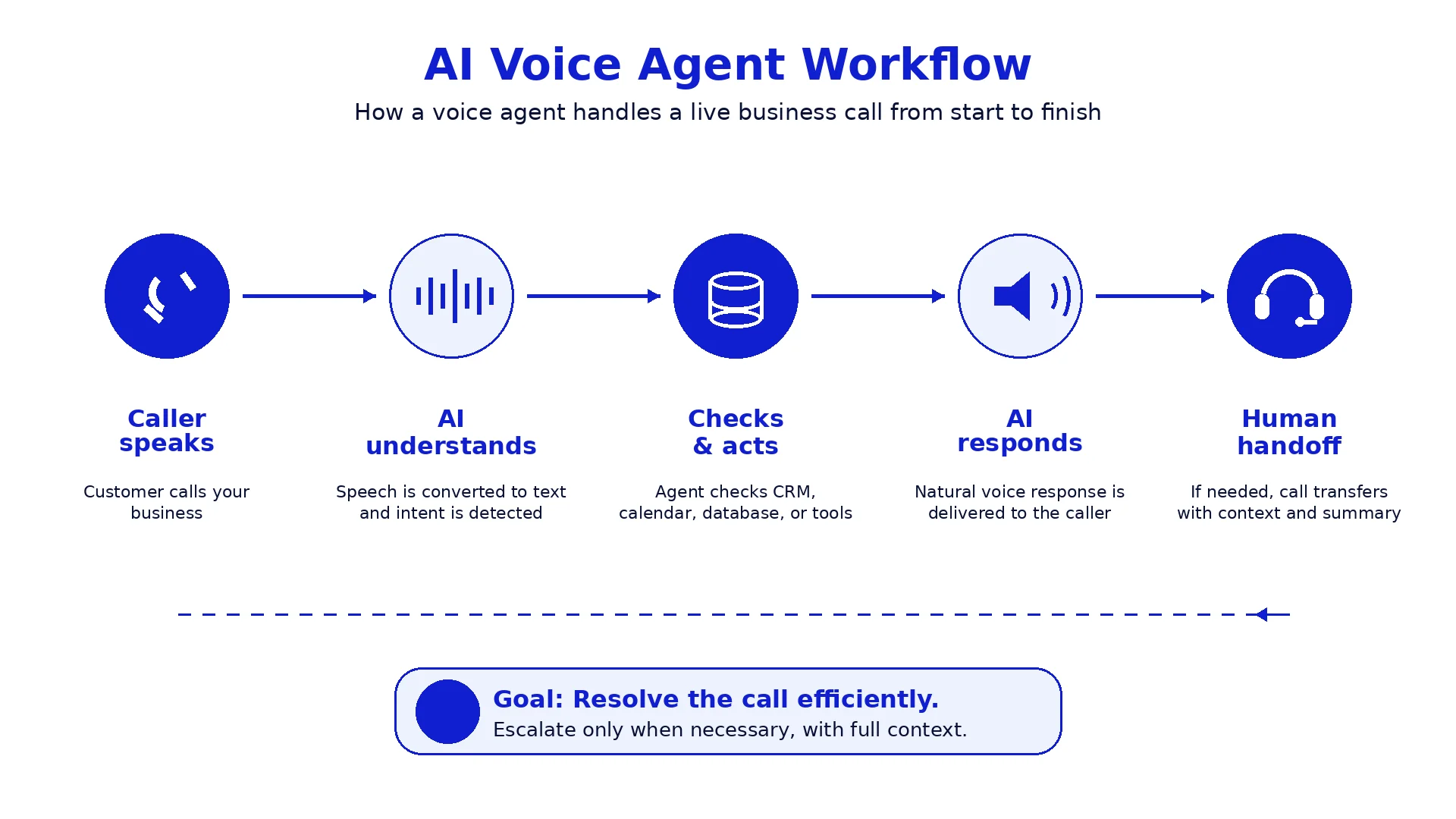
Platform, Managed, or Custom: Which AI Voice Agent Setup Makes Sense?
Not every business needs a custom AI voice agent from day one. The right choice depends on your call volume, workflow complexity, and how much control you want.
A DIY platform works well when your call flow is simple and your team is still experimenting.
This is usually enough for basic FAQs, call routing, simple lead capture, or appointment requests. The starting cost is lower, and you can launch quickly. The trade-off is that your team owns the messy parts: prompts, testing, integrations, missed edge cases, and ongoing maintenance.
A managed platform is a better fit when you want faster deployment but do not want your internal team handling every technical detail.
You get support, setup help, and less engineering overhead. This works well for businesses that need a reliable voice agent but do not need deep customization. The trade-off is flexibility. You may be limited by the platform’s workflow rules, pricing model, and integration options.
A custom build makes sense when the agent needs to do more than answer basic questions.
If it has to qualify leads, book appointments, update CRM records, create tickets, check customer data, route calls, and hand off with full context, custom is usually the stronger choice. It costs more upfront, but gives you better control, reliability, and long-term fit.
Enterprise builds are for businesses with multiple departments, high call volume, compliance needs, multilingual support, or deep CRM, EHR, ERP, or support system integrations.
This is the highest cost option, but it is often the right one when the voice agent is part of core operations rather than a side experiment. The simple rule: use a platform for simple calls, managed voice AI for faster rollout, custom AI voice agents for serious workflows, and enterprise builds when scale and compliance matter.
Hidden Costs Nobody Puts on the Pricing Page
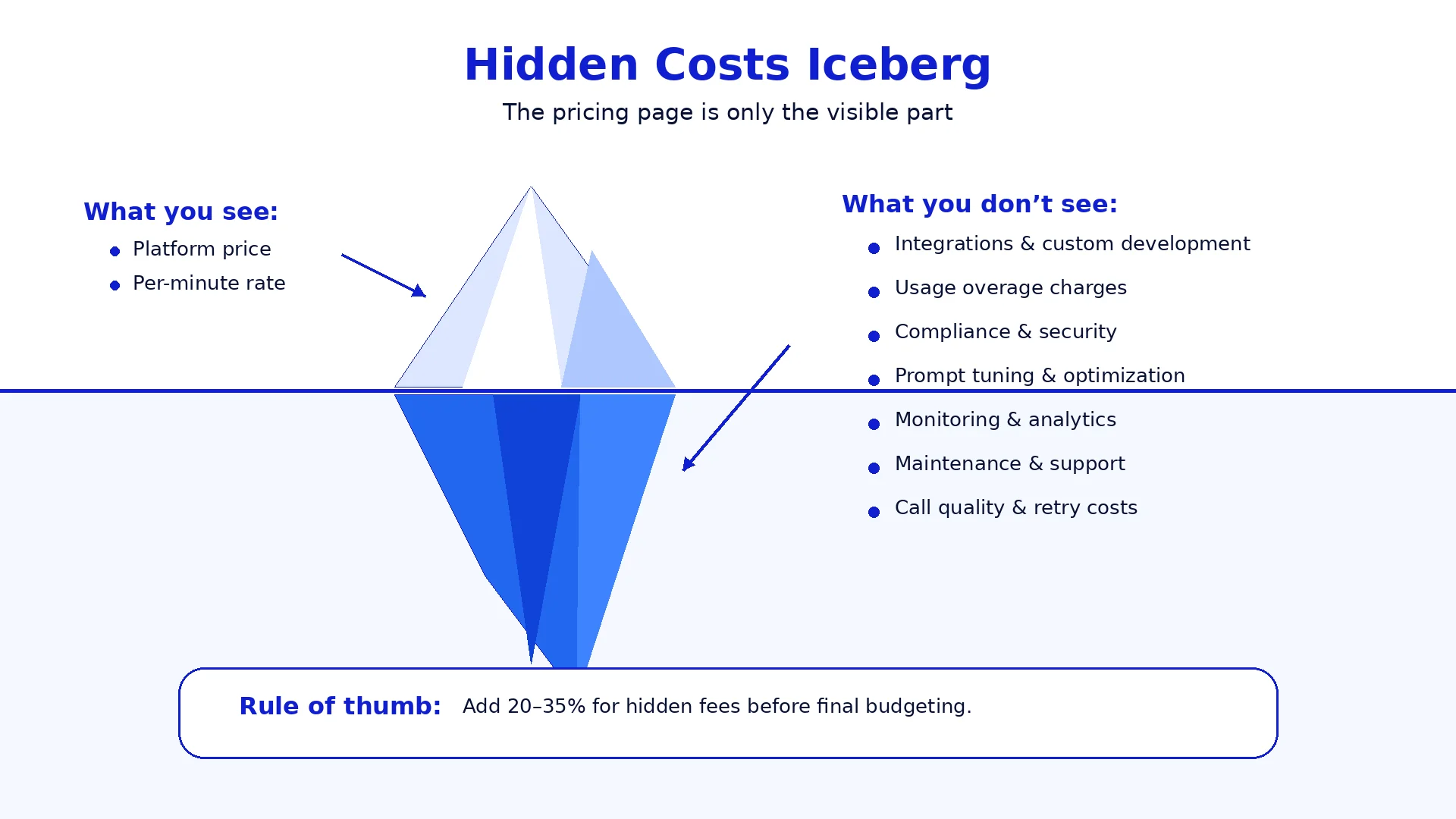
This is where most businesses get blindsided. The advertised per-minute rate is rarely the number you end up paying.

Setup and onboarding fees
$500–$50,000+ depending on whether you're a solo operator on a self-serve platform or an enterprise needing discovery workshops, prompt engineering, and staff training.

Integration costs
Custom development to connect your CRM, booking system, or internal database can add $1,000–$5,000 on the low end, and considerably more if your systems are legacy or poorly documented.

Overage penalties
Go over your included minutes and some providers charge 2–3x the base rate for the overage.

Compliance surcharges
If you're in healthcare, insurance, or finance, HIPAA or PCI-DSS-compliant infrastructure often costs extra, sometimes thousands more per month.
Your own engineering time
This is the one people forget to count. If you're piecing together a DIY stack on a "cheap" per-minute platform, someone on your team is spending real hours building and babysitting it. At $50–$150/hour in engineering time, a "budget" platform can quietly end up costing more than a fully managed build.

The rule of thumb
Whatever the vendor quotes you, add 20–35% before you take it to your budget owner. That's roughly what hidden fees add on average once everything is accounted for.
What Is Included in the AI Voice Agent Build Cost?
A proper AI voice agent build is not just prompt writing. The development cost usually includes discovery, workflow design, voice architecture, integration, testing, deployment, and post-launch tuning.
| Build Component | What It Covers |
|---|---|
| Call Flow Design | Mapping how the agent greets callers, asks questions, confirms details, and handles different paths |
| Conversation Design | Writing and testing the agent’s tone, prompts, fallback responses, and escalation logic |
| Voice Stack Setup | Connecting STT, LLM, TTS, telephony, and orchestration layers |
| Business Logic | Adding rules for booking, lead scoring, support routing, qualification, or workflow decisions |
| System Integrations | Connecting CRM, calendar, ERP, EHR, ticketing tools, payment systems, or internal databases |
| Human Handoff | Passing the caller to a human with call summary, reason, captured details, and conversation context |
| Testing and QA | Testing accents, interruptions, wrong answers, edge cases, latency, silence, background noise, and failed flows |
| Analytics Setup | Tracking call volume, conversion rate, escalation rate, failed intents, average call duration, and lead quality |
| Deployment | Launching the agent on live numbers, routing calls, configuring access, and monitoring performance |
This is why a custom AI voice agent costs more than a monthly platform subscription. You are not only paying for the AI. You are paying for the business workflow around the AI.
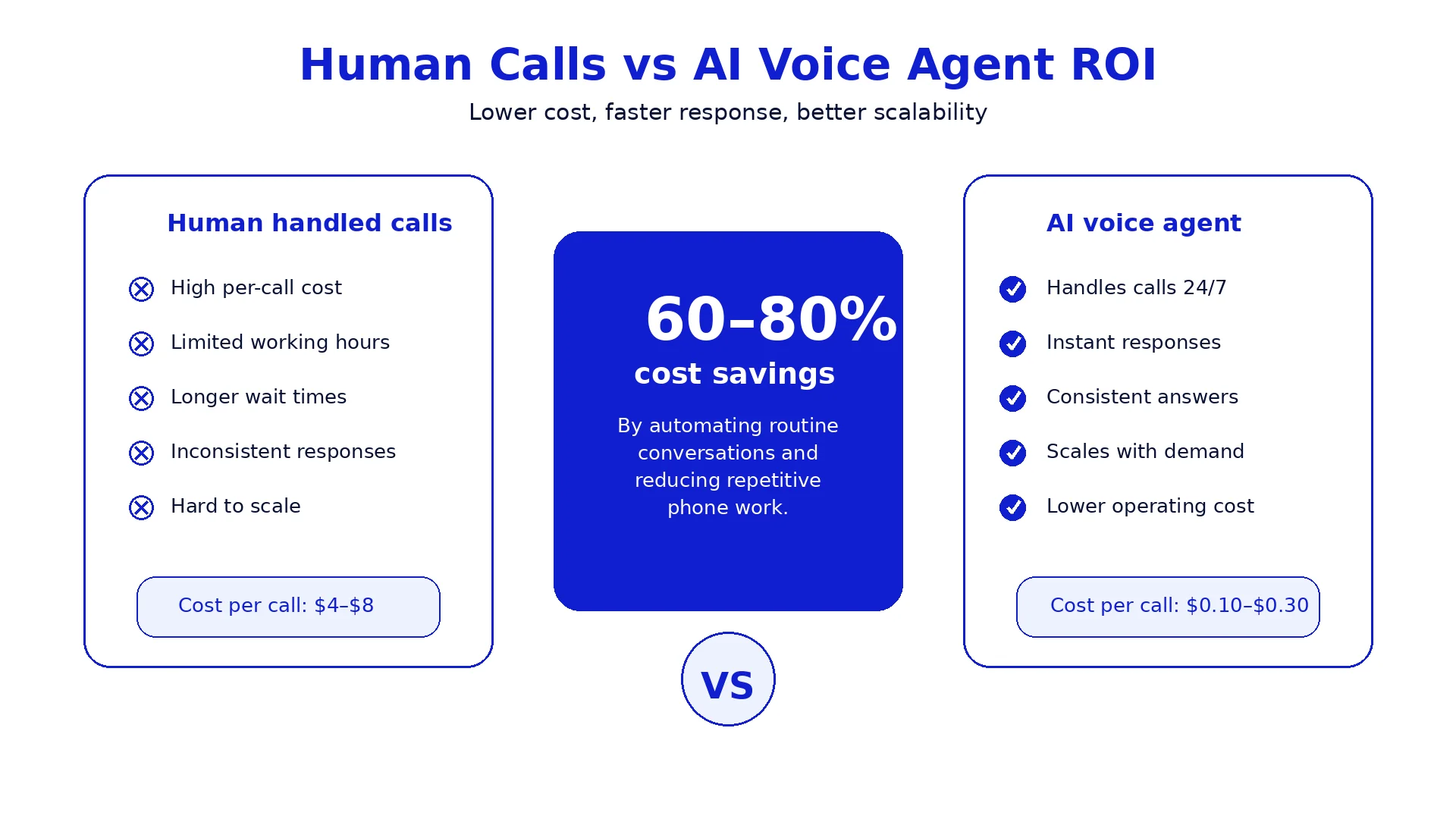
Is an AI Voice Agent Worth It?
The ROI comes down to simple math. A human handled phone call can cost around $7 to $12 per interaction once you include salary, training, benefits, and turnover. An AI voice agent can handle a similar routine call for roughly $0.30 to $0.50.
So the calculation is simple:
Monthly call volume × current cost per call = current monthly call cost
Then compare that with your AI voice agent build and monthly running cost. If most of your calls are routine, such as bookings, order updates, FAQs, reminders, lead qualification, or basic support, the agent can often pay for itself within 3 to 6 months. The catch is quality.
A cheap voice bot with poor setup, weak integrations, and bad handoff logic can frustrate callers and fail fast. The real ROI comes from building a voice agent people actually use. It should solve real call problems, reduce manual workload, and pass complex conversations to your team with full context.
A DIY platform works well when your call flow is simple and your team is still experimenting.
This is usually enough for basic FAQs, call routing, simple lead capture, or appointment requests. The starting cost is lower, and you can launch quickly. The trade-off is that your team owns the messy parts: prompts, testing, integrations, missed edge cases, and ongoing maintenance.
A managed platform is a better fit when you want faster deployment but do not want your internal team handling every technical detail.
You get support, setup help, and less engineering overhead. This works well for businesses that need a reliable voice agent but do not need deep customization. The trade-off is flexibility. You may be limited by the platform’s workflow rules, pricing model, and integration options.
A custom build makes sense when the agent needs to do more than answer basic questions.
If it has to qualify leads, book appointments, update CRM records, create tickets, check customer data, route calls, and hand off with full context, custom is usually the stronger choice. It costs more upfront, but gives you better control, reliability, and long-term fit.
Enterprise builds are for businesses with multiple departments, high call volume, compliance needs, multilingual support, or deep CRM, EHR, ERP, or support system integrations.
This is the highest cost option, but it is often the right one when the voice agent is part of core operations rather than a side experiment. The simple rule: use a platform for simple calls, managed voice AI for faster rollout, custom AI voice agents for serious workflows, and enterprise builds when scale and compliance matter.
How to Reduce AI Voice Agent Cost Without Building a Weak Bot
The easiest way to reduce AI voice agent cost is not to cut corners. It is to start with the right scope.
Start with one high-value workflow instead of trying to automate every call from day one
For example, begin with appointment booking, lead qualification, missed call handling, or FAQ support.
Keep the first version focused
A voice agent that handles five common call types well will perform better than one that tries to handle every possible customer question badly.
Use existing tools where possible
If your CRM, calendar, support desk, or booking system already works, integrate with it instead of rebuilding the entire workflow.
Create strong human handoff rules
The agent does not need to solve everything. It needs to know when to stop, summarize the call, and transfer the caller to the right person.
Track calls from day one
The first few hundred calls will show which questions repeat, where callers get stuck, and which workflows should be automated next.
The goal is not to build the biggest voice agent
The goal is to build the smallest version that creates measurable business value.
Which Voice AI for Business Actually Fits Your Company?
| Monthly Call Volume | Business Need | Best Fit | Estimated Cost per month | Recommendation |
|---|---|---|---|---|
| Under 500 calls/month | Single simple tasks like bookings, business hours, or basic FAQs | Subscription platform | $99 to $350 | A ready made platform is enough. Do not overbuild at this stage. |
| 500 to 5,000 calls/month | A few call intents with 1 to 2 system integrations | Lightweight custom AI voice agent | $15,000 to $35,000 | A custom build starts making more sense for reliability, workflow control, and long term cost. |
| 5,000+ calls/month | Multiple departments, compliance needs, CRM/EHR integration, or complex workflows | Enterprise AI voice agent | $80,000 to $150,000+ | A proper enterprise build is the better choice. No code tools can become messy and expensive at this scale. |
The mistake we see most often is businesses in the second or third bracket trying to force a self-serve platform to do a custom job. It works for the demo. It falls apart at month three when an edge case the platform can’t handle starts routing angry customers to voicemail.
A Worked Example: What a Voice AI for Business Actually Costs at 10,000 Minutes a Month
Numbers land better with a real scenario, so let’s run one. Say you’re a mid-sized business handling roughly 3,000 calls a month, averaging 3.5 minutes each — that’s about 10,000 minutes of conversation, a fairly typical volume for a growing customer service or appointment-driven operation.
On a bare-bones, bring-your-own-key platform, you’d be looking at something like:
- Platform/orchestration fee: $0.05/min → $500
- LLM cost: usually under $200 at this volume
- TTS (standard voice): $0.02–$0.03/min → $200–$300
- STT: $0.005–$0.01/min → $50–$100
- Telephony: roughly $0.01–$0.02/min → $100–$200
At 10,000 call minutes a month, raw API costs can hit $1,000 to $1,300/month before setup, integrations, prompt tuning, premium voices, multilingual support, or team maintenance.
A managed platform may cost $500 to $900/month with less effort. A custom AI voice agent may bring API spend down to $150 to $600/month, but needs a higher upfront build of $35,000 to $80,000.
DIY is fine if you have engineering bandwidth. Managed or custom is better if you want reliability without constant maintenance.
The real mistake is choosing the option that looks cheapest upfront, then paying for it later through overages, broken workflows, and wasted team time.
FAQs
For a genuinely narrow job like answering hours, taking a message, routing a call, it can work fine. The trouble starts when a business tries to stretch it into handling appointment changes, account lookups, or anything requiring real integration with their systems. At that point you’re either upgrading tiers or hitting a wall.
A basic single-intent custom AI voice agent typically takes 4–6 weeks. A production multi-intent system with CRM integration runs 10–14 weeks, largely because integration and testing take longer than the core AI build itself.
Often, yes. Sales-focused agents tend to cost 20–30% more because of the added lead-qualification logic and deeper CRM syncing required to hand off a warm lead properly. You’re not just answering questions, you’re capturing and routing intent.
Integration. Almost everyone budgets for “the AI part” and underestimates how much work it takes to connect the agent to a real, sometimes messy, CRM, PMS, or claims system. That’s routinely 40–60% of the total build effort.
Questions to Ask Before You Sign Anything
Whoever you end up working with, platform or agency, get straight answers on these before committing:
- What's included in the base price, and what's billed separately (LLM, TTS, telephony, overages)?
- Who owns the conversation design and prompt engineering - you, or them?
- What happens when the agent cannot answer something? Is the handoff to a human seamless with full context, or does the caller have to start over?
- What's the real cost per 10,000 minutes once every line item is added up, not just the headline per-minute rate?
- If you need HIPAA, PCI-DSS, or other compliance later, is that a rebuild or a toggle?
If a vendor can’t answer these clearly on the first call, that’s information too.
The Bottom Line on AI Voice Agent Cost
There is no fixed cost to build an AI voice agent. A $300/month platform and an $80,000 custom build can both be right, depending on your workflow, call volume, and integrations. The real risk is choosing a cheap option that ignores setup, maintenance, edge cases, and hidden costs. Nyx Wolves can help you find the right setup with a clear, no-surprise estimate.