NEW EBOOKThe enterprise playbook to getting AI pilots right — grab your complimentary copy.Check it out ›
Nyx Wolves→ Blog→ AI Governance
Everyone's treating AI governance like a corrective tax. It could be the cheapest insurance you never pay for.
Learn how AI governance reduces breach risks, controls shadow AI, strengthens AI agents, and helps enterprises scale successful pilots safely.
Nyx Wolves Team · 9 min read
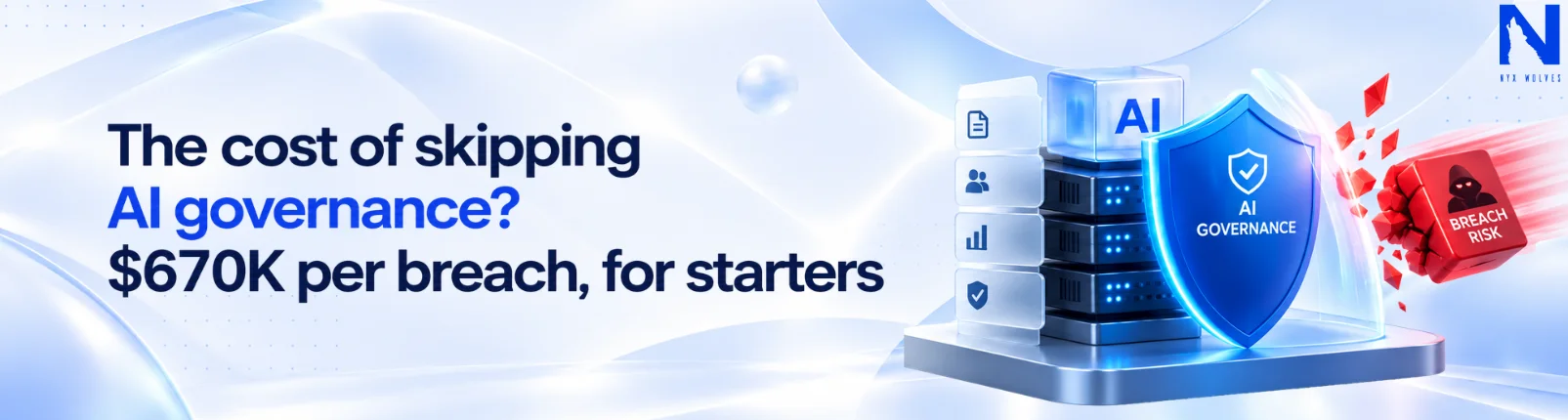
Someone brings up AI governance in a leadership meeting, and the conversation immediately becomes more cautious. Questions about risk, compliance and approval begin to replace the earlier excitement about innovation and growth.Shoulders sag. Someone checks their phone. Governance has become shorthand for everything that slows us down: the extra sign-off, the committee review, the reason IT can’t just ship the thing already. It is understandable why it feels that way. Nobody gets promoted for writing a policy document. But what if the delay leaders resent is the very thing preventing their organization from making a costly public mistake? Governance is never meant to be the hurdle to your AI projects. It’s meant to be the guardrail on your path to AI success. Like a barrier on a mountain road, its mostly invisible, easily forgotten, and the only thing standing between a smooth implementation and a public crash in news headlines.
Why most companies introduce AI governance too late
Most companies do not build governance into their AI tools from the start. Instead of treating it as a separate layer, governance must be embedded into every deployed AI tool through its programming, prompting, and guardrails. Yet many companies address it only after something has already gone wrong.
A model generates a potentially career-ending response, or an AI agent takes an action that nobody approved. A regulator asks a question that nobody in the company can answer. Only then, red-faced and scrambling, does someone finally sit down to write the policy. And this isn’t a rare occurrence. It’s the norm. Right now, 63% of organizations have no AI governance policy at all. Governance arrives as damage control, then gets dressed up afterward to look as though it had been the plan all along.
63%
of organizations have no AI governance policy at all — right now.
How early AI governance reduces breach costs and operational risk
Let’s draw a parallel between the cost of implementing safeguards, and building governance into your AI, to the insurance costs you pay while purchasing new assets. You pay insurance ahead of time to ensure that whenever anything goes wrong, you’re protected from the fallout, and insulated from the cost of failure. Governance has always been an insurance, yet for the longest time, companies have been treating it like a fine, or a cost of entry that is avoidable.
When employees use shadow AI(AI tools that the company hasn’t approved), leaving your technology stack vulnerable to data breaches, this adds an average of $670,000 to the cost of an incident that already averages a staggering $4.44 million globally.
Meanwhile, the companies that prioritized building governance into their cybersecurity agenda have saved up to $1.9 million and were back on their feet nearly 80 days sooner. Let that sink in for a second because it’s kind of maddening when you think about it. Almost $2.5 million separates “we’ll get to governance eventually” from “we just did it right the first time” and that’s not a rounding error. That’s a company either sleeping easy or losing sleep over a decision that was sitting right there the whole time.
And that’s before you get to the quieter cost, the one nobody puts on a slide. AI hallucinations, those confidently wrong answers that sound completely believable, are estimated to have cost businesses $67.4 billion globally in a single year. On top of that, the average knowledge worker spends almost 4.3 hours every week fact-checking AI-generated output. Nobody calls it an added cost. But that’s exactly what it is.
Shadow AI breach premium
+$
0
K
Average global breach cost
$
0
M
Saved with early governance
$
0
M
Faster recovery, governed orgs
~
0
days
Interestingly, we have already seen this play out in one of our own projects. Our insurance sales chatbot uses structured conversational flows, risk-assessment algorithms, and an up-to-date policy database to guide customers through policy enquiries and generation. The result was a 40% improvement in user satisfaction, 50% less manual data entry and processing, and 30% fewer errors in policy generation.
The safeguards did not slow the product down. They made it more accurate, efficient, and useful. Governance works the same way. It is not a tax added after the product is built. It is part of what makes the product worth using in the first place.
Case Study — Insurance Sales Chatbot
Our insurance sales chatbot uses structured conversational flows, risk-assessment algorithms, and an up-to-date policy database to guide customers through policy enquiries. The safeguards did not slow the product down — they made it more accurate and useful.
User satisfaction
+
0
%
Manual processing
0
%
Errors in policy generation
0
%
How leading organizations turn AI pilots into scalable systems
KPMG went looking for why AI pilots work beautifully in isolation and then fall apart the moment a company tries to roll them out everywhere, and what they found should sting a little. If the technology itself were really the deciding factor, a lot more companies would already be winning at this. Nor was it the budget, or the hardware. It’s whether anyone actually did the unglamorous foundational work that is strategy, architecture, data, and people before racing toward the finish line.
The leaders who get AI projects right, don’t absolve themselves of responsibility after approving budgets, they see AI projects as a digital transformation that they own; that they have to see through to the end. Treating it as a project with milestones, reviews post-launch, proper testing and iteration, can set these projects up for success. Not a cheaper version just because “it’s AI, how hard can it be.”
Deloitte rewrote job titles for all 181,500 of its US employees in 2026, purely because AI had already quietly reshaped what the work itself looked like. That’s not a symbolic gesture, that’s a company admitting the org chart had stopped matching reality. We’ve watched the same thing unfold building a comprehensive HRMS solution. The technology only earns its keep once the roles and habits wrapped around it finally catch up to it.
The four foundations that cause enterprise AI to fail
Trace a failure back far enough and it’s almost never the model. It’s four things crumbling underneath it, usually all at once.
People
Leadership signs the check and then disappears. Nobody’s championing the ‘why’, so nobody downstream feels any real urgency about the ‘how.
Process
AI gets treated like a one-and-done deployment instead of a living program, no meaningful milestones, no honest review after launch, no UAT worth the name.
Data
The actual business context never made it into the project to begin with, so the AI has been reasoning on half a picture since day one.
Infrastructure
IT gets left to figure it out alone, without the cross-functional backup that would’ve caught these gaps months earlier, and by the time anyone notices, you’re not patching something small, you’re rebuilding.
Read that list once more, slowly. The combined concurrent collapse of all four leads to your AI projects failing. But underneath these four seemingly different reasons constitute the same mistake: nobody laid the foundation before sprinting for the finish line.
Five controls every enterprise AI agent needs
Governance stops being a theoretical policy the second your systems start acting on their own which is precisely what’s happening as agentic AI works its way into everyday enterprise workflows. Forget the version that lives in a slide deck. Get a glimpse of what actually governing an agent looks like, day to day.
01
Define access controls for each agent:
Every AI agent should have clearly defined permissions. Organizations need to specify which tools and databases an agent can access and whether it can only read information or also make changes. A single access policy for all AI systems is not enough.
02
Monitor the agent’s complete workflow:
Organizations should be able to see what an agent does at every stage of a task. Monitoring only the initial request and final response leaves critical actions hidden and makes errors harder to investigate.
03
Keep people involved in high-impact decisions:
Any action involving pricing, claims, hiring, financial transactions, or personal data should require human review before it is completed. The greater the potential impact, the stronger the approval process should be.
04
Maintain detailed audit trails:
Every decision, data interaction, approval, and triggered guardrail should be recorded. These records should clearly show what happened, why it happened, and who approved it when questions arise.
05
Identify unauthorized agents early:
Organizations should regularly check for AI agents that employees have created or deployed without formal approval. Discovering these systems early helps address security and compliance risks before they become serious incidents.
It’s the same approach we used building a real-time AI-driven SCADA system. The value was never the dashboard itself. It was catching a problem while it was still small enough to fix quietly. Agent governance runs on that same instinct. It’s the same idea behind the workplace safety and compliance solution we built around constant oversight instead of a once-a-year checklist. Governance that only shows up once a year isn’t governance. It’s a eulogy with better formatting.
A practical 90-day AI governance roadmap
Stop treating governance like a fire drill you schedule when the calendar reminds you. The organizations actually pulling ahead build it into the architecture from the very first day, the same instinct you’d apply to security, baked in as a default nobody has to remember to switch on.
Three moves worth making in the next 30 to 90 days:
Days 0–30
Take honest stock of every AI system and agent already running in your environment, approved or not. You cannot govern what you refuse to look at, and most leaders are genuinely startled by what that list turns up.
Days 30–60
Put real access controls and real monitoring on your three riskiest use cases like anything touching customer data, money, or legal exposure. Don’t wait for a company-wide rollout before you protect the parts that would actually hurt.
Days 60–90
Hand governance to someone with real standing, not just a title in IT. Opt someone who can pull legal, data, and business leadership into a room the moment a decision needs making, rather than another policy nobody reads.
Governance was never the roadblock on the way to real AI outcomes. It is, and always will be, the insurance policy you take out against your AI thinking it’s smarter than you.
Closing thoughts
So is AI governance really the speedbreaker standing between you and the outcomes you’re chasing? Only if you keep looking at it the way most boardrooms still do, as the roadblock standing between you and realizing the value that we all know AI can deliver for enterprises.
But if you step back and look at the flipside, the numbers will make your decision a no-brainer. A $670,000 premium tacked onto a breach you never had to have. A $1.9 million saving quietly waiting for whoever’s willing to build governance early instead of late. Governance was never the roadblock on the way to real AI outcomes. It is, and always will be the insurance policy you take out against your AI thinking it’s smarter than you, and costing you and your business reparations.
So where do we go from here?
That insurance policy was never a policy against AI, rather against the approach taken to building it; against the order most companies it is built in: Technology first, foundation later. And then everything comes crumbling down, and boardrooms are baffled about where things went wrong. Get the order right, and something interesting happens: the technology, the piece leaders were so nervous about, stops being the risky part. The real risk was sitting somewhere else the whole time.
Knowing that is one thing. Sequencing it correctly, under deadline pressure, with everything else competing for attention, is a lot harder for most leadership teams. Here’s where to start.
Get started on these five concrete steps to ensure success in your AI initiatives:
- Unify your workflows by interconnecting your IT toolset: Scale AI maturity with varying degrees of capability, spanning APIs, MCP and iPaaS.
- Centralize & distribute data to your AI systems: Build a data foundation layer beneath your AI stack to ensure your assistance is grounded in business context.
- Align your AI and your workforce architecturally: Make AI adoption natural for your workforce and reduce friction for an easier path to realizing value.
- Governance as a proactive best practice: The race to adopt AI leaves caution in the wind. Prioritize accountability from the get-go to avoid remediation costs.
- Evaluate outcomes as KPIs, not numbers: Conflating data and KPIs has become the norm. But when it comes to AI, your tangible outcomes matter more than statistics.
We’ll break these pointers down into in-depth actionable approaches in our latest ebook. We’ve compiled everything you’ll need to set up your AI pilots for success, from our decade of experience in the field. Grab your complimentary copy to learn more about how you can:
- Build a data driven approach to enterprise AI projects by leaning on data from leading analysts and industry researchers.
- Take away learnings from their findings and avoid the black hole of AI investments that yield no results, or unimpressive value.
- Avoid the mistakes that most enterprises have made, and learn what they got right.
- Learn how you can tailor your AI projects and solutions to your businesses unique requirements.
From the blog — AI Governance
Governance isn't the tax on your AI project. It's the insurance you never pay for.
Be it AI projects, bespoke solutions, or staffing — we’ve got you covered.
6%
McKinsey’s most recent survey on the state of AI found that 6% of organizations qualify as true AI high performers.
These businesses are thrice as likely to
- Have fundamentally redesigned their workflows around AI
- Have senior leadership directly committed to the effort, past the pilot
- Be scaling AI agents across the business, rather than in silos across functions and business teams
Free eBook
The enterprise playbook to getting AI pilots right
Are you looking for AI solutions for your organization?
Be it AI projects, bespoke solutions, or staffing — we’ve got you covered.