Introduction
Artificial intelligence (AI) has moved from emerging technology to enterprise staple in just a few years. But one surprising challenge remains for many large organizations: they don’t know how much they actually spend on AI. Companies think they understand licensing fees or cloud bills, yet true AI spend hides in unexpected places, from shadow projects to talent allocation and cloud egress charges.
In this blog, we unpack why enterprises struggle with AI cost transparency and how leaders can gain real visibility into spending. We will explain:
- Hidden costs in AI programs
- Structural reasons enterprises misreport AI spend
- Practical steps for clarity and accountability
This is a must-read if you are a CTO, CFO, AI leader, or strategist responsible for operationalizing AI.
Why AI Cost Transparency Matters Now
As artificial intelligence becomes embedded in core business strategy rather than remaining an experimental IT initiative, accountability for AI spending shifts from technical teams to finance leaders and the C suite. Cost transparency is no longer optional because AI investments directly influence profitability, capital allocation, and long term competitiveness. Research from Deloitte indicates that organizations that manage AI with structured financial oversight outperform those that treat it as an isolated innovation effort.
When visibility into AI expenditure is weak, the consequences compound quickly. Budget overruns become common, funds are misallocated across competing initiatives, and return on investment cannot be measured with confidence.
As a result, many enterprises are spending millions on AI programs without truly understanding what they are gaining in return, simply because they lack a consolidated view of where every dollar is going. For organizations looking to formalize AI governance and cost oversight, structured advisory support such as our AI & IT Consultation services can help align finance, technology, and leadership teams around measurable AI investment outcomes.

AI Costs Are Not Just Licenses
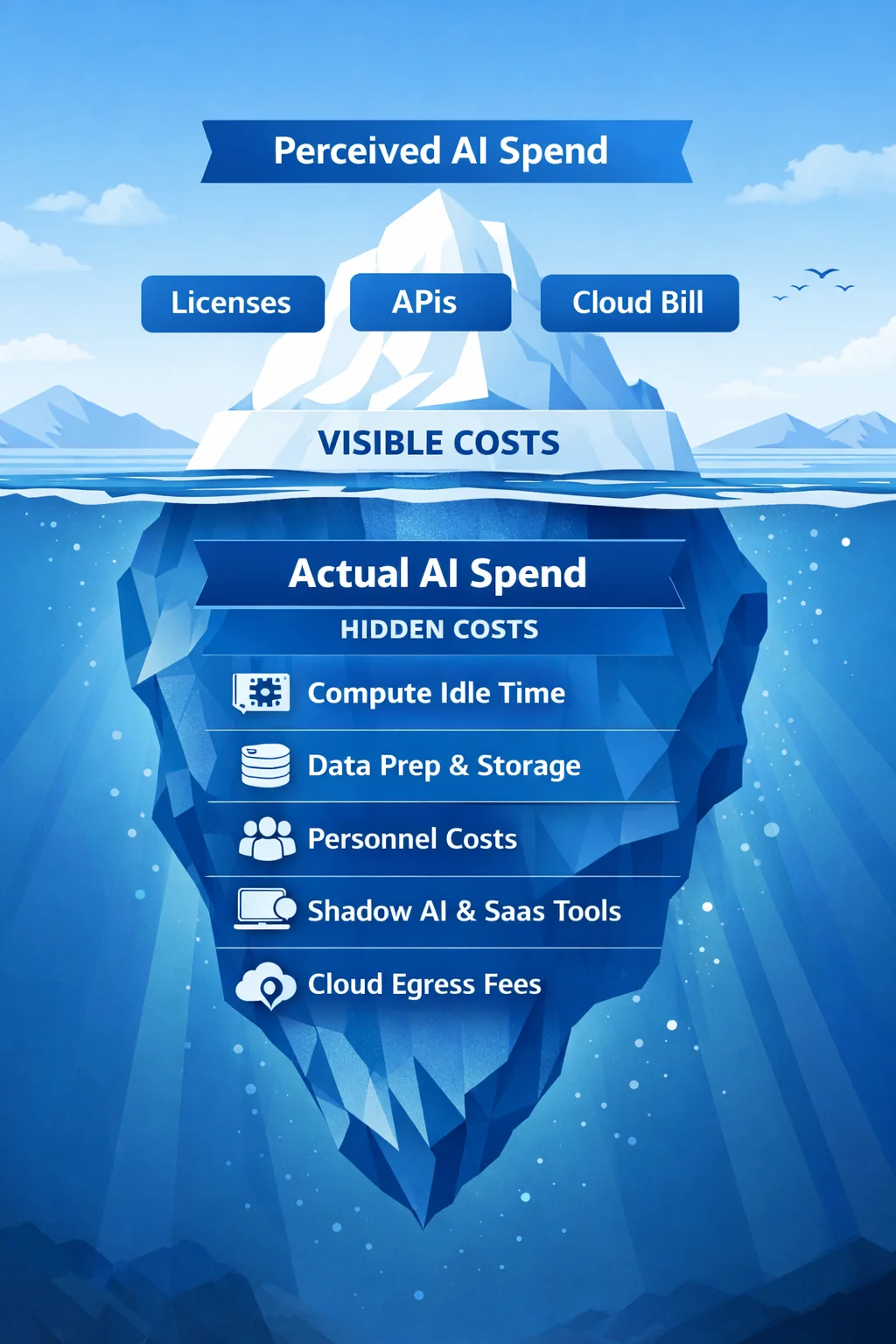
Most enterprises can point to software license fees like Microsoft Azure AI, Google Vertex, or OpenAI APIs, but assume that represents all AI costs. It does not. AI cost layers include:
Cloud GPU/TPU hours are expensive and often invisible. Many teams spin up instances for experimentation without tracking utilization or idle time. This means businesses pay for unused computer resources.
AI thrives on data. Cleaning, labeling, transformation, feature engineering, and storage costs can dwarf model training fees.
Often this spend is buried in general data infrastructure budgets, making it invisible to AI spend reports.
Think about this as a team of data scientists, ML engineers, and data analysts can cost more than half the AI budget. Yet, traditional finance systems don’t map salary and time tracking to specific AI deliverables.
This leads to underestimated true AI project costs.
Teams sometimes adopt tools like AI-supported analytics, automation platforms, or LLM integrations without central approval. This is known as shadow AI spend. These decentralized subscriptions often slip past procurement controls.
Estimates show organizations use over 100 SaaS applications without central oversight.² Each unchecked tool contributes to the mystery around AI costs.
Cloud providers charge for:
- Data ingress/egress
- API requests
- Storage tier costs
- Network transit
These fees are frequently labeled as generic cloud costs, not specifically tied to AI workloads.
Why Finance and Procurement Struggle with AI Visibility
AI cost visibility is not merely a tooling gap. It is a structural disconnect between how modern AI systems operate and how traditional enterprise finance models are designed. Most finance and procurement frameworks were built for predictable capital expenditures, long term vendor contracts, and clearly defined IT assets. AI does not behave that way. It is iterative, experimental, elastic, and deeply intertwined with data infrastructure.
1. Misaligned Cost Categories
Finance charts of accounts are built for traditional IT spending and not dynamic AI pipelines where iterative experimentation is normal. This creates a mismatch between how tech teams report costs and how finance categorizes them.
2. Lack of Unified Tracking Tools
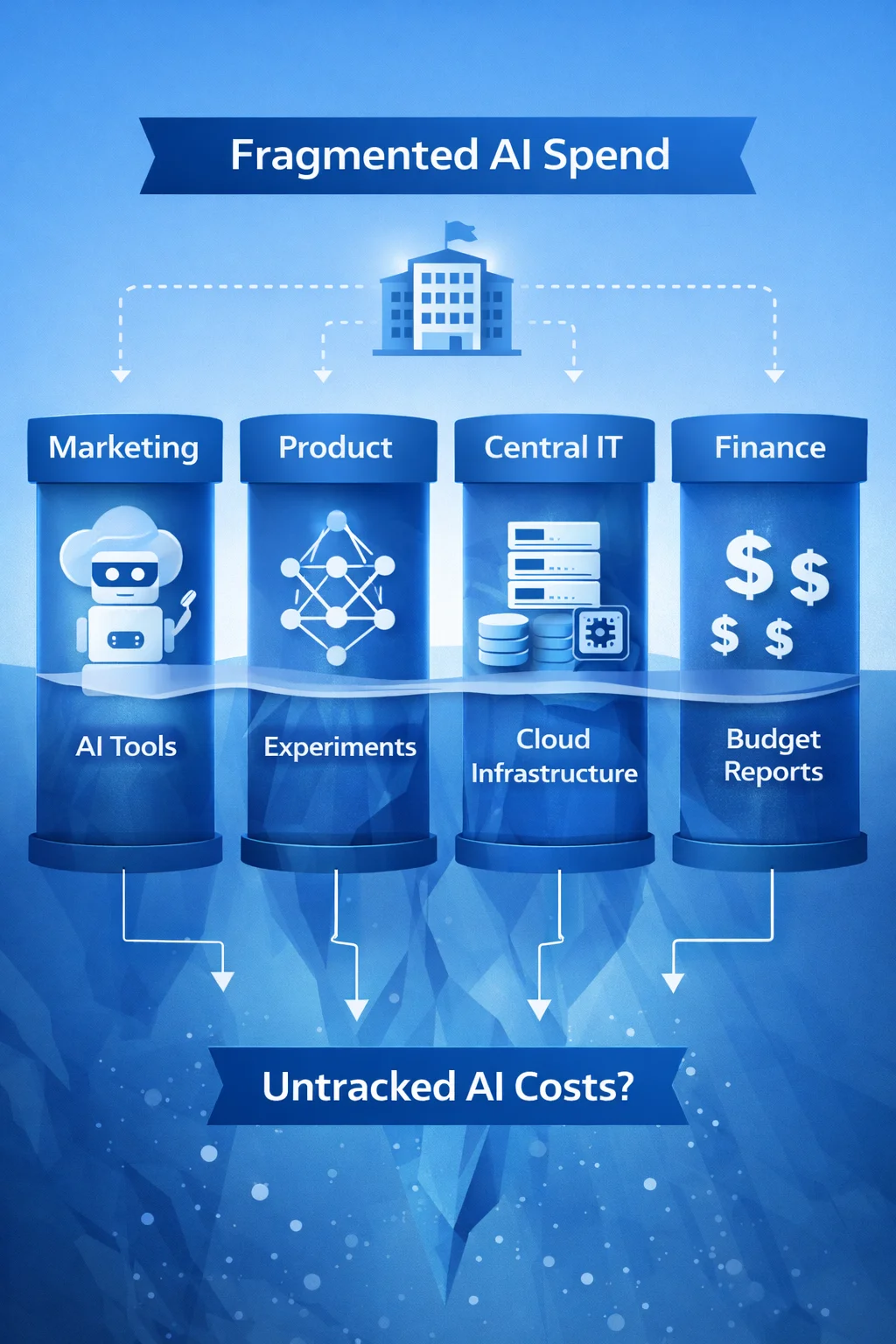
Many enterprises use different systems for procurement, cloud billing, and project management. Without integration, cross-referencing AI costs becomes manual and error prone.
3. Decentralized Projects
AI pilots often start in business units, not central IT. These projects maintain separate budgets or get expensed informally, creating hidden lines in financial records.
4. Measurement Culture
In product-led engineering teams, speed outweighs accounting governance. Teams prefer spending cycles prototyping rather than tagging costs properly. This fosters a culture where cost tagging happens after deployment.
The Real Consequences of Missing True AI Spend
| Impact Area | What Happens When AI Spend Is Not Transparent | Business Consequences |
|---|---|---|
| ROI Becomes Guesswork | Leaders lack accurate visibility into total AI costs across compute, data, personnel, and tools. ROI calculations are based on incomplete or underestimated financial inputs. | • Underfunded high-potential AI initiatives • Misleading performance metrics • Increased risk aversion from executives and boards • Difficulty justifying future AI investments |
| Compliance and Audit Risks | Organizations cannot clearly map where data is processed, which vendors are involved, and how infrastructure costs align with regulatory obligations. | • Exposure to GDPR and data residency violations • Weak internal audit trails • Inconsistent vendor reporting • Heightened regulatory scrutiny and reputational risk |
| Innovation Suffers | Budget surprises trigger reactive cost cutting rather than strategic optimization. AI funding becomes defensive instead of growth oriented. | • Stalled next-generation AI programs • Engineering teams diverted to cost remediation tasks • Delayed roadmap execution • Slower competitive differentiation |
Five Steps to Real AI Cost Transparency
Enterprise Workflow Model
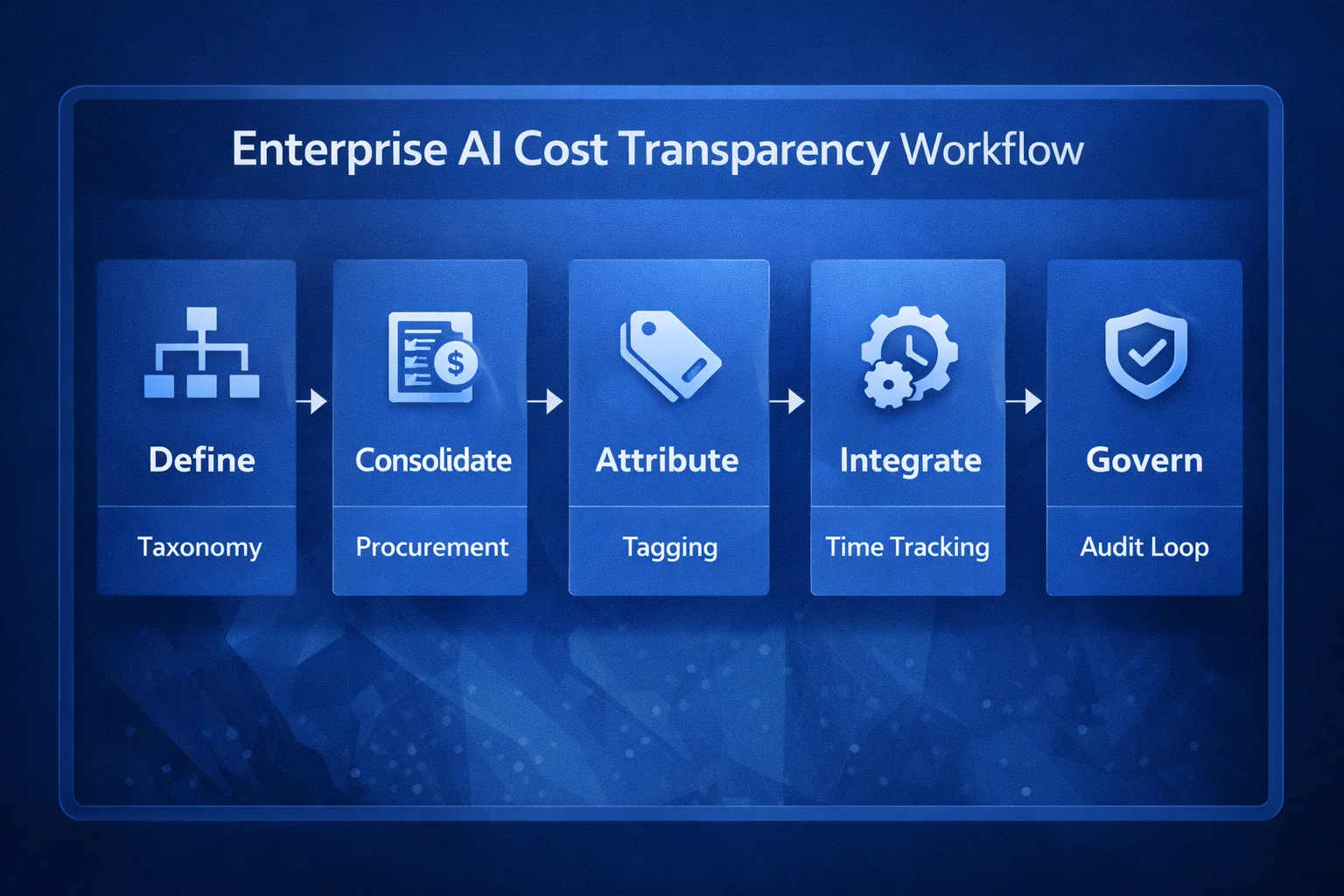
Below is a structured workflow that organizations can operationalize across finance, IT, and AI teams.
Objective: Establish a shared definition of AI spend.
Step 1: Clarify What Constitutes AI Spend
Inputs
- Current cloud invoices
- SaaS subscriptions
- HR allocation reports
- Vendor contracts
Actions
- Officially define AI cost categories:
- Compute
- Software licenses
- Data storage and processing
- Personnel allocation
- Third party services and consulting
- Create standardized naming conventions
- Align finance chart of accounts with engineering terminology
Outputs
- AI Cost Taxonomy Document
- Standard cost classification model
- Finance and IT alignment signoff
Objective: Eliminate fragmented and shadow AI spend.
Step 2: Centralize Billing and Procurement
Inputs
- Department level SaaS usage
- Procurement database
- Vendor contracts
Actions
- Route all AI software purchases through centralized procurement
- Consolidate vendor contracts under enterprise agreements
- Establish approval workflows for new AI tools
- Maintain a single AI vendor registry
Outputs
- Unified AI vendor ledger
- Reduced shadow spend
- Single source of financial truth
Objective: Track AI costs at granular workload level.
Step 3: Apply Tagging and Internal Chargeback Systems
Inputs
- Cloud infrastructure accounts
- Kubernetes clusters
- Data pipelines
- Model training environments
Actions
- Apply cost center tags to:
- Compute instances
- Storage buckets
- Data processing jobs
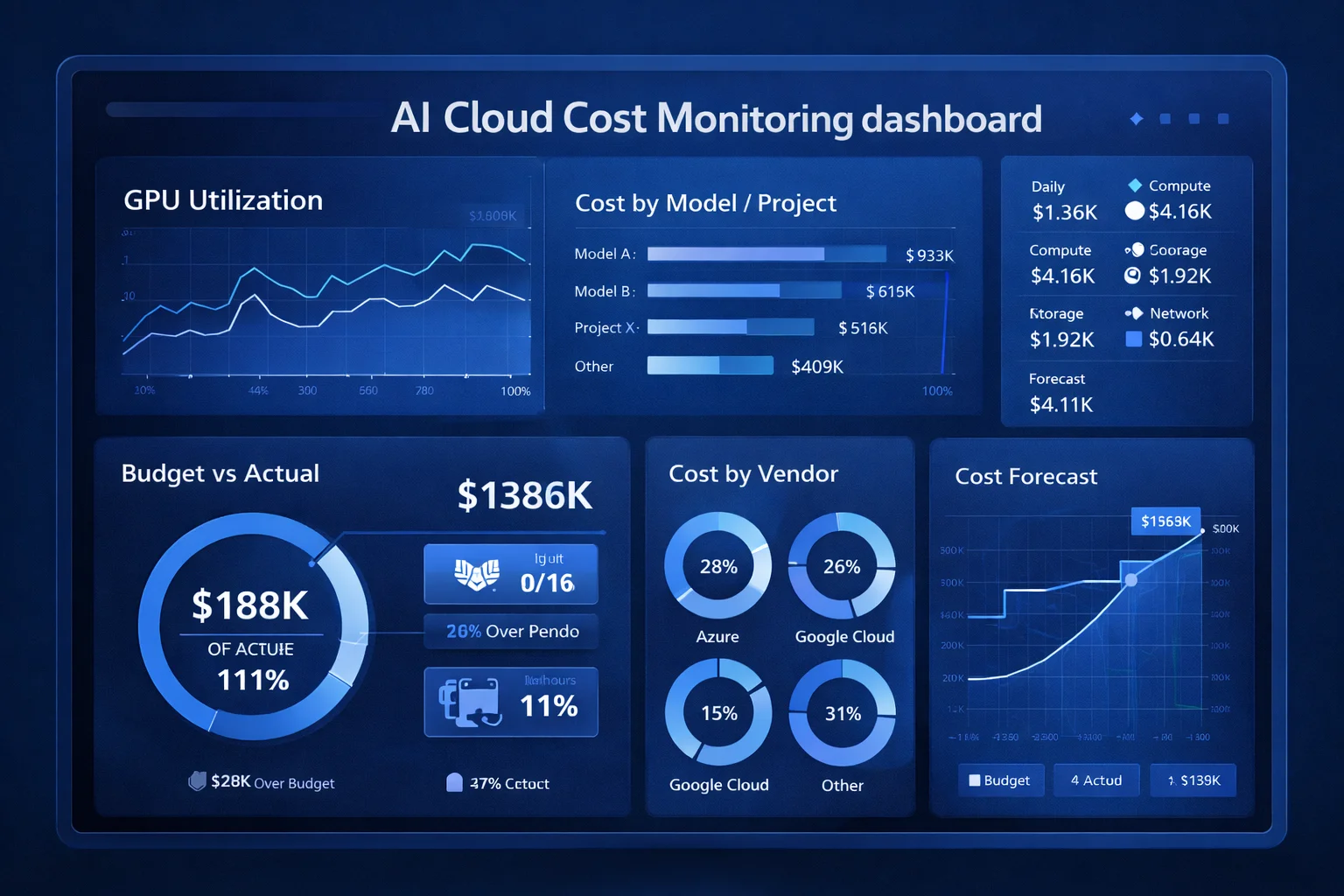
- Implement FinOps dashboards
- Enable internal chargeback or showback models
- Monitor idle compute and unused environments
Outputs
- Real time AI cost dashboards
- Workload level visibility
- Cost per model or project tracking
Objective: Accurately account for AI personnel investment.
Step 4: Track Time and People Costs
Inputs
- HR systems
- Project management tools
- Time tracking platforms
Actions
- Map employee time to AI project codes
- Link effort allocation to specific deliverables
- Distinguish experimentation from production workloads
- Integrate personnel cost into AI P and L view
Outputs
- True project level AI cost accounting
- Improved ROI calculations
- Visibility into engineering utilization efficiency
Objective: Establish recurring oversight and optimization loop.
Step 5: Quarterly AI Spend Review Cycle
Participants
- Finance leadership
- CIO or CTO office
- Business unit AI owners
- Procurement
Review Components
- Variance analysis
- Forecast versus actual spend
- Idle resource identification
- Vendor cost benchmarking
- Optimization recommendations
Outputs
- AI spend variance report
- Budget reallocation decisions
- Continuous improvement plan
End to End Workflow Summary
Define → Consolidate → Attribute → Integrate → Govern
- Define cost categories
- Centralize procurement
- Tag and attribute spend
- Integrate personnel costs
- Review and optimize quarterly
When this workflow is institutionalized, AI shifts from an opaque innovation expense to a governed strategic investment. Finance gains clarity, engineering retains agility, and leadership can allocate capital with confidence. Enterprises implementing enterprise grade governance frameworks often integrate cost transparency directly into their broader AI transformation strategy, as outlined in our AI and Digital Transformation Solutions.
Download our AI Spend Transparency Framework
Start mapping real versus perceived AI spend today.
How AI Leaders Should Communicate Cost Transparency
Leaders must frame transparency not as a policing mechanism but as a business driver:
- Cost clarity accelerates ROI justification
- Transparency improves predictability
- FinOps and AIOps alignment fosters operational excellence
Case Example
A company struggled with AI cloud bills that ballooned after model retraining cycles. Finance thought AI spend was $3M annually, but a cross-functional audit revealed real spend was closer to $6M.
Hidden costs included:
- Unmonitored GPU clusters running idle 40% of the time
- Data transformation costs labeled under BI
- Shadow AI tools purchased by marketing and product teams
Once these were corrected and centralized, the company reallocated 15% of its AI budget to strategic innovation initiatives.
AI Cost Transparency Tools to Consider
To strengthen AI cost visibility, enterprises can leverage specialized tooling that enhances allocation, monitoring, and reporting.
Provides multi cloud cost allocation, governance controls, and financial visibility across AI workloads and infrastructure. Useful for enterprise level FinOps implementation.
Designed for Kubernetes environments, it tracks container level resource consumption and attributes costs to teams, services, or AI models running on clusters.
Business intelligence platforms that enable custom dashboards, helping organizations consolidate cloud billing, procurement data, and project level AI spend into unified reporting views.
These tools do not replace governance strategy, but they provide the operational layer required for accurate tracking and informed financial decision making.
Future Outlook
Enterprises that master AI cost transparency will outperform peers. As AI budgets grow, cost governance moves from optional to essential. Transparency becomes a competitive edge helping leaders invest wisely and build sustainable AI programs.
Ready to optimize your enterprise AI investments?
Book a consultation with Nyx Wolves experts
Conclusion
AI cost transparency is not a finance problem alone. It sits at the intersection of technology, data, procurement, and organizational culture. Most enterprises do not know their real AI spend because costs are fragmented across compute, data, personnel, and untracked tools.
But with clear definitions, centralized billing, tagging, and regular reviews, leaders can uncover spend patterns, optimize investments, and unlock predictable ROI. Transparency transforms AI from a black box budget line into a strategic business investment.