
Hire .NET Developers in Germany for Scalable Web, Cloud, and Enterprise Applications

Introduction

Hiring .NET developers in Germany is not just about adding engineering capacity. It is about keeping critical software stable, scalable, and delivery ready. For many companies in Germany, .NET powers customer portals, dashboards, ERP workflows, payment systems, logistics platforms, healthcare tools, finance systems, and enterprise APIs. 

The real challenge is finding developers who understand industrial platforms, ERP connected systems, APIs, and enterprise dashboards, can work inside existing systems, and can solve legacy modernization and industrial system integrations without creating future technical debt, which is why CTOs, IT Directors, Engineering Managers should treat .NET hiring as a delivery strategy, not just a recruitment task.

Why .NET Still Matters for Companies in Germany

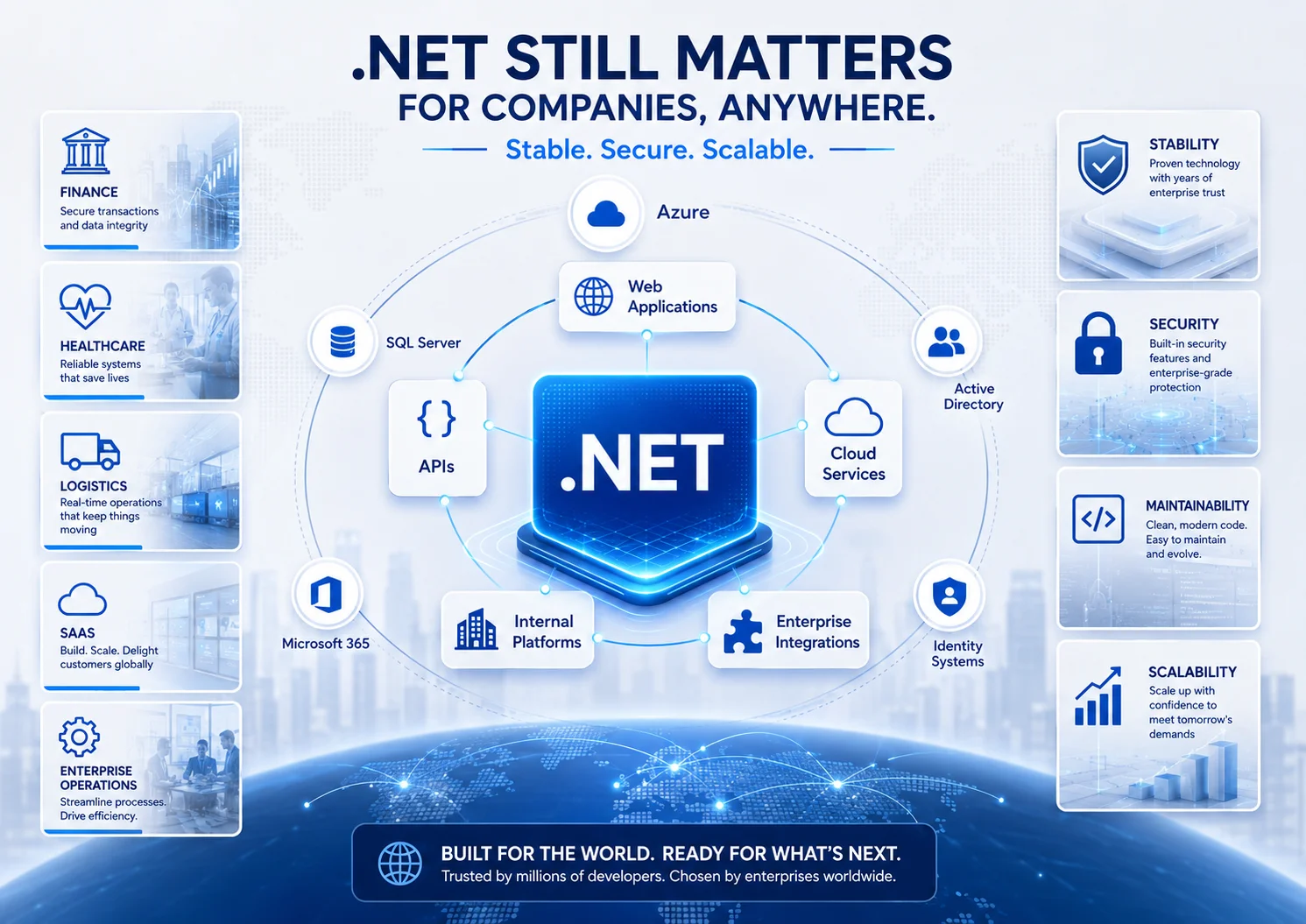
.NET still matters for companies in Germany because it supports practical, business critical software, from web applications and APIs to cloud services, internal platforms, enterprise integrations, and Microsoft aligned systems.

For companies across manufacturing, automotive, enterprise SaaS, Industry 4.0, .NET is useful when teams need stable, secure, and maintainable platforms, whether they are modernizing old systems, building SaaS backends, improving reporting workflows, or connecting business applications with AI and automation layers. Experienced .NET developers help protect the systems that already keep the business running while making them easier to scale.

The Real Hiring Gap in Germany

Most companies in Germany do not struggle to find .NET resumes. They struggle to find developers who are ready for real delivery.

A profile may mention C#, ASP.NET Core, MVC, SQL Server, Azure, or Entity Framework, but those keywords do not prove that the developer can handle production systems, database performance, cloud deployment, modern architecture, or complex business logic.

The real gap usually comes down to three things:

Hiring GapWhat It Means for Your Team
finding developers with enterprise architecture depthIt becomes harder to find developers who can contribute without a long ramp up time.
Lack of legacy modernization and industrial system integrations ExperienceDevelopers may know .NET, but not the specific systems your business needs to build or modernize.
Need for Speed with ControlTeams want to move faster without giving away product ownership or delivery visibility.

That is why .NET hiring should go beyond resume screening. The right developer should be evaluated on how they work when the system is complex, the timeline is tight, and the software cannot afford downtime.

What a Strong .NET Developer Should Bring

A strong .NET developer should bring more than framework knowledge. For companies in Germany, the right developer should be able to support real business systems where code quality directly affects customer experience, reporting accuracy, workflows, compliance, and internal productivity.

Backend engineering depth

Build clean, reliable backend services using C#, ASP.NET Core, APIs, and structured business logic.

Secure API development

Design APIs with proper authentication, authorization, validation, error handling, and access control.

Database understanding

Work confidently with relational databases, queries, performance issues, migrations, and data integrity.

System modernization ability

Improve existing .NET applications, refactor old code, and support legacy modernization without disrupting business operations.

Cloud deployment awareness

Understand how .NET applications move through staging, production, CI/CD workflows, monitoring, and cloud environments.

Production problem solving

Investigate bugs, performance issues, downtime risks, and integration failures with a practical debugging mindset.

Maintainable coding habits

Write business logic that is clear, testable, documented, and easy for other developers to continue.

Team communication

Communicate blockers, technical risks, estimates, and decisions clearly with product, QA, DevOps, and leadership teams.

Architecture judgment for senior roles

Senior .NET developers should also explain architecture tradeoffs in simple language and guide the team toward scalable technical decisions.

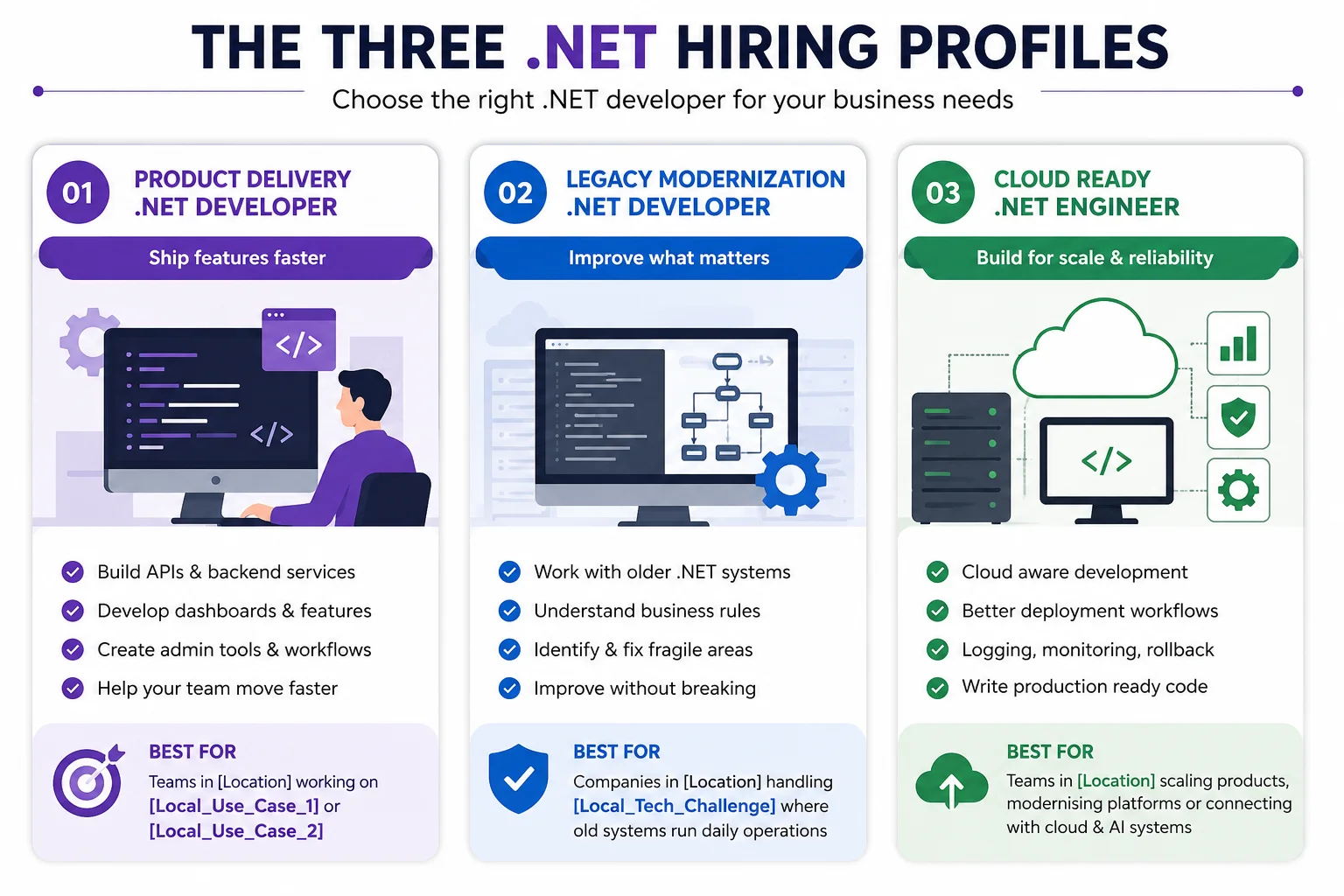
The Three .NET Hiring Profiles

Before hiring, define what kind of .NET developer your business actually needs.

Hiring Model: Local, Freelance, Outsourced, or Staff Augmented

Hiring ModelBest ForMain AdvantageLimitation
Local HiringStrategic leadership roles, long term internal ownership, senior engineering positionsStrong cultural alignment and closer internal collaborationCan be slow, expensive, and difficult when senior .NET talent is limited
Freelance DeveloperShort tasks, bug fixes, small modules, temporary supportQuick access for narrow requirementsMay not provide continuity for enterprise systems or long term product delivery
Traditional OutsourcingFixed scope projects with clear requirements and limited internal involvementExternal team can take full project responsibilityCan create distance between product decisions and engineering execution
Staff AugmentationAdding skilled .NET developers into your existing team and workflowKeeps roadmap control with your team while increasing delivery capacityWorks best when you already have internal leadership, sprint process, or product ownership

Why Staff Augmentation Works for .NET Teams

Staff augmentation is useful when your internal team already knows what needs to be built but does not have enough engineering capacity. Instead of handing the full project to an external vendor, you bring vetted .NET developers into your existing delivery process. They work with your product owner, engineering manager, QA team, DevOps process, tools, and sprint rhythm.

This model helps companies in Germany because it reduces the delay of traditional hiring while keeping ownership inside the business.

A staff augmented .NET developer can support:

Dedicated .NET Team for Larger Roadmaps

One developer may be enough for a narrow backlog. But if your company is building or modernizing a larger platform, a dedicated team is often stronger.

A dedicated .NET team may include:

This is useful when a company in Germany needs to support industrial platforms, ERP connected systems, APIs, and enterprise dashboards across multiple workstreams. The benefit is continuity. Developers understand the system over time. QA protects release quality. DevOps supports deployment. The technical lead keeps architectural decisions consistent.

For manufacturing and industrial software delivery, this model often works better than hiring isolated developers.

What to Check Before Hiring .NET Developers

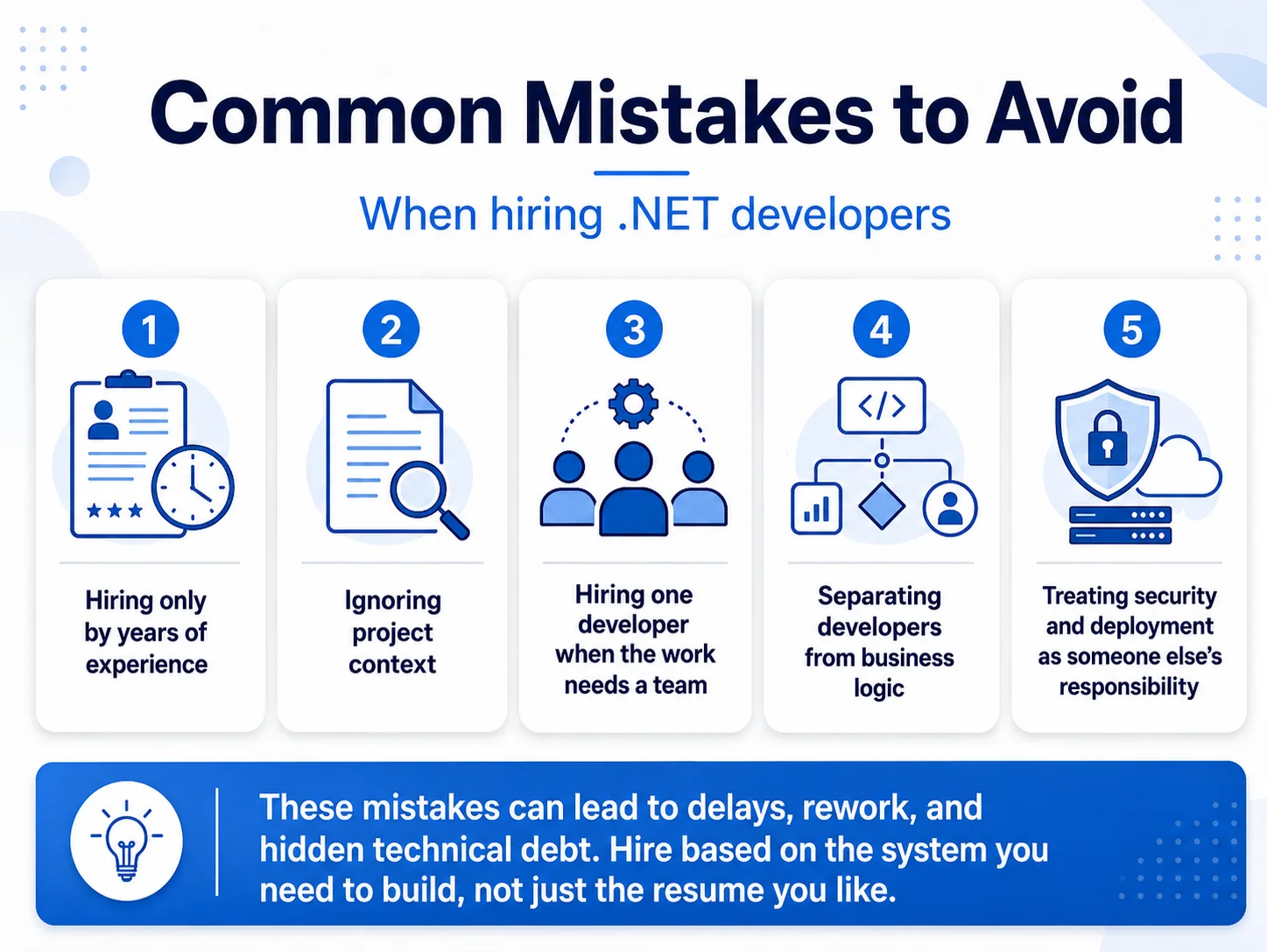
Most interviews do not test the real work. They ask about syntax, framework names, or years of experience. That is not enough. A better .NET hiring process should check practical judgment.

Architecture Thinking

Ask the candidate how they would design a backend system for a customer portal, payment workflow, inventory system, reporting dashboard, or internal operations platform. Look for questions around scale, authentication, roles, audit logs, database structure, integration points, and failure handling. The best candidates do not overcomplicate the answer. They choose architecture that fits the business.

Legacy System Thinking

Ask what they would do after joining a project with old code, no tests, and weak documentation. A poor answer focuses on rewriting everything. A strong answer focuses on understanding the system, mapping critical workflows, adding tests around risky areas, and modernizing in stages.

This is important for companies in Germany dealing with legacy modernization and industrial system integrations.

Database and Performance Awareness

.NET developers often work close to databases. They should understand queries, indexes, transactions, migrations, data modeling, and performance troubleshooting.

Ask how they would investigate a slow API in production. Strong answers will mention logs, database queries, indexes, caching, traffic patterns, external services, and recent release changes.

Security Awareness

A .NET developer should understand authentication, authorization, secure APIs, role based access, input validation, dependency updates, secrets management, and safe error handling.

Cloud and Deployment Awareness

Modern .NET developers should understand how applications move from local development to production. They should know the basics of CI/CD, staging environments, environment variables, secrets, logs, monitoring, rollback, and cloud deployment.

For Germany companies working toward [Local_Cloud_Context], this is not optional. It is part of delivery quality.

Timezone and Offshore Collaboration

If your company in Germany is considering offshore .NET developers, timezone overlap matters. But timezone overlap alone is not enough. Offshore delivery works when communication is structured, sprint planning is clear, code reviews are consistent, and ownership is defined.

The best offshore .NET developers reduce management load. They do not create more of it.
How Nyx Wolves Helps Companies Hire .NET Developers in Germany

What You NeedHow Nyx Wolves Helps
One Skilled .NET DeveloperMatch you with a dedicated .NET developer who can support your backlog, APIs, features, bug fixes, and ongoing product work.
More Delivery CapacityAdd vetted .NET engineers to your existing team through staff augmentation without changing your internal workflow.
A Complete .NET TeamBuild an offshore .NET development team with backend, frontend, QA, DevOps, and technical leadership support.
Legacy System ImprovementSupport modernization of older .NET Framework, ASP.NET, MVC, or enterprise applications without disrupting daily operations.
Cloud Ready DevelopmentHelp develop .NET applications that are ready for Azure, AWS, containers, CI/CD, monitoring, and scalable deployment.
Enterprise IntegrationsBuild APIs, connect third-party tools, integrate SaaS platforms, and support ERP, CRM, payment, and workflow systems.
Long Term Product SupportProvide developers who can stay aligned with your roadmap, sprint process, release cycle, and maintenance needs.

When Nyx Wolves Is a Good Fit

Nyx Wolves is a good fit if your company already knows what needs to be built but does not have enough engineering capacity to execute it. It is also a good fit if your .NET platform is important to the business and needs better performance, modernization, cloud readiness, security, or release discipline. The model works best when there is a clear business requirement, an internal owner, and a need for reliable technical capacity.

Build a dedicated .NET team for your Germany roadmap

Nyx Wolves helps companies in Germany hire dedicated .NET developers, extend internal engineering teams, and modernize enterprise applications without losing control of delivery.

Share your current stack, roadmap, team gap, and hiring timeline. Nyx Wolves can help you identify whether you need one developer, a dedicated team, or a staff augmentation model.

Contact us

Partner with Nyx Wolves

As an experienced provider of AI and IoT software solutions, Nyx Wolves is committed to driving your digital transformation journey. 

Your benefits:

What happens next?
1

We Schedule a call at your convenience 

2

We do a discovery and consulting meeting 

3

We prepare a proposal 

Schedule a Free Consultation
case studies

See Our Case Studies