AI Predictive Maintenance for Heavy Machinery & Industrial Equipment Industry: Reduce Downtime and Maintenance Costs
Introduction
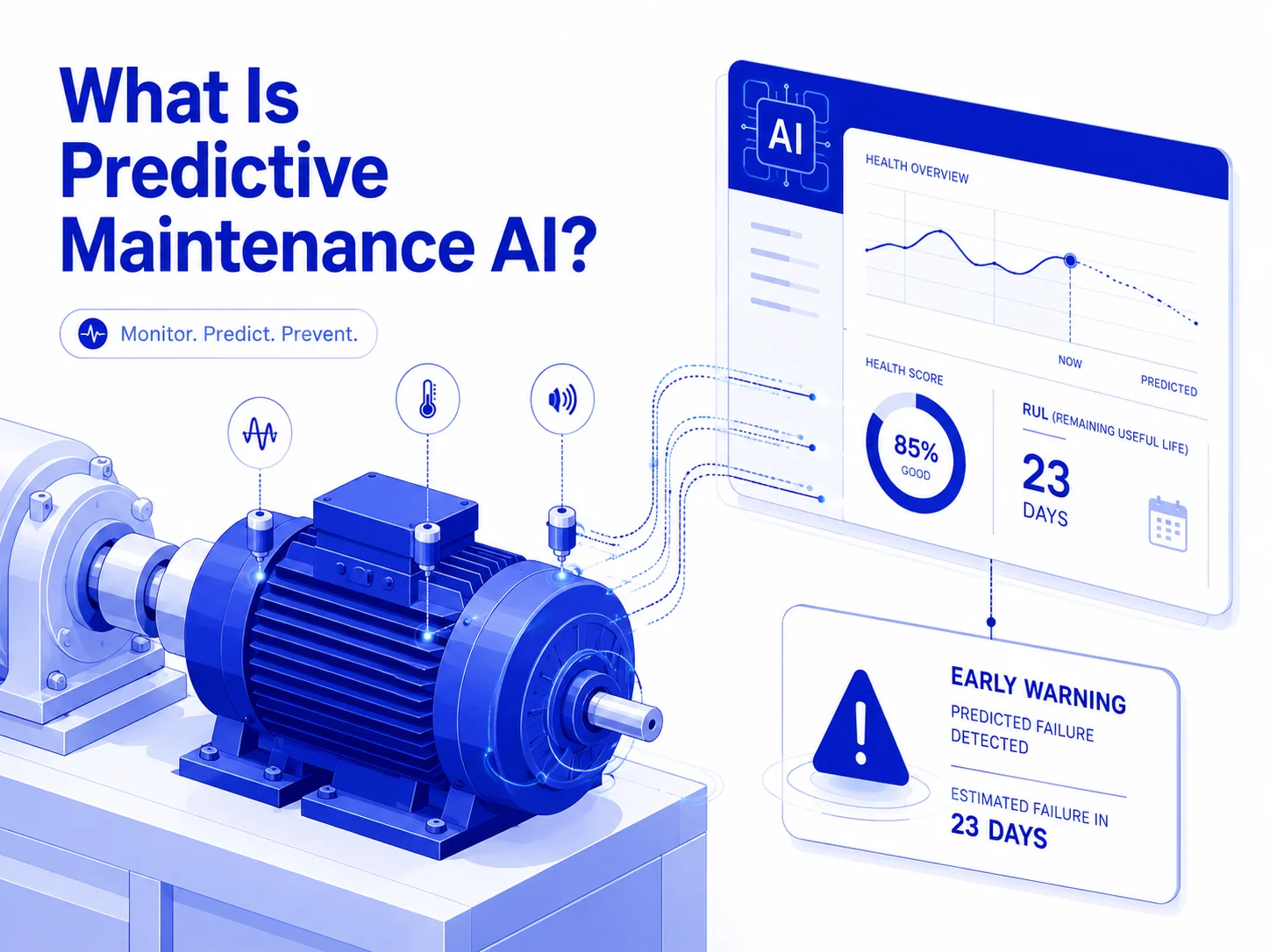
Predictive maintenance AI helps manufacturers identify equipment problems before they become production-stopping failures. Instead of servicing machinery on a fixed schedule or waiting for it to break, the system continuously analyses operating data such as vibration, temperature, pressure, electrical current and acoustic patterns. When the data begins to show signs of deterioration, maintenance teams receive an early warning.
For a Heavy Machinery & Industrial Equipment industry facility operating Hydraulic Systems, that warning can mean the difference between a planned two-hour repair and an unexpected shutdown that disrupts production for days.
This guide explains how predictive maintenance AI works, when it makes financial sense, what implementation involves and how manufacturers can start with a focused pilot instead of committing to a facility-wide rollout.
What Is Predictive Maintenance AI?
Predictive maintenance AI uses equipment data and machine learning to estimate when a component is likely to fail. It improves on two traditional maintenance approaches:
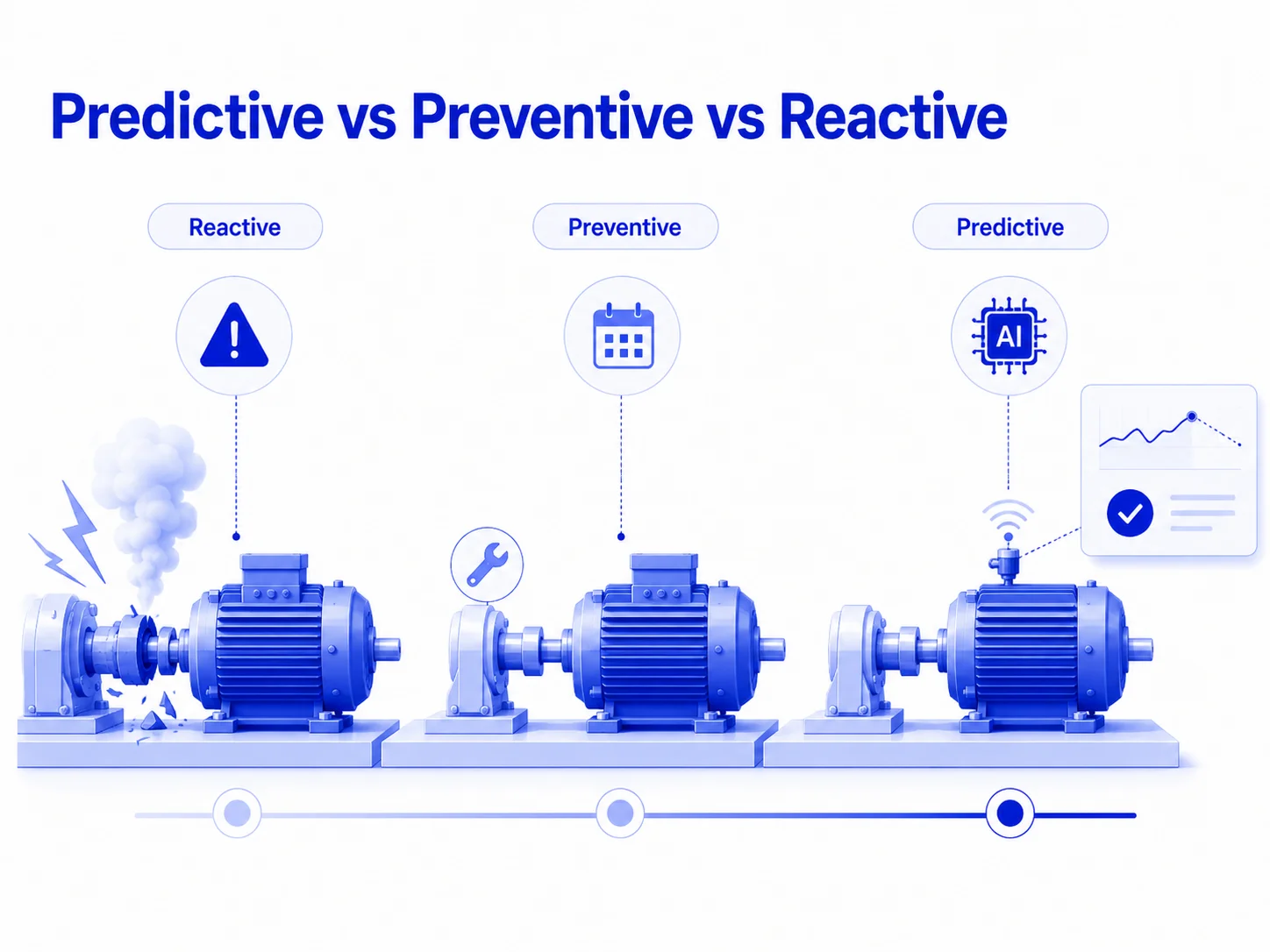
Reactive maintenance waits until equipment fails. It requires little upfront investment, but breakdowns can create expensive production losses, emergency labour costs and delayed customer deliveries.
Preventive maintenance services equipment at fixed intervals. It reduces some failures, but parts are often replaced before necessary, while faults that do not follow the maintenance calendar can still be missed.
Predictive maintenance uses the actual condition of the equipment to determine when intervention is needed.
The system learns what normal operating behaviour looks like for a particular machine. It then identifies changes that may indicate bearing wear, motor degradation, overheating, pressure loss, misalignment or another developing problem. Maintenance teams can use that information to plan the repair during a scheduled production window.
According to IBM’s guide to predictive maintenance, manufacturers use real-time condition monitoring to detect equipment deterioration and improve asset uptime.
Signs Your Plant May Need Predictive Maintenance
Predictive maintenance is most valuable when equipment failures have a measurable operational or financial impact.
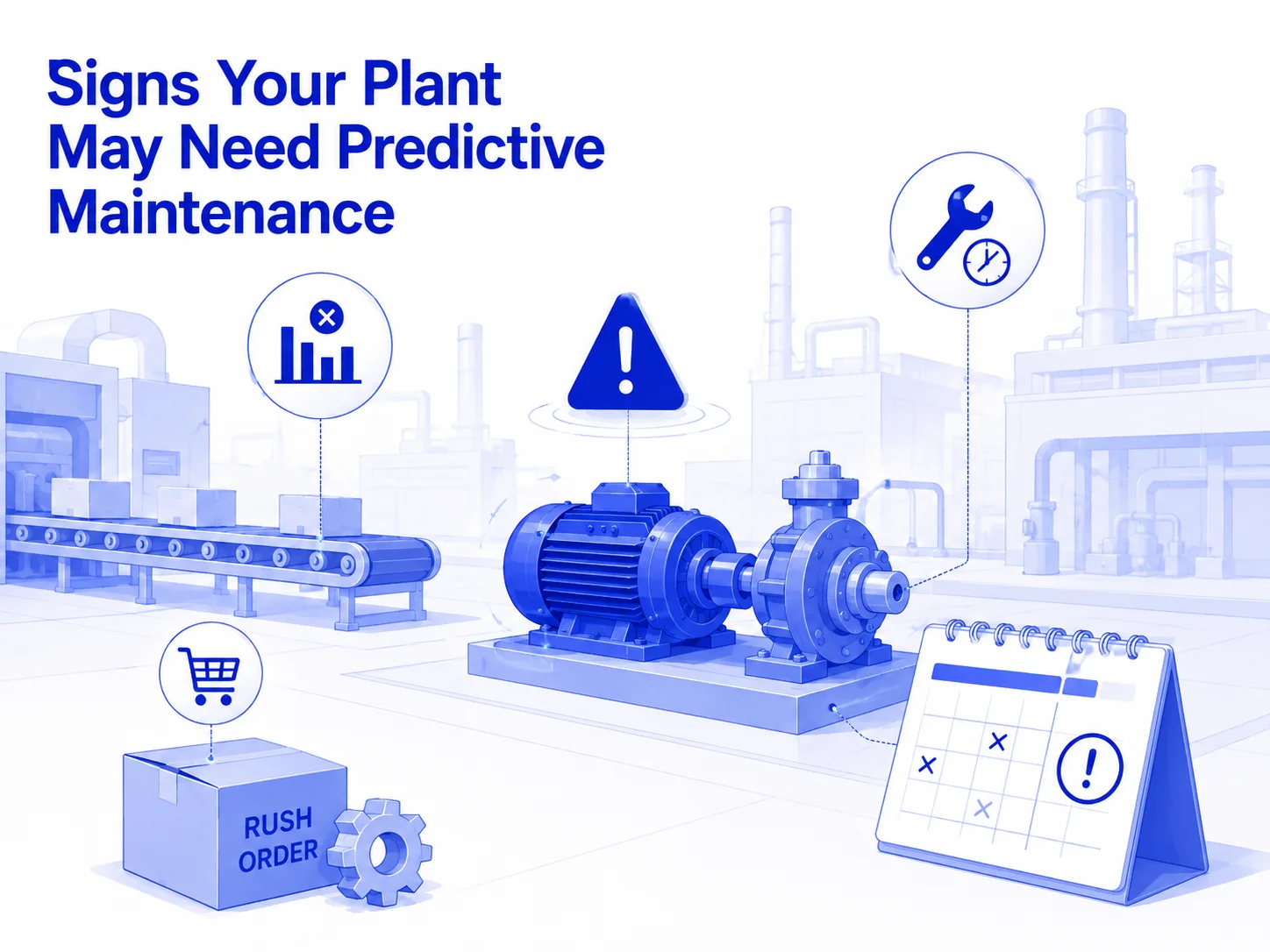
Your Heavy Machinery & Industrial Equipment industry facility may be ready for a predictive maintenance pilot when:
- The same machines repeatedly cause production stoppages
- Maintenance overtime has increased over several months
- Critical equipment is approaching or exceeding its expected service life
- Maintenance teams spend more time responding to emergencies than planning work
- One equipment failure frequently affects downstream processes
- Spare parts are regularly ordered at premium or expedited rates
- Production teams cannot clearly explain why certain machines fail
- Maintenance records exist, but they are not being used to predict future issues
When several of these conditions are present, the cost of continuing with reactive maintenance may already be higher than the cost of a targeted pilot.
The True Cost of Unplanned Downtime
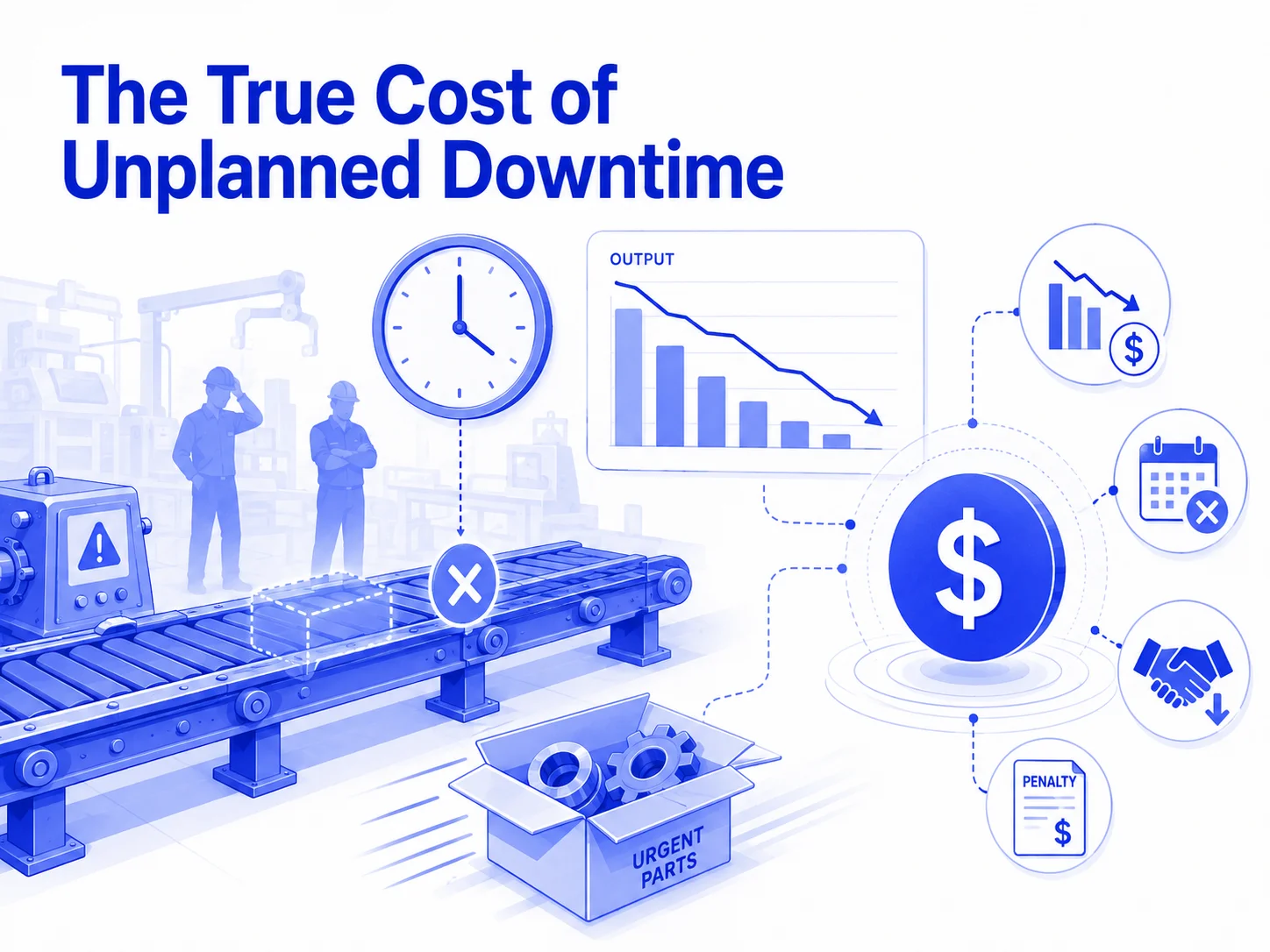
Many manufacturers underestimate downtime because its cost is spread across multiple budgets. The production loss may appear in one report, while overtime, expedited parts, quality issues and missed delivery penalties appear elsewhere. As a result, leadership rarely sees the complete financial impact of a single breakdown.
The total cost may include:
- Lost production output
- Idle operators and production staff
- Maintenance overtime
- Expedited replacement parts
- Scrap and rework
- Delayed customer orders
- Contractual penalties
- Additional energy consumption during shutdown and restart
- Damage to connected equipment
- Reduced customer confidence
The most serious failures rarely affect only one machine. A fault in a critical asset can interrupt an entire production sequence, particularly when there is no backup capacity.
For Heavy Machinery & Industrial Equipment industry manufacturers, where delivery reliability can be as important as price, repeated downtime can also affect renewals and future contracts.
How Predictive Maintenance AI Works
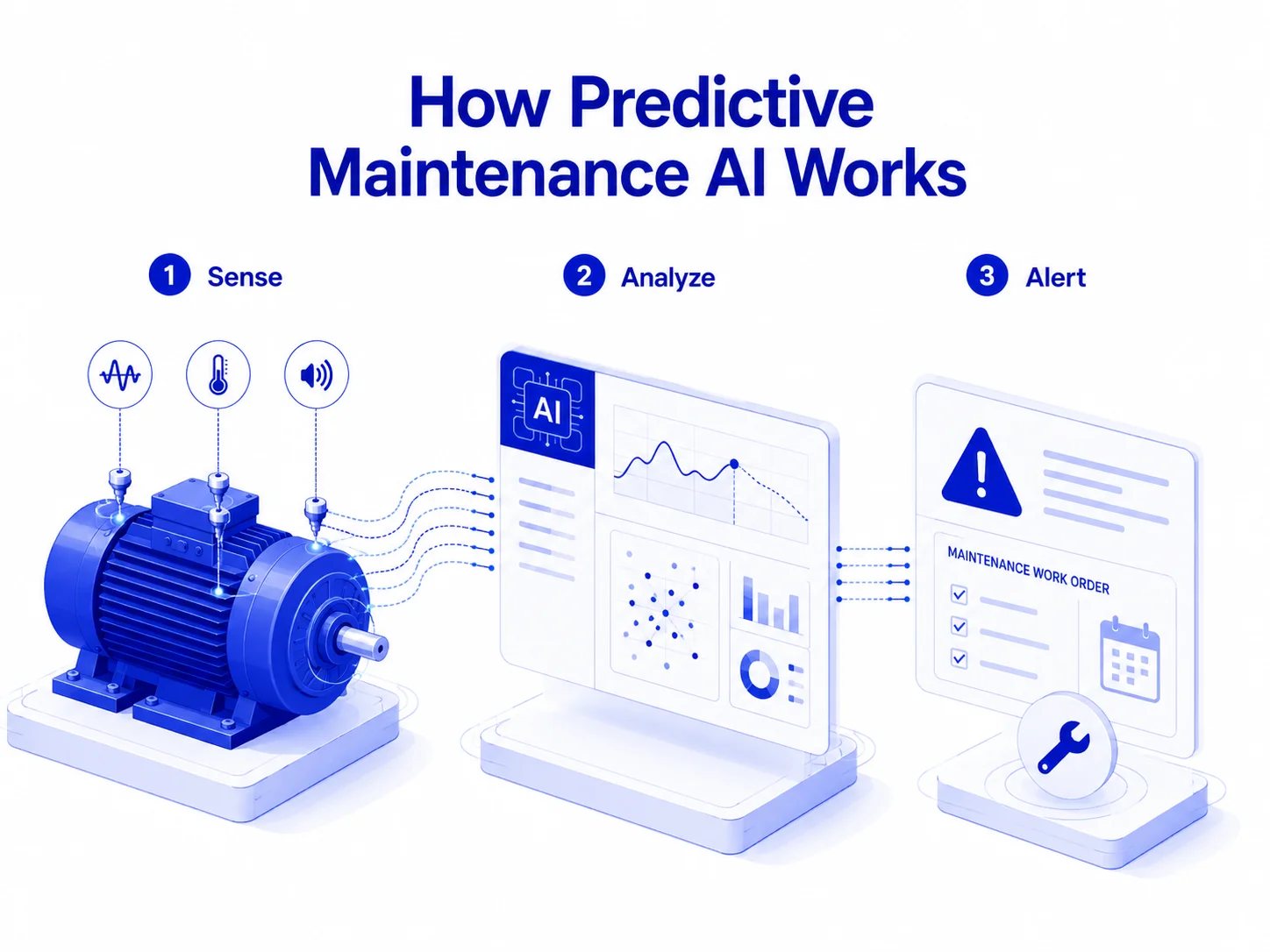
A reliable predictive maintenance system usually combines three layers: equipment data, machine learning and maintenance workflow integration.
Sensors collect data from critical assets while they are operating.
Depending on the equipment and likely failure modes, this may include:
- Vibration
- Temperature
- Pressure
- Electrical current
- Rotational speed
- Oil condition
- Flow rate
- Acoustic signals
The data may come from newly installed IoT sensors or from systems already operating inside the facility, including programmable logic controllers, SCADA platforms and existing condition-monitoring equipment.
This first layer is critical. Poor sensor placement, inconsistent readings or missing historical data will limit the accuracy of any model built on top of it. A sensor and data audit should therefore happen before model development begins.
Machine learning models analyse the collected data to identify patterns associated with equipment deterioration. In some cases, the model is trained using historical examples of known failures. In others, it learns the machine’s normal operating behaviour and detects unusual deviations.
For example, a model monitoring an industrial motor may identify a combination of rising vibration, temperature variation and abnormal current draw. Each signal may appear harmless in isolation, but together they may indicate an emerging bearing or alignment problem.
The goal is not simply to report that something looks unusual. A useful system should help answer:
- Which asset is affected?
- What component may be at risk?
- How serious is the issue?
- How soon should the team inspect it?
- What operating data supports the warning?
Maintenance teams are far more likely to act on an alert when they understand why it was generated.
A prediction creates value only when it leads to action. Alerts should therefore connect with the systems maintenance teams already use, such as:
- Computerised maintenance management systems
- Enterprise resource planning platforms
- SCADA systems
- Parts inventory systems
- Email, mobile or operational notification tools
A high-risk prediction could automatically generate an inspection request, check whether the required spare part is available and recommend a suitable maintenance window. Without this integration, alerts may remain in a dashboard that operators rarely check.
Predictive vs Preventive vs Reactive Maintenance
| Area | Reactive | Preventive | Predictive AI |
|---|---|---|---|
| Maintenance timing | After failure | Fixed schedule | Based on equipment condition |
| Downtime | Usually unplanned | Partly planned | Mostly planned |
| Labour requirements | Emergency response | Routine scheduled work | Prioritised, condition-based work |
| Parts usage | Replaced after failure | May be replaced too early | Replaced when deterioration is detected |
| Data required | Minimal | Maintenance records | Sensor and operating data |
| Initial investment | Low | Moderate | Higher |
| Long-term efficiency | Low | Moderate | Potentially high |
Reactive maintenance is inexpensive to establish but can become costly when critical equipment fails.
Preventive maintenance offers more control, although it still relies on estimated service intervals rather than the machine’s actual condition. It requires more preparation, but it allows maintenance decisions to be based on real equipment behaviour.
Predictive Maintenance for Hydraulic Systems in Heavy Machinery & Industrial Equipment
Hydraulic Systems used in Heavy Machinery & Industrial Equipment operations often develops measurable warning signs before a major failure. These signs may include changes in vibration, heat, pressure, energy consumption, lubrication or acoustic behaviour. When monitored consistently, they can reveal deterioration long before it becomes visible to an operator. The best starting point is not necessarily the asset that is easiest to monitor. It is the asset whose failure creates the greatest operational impact.
Manufacturers can prioritise equipment using factors such as:
- Historical failure frequency
- Average repair cost
- Downtime per incident
- Effect on downstream production
- Availability of replacement parts
- Safety or quality consequences
- Availability of historical operating data
This produces a defensible list of assets for the first pilot. For example, if three machines account for most of the facility’s unplanned downtime, monitoring those assets is likely to produce more value than installing sensors across dozens of low-risk machines.
Where the ROI Comes From
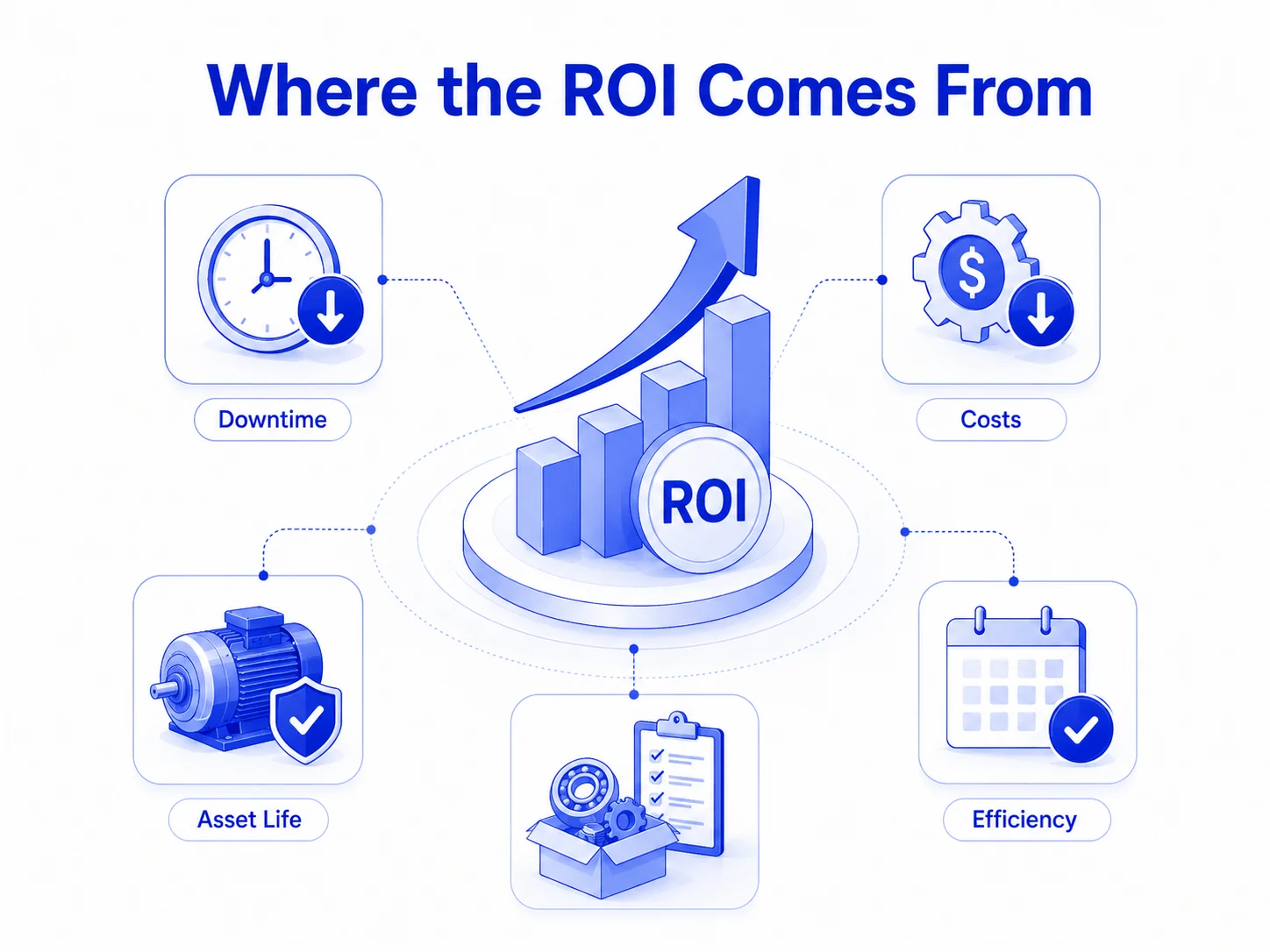
The financial return from predictive maintenance usually comes from several improvements rather than one dramatic saving.

Reduced Unplanned Downtime
Early warnings allow maintenance work to happen during planned production windows. Even when a failure cannot be completely avoided, earlier detection may reduce the severity and duration of the shutdown.

Lower Maintenance Costs
Condition-based maintenance reduces unnecessary servicing and premature replacement of healthy components. It can also reduce emergency labour, expedited shipping and last-minute contractor costs.

Longer Equipment Life
A small fault can damage surrounding components when it is allowed to continue. Addressing the original issue early may prevent secondary damage and extend the useful life of the asset.

More Efficient Maintenance Teams
Predictive insights help teams prioritise work based on operational risk rather than responding to whichever machine fails next. This creates more stable schedules and allows skilled technicians to spend more time on planned work.

Better Spare-Parts Planning
When a likely failure is identified early, the required part can be ordered before the maintenance window instead of being purchased urgently after the breakdown. The actual ROI will depend on your equipment mix, current maintenance approach, cost of downtime and quality of available data.


How Much Does Predictive Maintenance AI Cost?
The cost of predictive maintenance depends on the number of assets being monitored, the available data and the level of integration required.
Most projects include three cost areas:
Sensor Hardware and Installation
This includes sensors, gateways, installation work and any required connectivity infrastructure. Facilities that already collect reliable equipment data may need less additional hardware.
Software and Model Development
Manufacturers may choose an off-the-shelf predictive maintenance platform or a model developed around their own equipment. Standard platforms can reduce initial development time, while custom models may perform better when machinery, operating conditions or failure patterns are highly specialised.
Systems Integration and Ongoing Support
The solution may need to connect with SCADA, ERP, CMMS and parts-management systems. Models also require monitoring and occasional retraining as equipment ages, production conditions change or new failure data becomes available.
A focused pilot keeps the initial investment controlled. Instead of estimating the cost of monitoring an entire facility, the manufacturer can test the approach on a small group of high-impact assets.
Build In-House or Work With a Predictive Maintenance Partner?
Building an internal predictive maintenance system can make sense for manufacturers with mature data engineering, machine learning and reliability teams. However, the project requires more than training an algorithm.
The team must also handle:
- Sensor selection and installation
- Industrial data pipelines
- Data cleaning and synchronisation
- Model development
- Equipment-specific failure analysis
- SCADA and ERP integration
- Cybersecurity
- Alert validation
- Model monitoring and retraining
- Adoption by maintenance teams
An internal build provides greater control over intellectual property and system architecture. It may be the right choice when the organisation already has plant-floor data experience and can support a longer development cycle.
A specialist partner may be more appropriate when the goal is to validate the opportunity quickly. Existing integration frameworks and industrial AI experience can shorten the path to a working pilot.
A practical decision rule is:
Build internally when you already have the right technical and operational team and want full long-term ownership.
Work with a partner when you need to prove value on real equipment before investing in a larger internal programme.
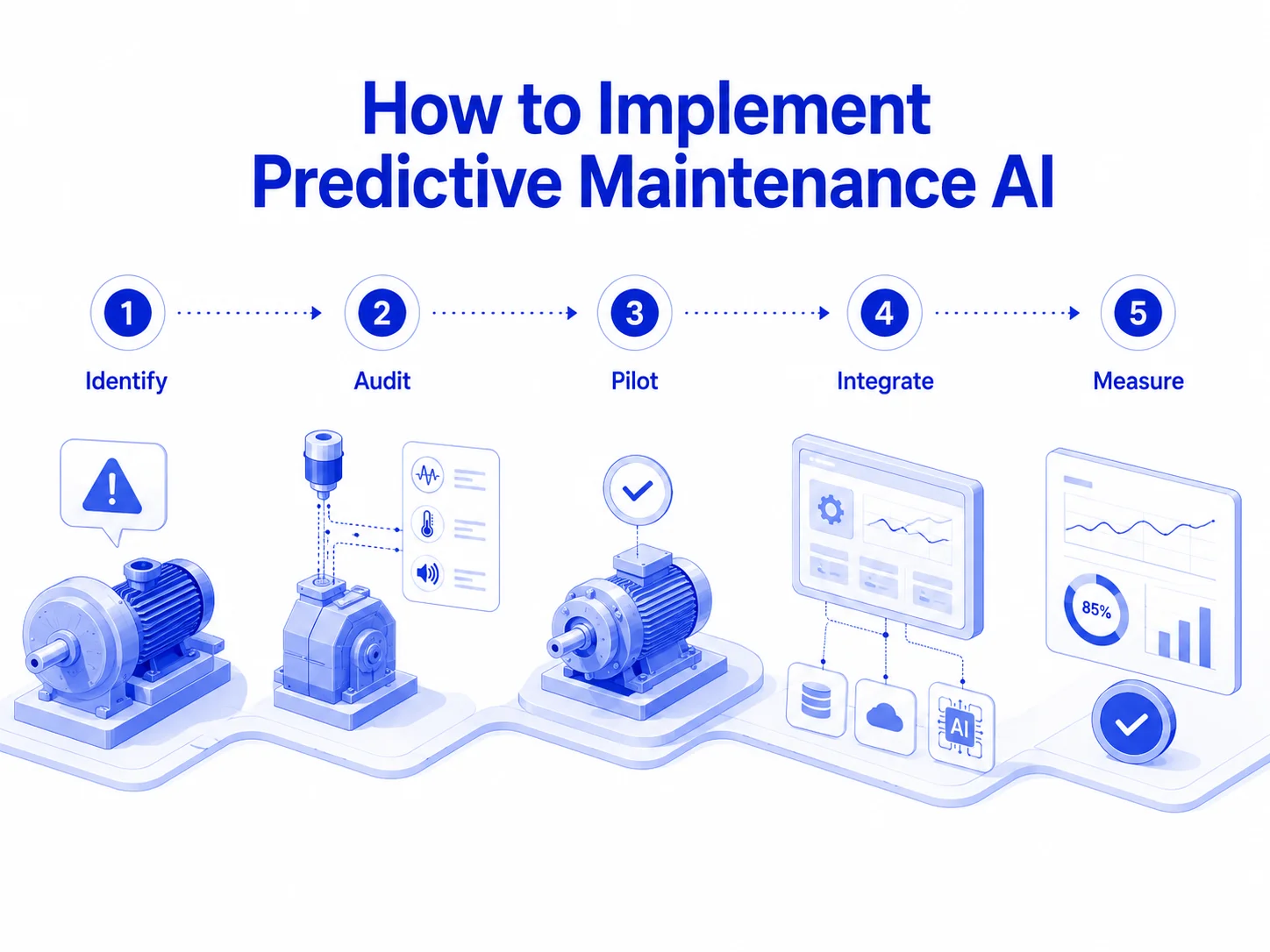
How to Implement Predictive Maintenance AI
The strongest implementations usually begin with a narrow business problem rather than a plant-wide technology rollout. McKinsey’s predictive maintenance implementation framework recommends carefully selecting assets, involving the right partners and integrating predictive maintenance into the wider digital ecosystem.
Review maintenance records, production reports and operator feedback to identify which assets cause the most disruption. The pilot should focus on a clear operational outcome, such as reducing failures on a specific motor, pump, conveyor, compressor or production line.
Determine what information is already available and whether it is reliable enough for analysis.
This may include:
- Existing sensor data
- SCADA records
- Maintenance logs
- Work orders
- Failure reports
- Operator notes
- Spare-parts history
- Production conditions
The audit should also identify gaps in sensor coverage or data quality.
Choose an asset with:
- A meaningful cost of failure
- Measurable failure indicators
- Sufficient operating data
- Support from maintenance and production teams
- Enough operating time to validate the model
A pilot that succeeds on a low-impact asset may prove the technology works without proving that it creates meaningful business value.
The model should be tested against real operating conditions and known maintenance events. Maintenance engineers should review alerts during this phase to determine whether they are useful, understandable and actionable.
Integrate validated alerts with the maintenance process. Define who receives each type of alert, what action should follow and how the outcome will be recorded.
Track a small set of operational metrics, such as:
- Unplanned downtime
- Mean time between failures
- Mean time to repair
- Maintenance overtime
- Emergency parts orders
- Alert accuracy
- Avoided production loss
These results determine whether the solution should be expanded to additional assets or production lines.
Why Singapore Manufacturers Are Investing Now
Manufacturers in Singapore are facing a combination of cost pressure, labour constraints and tighter customer expectations. Energy-intensive shutdowns are becoming more expensive. Experienced maintenance technicians are difficult to replace. Customers expect shorter delivery windows and greater reliability.
At the same time, many facilities already collect equipment data through PLCs, SCADA systems and industrial sensors but use it mainly for real-time monitoring rather than failure prediction. Predictive maintenance allows manufacturers to generate more value from that existing data.
The objective is not to add AI to every machine. It is to apply it where earlier decisions can prevent the largest operational losses.
How Nyx Wolves Approaches Predictive Maintenance
Nyx Wolves builds predictive maintenance and industrial monitoring systems for manufacturing, energy, and logistics operations. The starting point is never the model. It’s the equipment problem in front of you: which line, which asset, which failure is actually costing money.
A typical engagement runs in six stages:
- Review downtime and maintenance records to find where the real cost is hiding, not where it’s assumed to be.
- Audit sensors and existing equipment data to see what’s already usable and what needs new instrumentation.
- Select one high-impact pilot asset or production line instead of trying to instrument the whole facility at once.
- Build and validate the monitoring model against your actual failure history, not a generic training set.
- Connect alerts to SCADA, ERP, or CMMS workflows so a prediction becomes a work order, not a dashboard notification nobody acts on.
- Measure the operational impact before expanding past the pilot.
Each stage has to be cleared before the next one starts. Skipping straight to step four, building the model before anyone’s audited what data actually exists, is the most common way these projects go over budget and under-deliver.
Industrial Monitoring Case Study
In one process-industry deployment, a large floating desalination facility relied on a traditional SCADA environment with limited real-time analytics and no proactive maintenance capability. Unexpected equipment issues increased downtime and operating costs. Direct access to the operational network also raised security concerns.
Nyx Wolves implemented an AI-driven monitoring layer that analysed the available SCADA data without requiring unrestricted network access.
According to the project results, the system contributed to:
- A 30% reduction in downtime
- A 25% reduction in maintenance costs
- A 40% improvement in response time
The project involved process infrastructure rather than a discrete manufacturing line. However, the underlying challenge was similar: critical equipment was being maintained reactively because teams lacked an effective early-warning system.

FAQs
Yes, particularly when the facility depends on a small number of critical or expensive assets.
The size of the plant matters less than the operational cost of an equipment failure. A focused system monitoring two or three essential machines may produce a stronger business case than a broad rollout across low-impact equipment.
The requirement depends on the equipment, available sensors and failure mode.
Historical failure examples are valuable, but they are not always essential. Anomaly-detection models can begin by learning normal operating behaviour, although known maintenance records make alerts easier to validate.
A focused pilot can often be completed faster than a plant-wide programme because it limits the number of sensors, integrations and failure modes being analysed.
The timeline will depend on data availability, equipment access, integration complexity and the amount of historical information that must be prepared.
No.
It gives maintenance professionals better information about where and when intervention is needed. The system supports technical decision-making; experienced staff are still required to inspect equipment, interpret operating conditions and complete repairs.
In many cases, yes.
The solution can often use data already collected by SCADA, PLC or condition-monitoring systems. Additional sensors may only be needed where existing data does not capture the relevant failure indicators.
Usually not.
A narrow pilot on a high-impact asset is easier to validate, less expensive to implement and more useful for building a reliable business case. Once the model performs well under real production conditions, it can be expanded to similar equipment or additional production lines.
Start With the Equipment That Costs You the Most
Predictive maintenance does not need to begin as a large digital transformation programme.
Start with the asset that creates the greatest downtime, maintenance cost or production risk. Review the available data, identify the relevant failure indicators and test the system on a clearly defined pilot.
A successful pilot should answer three questions:
- Can the system identify meaningful equipment deterioration early?
- Can the maintenance team act on the alerts?
- Does that action reduce measurable operational cost or risk?
When the answer to all three is yes, scaling becomes a business decision rather than a technology gamble.
Partner with Nyx Wolves
As an experienced provider of AI and IoT software solutions, Nyx Wolves is committed to driving your digital transformation journey.
Your benefits:
- Client-oriented
- Independent
- Competent
- Results-driven
- Problem-solving
- Transparent
What happens next?
We Schedule a call at your convenience
We do a discovery and consulting meeting
We prepare a proposal
Schedule a Free Consultation
See Our Case Studies

AI-powered job matching platform
PerpectV AI-Powered Job Matching Platform for Leading South African

No-code web based AR Platform
Revolutionizing Online Product Showcase with No-Code WebAR Xarwin is


Case Study – Ecostay
Srivalli Ecostays offers a unique hospitality experience, allowing guests