Introduction
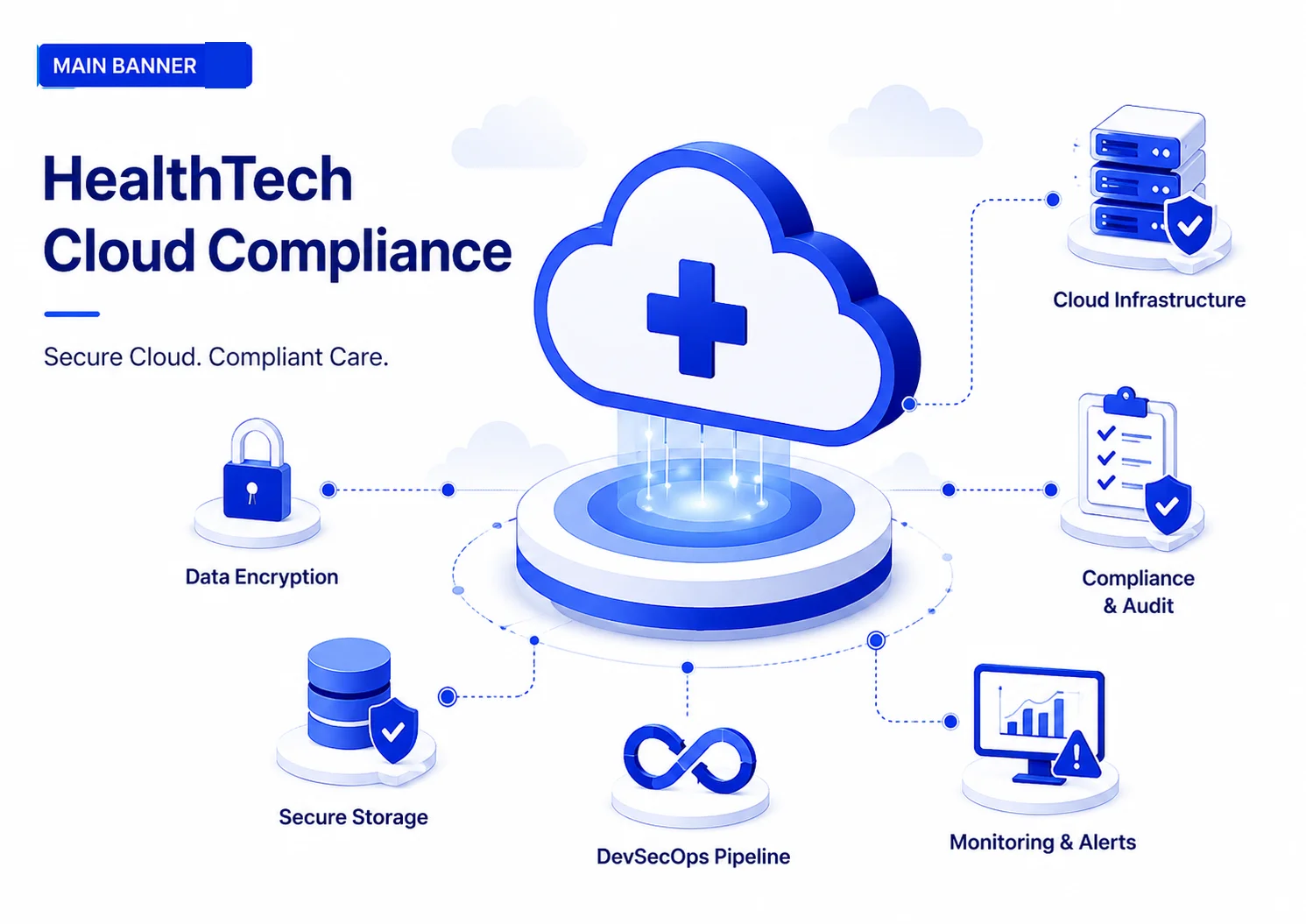
If you are building a HealthTech product, compliance is not a phase you complete and forget. It is a state your infrastructure must maintain every day, across every deployment, access request, configuration change, backup, integration, and log entry.
Many HealthTech companies discover this only when a hospital procurement team requests security documentation, an investor flags control gaps during due diligence, or a security incident exposes weaknesses the business was not prepared to explain.
This guide covers what compliant cloud and DevOps infrastructure requires, where HealthTech teams commonly create risk, what implementation can cost, and how to prepare before your next customer, investor, or compliance review.
The compliance debt nobody budgets for
The HealthTech team ships fast, wins early customers, and treats compliance as something to “handle later.” Later usually arrives in one of three ways:
- A hospital system's procurement team asks for a SOC 2 report before signing
- An investor's technical due diligence flags gaps in your HIPAA controls
- A breach happens, and now you're dealing with notification laws instead of a checklist
Retrofitting compliance into live infrastructure costs 3 to 5x more than building it in from the start, and it usually means downtime you can’t afford during a fundraise or a big customer rollout.
Does HIPAA actually apply to your HealthTech product?
Handling health-related information does not automatically mean every company is subject to HIPAA.
HIPAA primarily applies to covered entities and their business associates. Covered entities generally include certain healthcare providers, health plans, and healthcare clearinghouses. A technology company may become a business associate when it creates, receives, maintains, or transmits protected health information on behalf of one of those organisations.
The product model matters.
| Product model | Typical compliance consideration |
|---|---|
| Software provided to hospitals, clinics, or insurers | The company may be acting as a business associate and may need a BAA, risk analysis, access controls, audit controls, and incident procedures |
| Direct-to-consumer wellness or health application | HIPAA may not apply, but FTC rules, state privacy laws, and breach-notification obligations may still be relevant |
| Product serving people in the European Union | GDPR may apply, particularly when the company offers services to people in the EU or monitors their behaviour |
| Platform handling both clinical and consumer data | Different data sets may fall under different legal, contractual, and security requirements |
Before building a compliance roadmap, the company needs to understand who its customers are, whose data it processes, why the data is processed, and which role the company plays. A HealthTech business may act as a business associate in one customer relationship, a data processor in another, and a direct-to-consumer service provider elsewhere.
Choosing controls before answering these questions can create unnecessary costs or leave serious gaps.
Which compliance framework applies to you?
Not every HealthTech company needs every framework.
| Framework | Commonly relevant when | Primary focus |
|---|---|---|
| HIPAA | The company is a covered entity or business associate handling protected health information in the US | Privacy, security safeguards, permitted data use, and breach notification |
| HITRUST | Customers require independently validated assurance against a structured healthcare security framework | Risk-based controls mapped to HIPAA, NIST, ISO, and other standards |
| GDPR | The company operates in the EU, targets people in the EU, or monitors their behaviour | Lawful processing, data rights, privacy, and international transfers |
| SOC 2 | Enterprise customers are evaluating the company as a technology vendor | Security, availability, confidentiality, processing integrity, and privacy controls |
| FTC Health Breach Notification Rule | A consumer health application or connected product operates outside HIPAA | Notification following breaches involving identifiable health information |
HITRUST is a certifiable framework that maps to HIPAA and other standards, but it is not an official HIPAA certification. SOC 2 is an independent assurance report, with Type I assessing control design and Type II assessing how effectively controls operate over time.
Most HealthTech companies establish HIPAA-ready controls first, pursue SOC 2 as enterprise sales grow, and adopt HITRUST when required by a customer or contract.
A BAA does not make your architecture compliant
Signing a Business Associate Agreement with a cloud or technology provider does not make the application running on that platform compliant. A BAA defines contractual responsibilities for handling protected health information. It does not automatically configure identity management, encryption, network boundaries, logging, backup policies, application permissions, retention rules, or incident-response procedures.
The cloud provider secures parts of the underlying platform. Your company remains responsible for how that platform is configured and how protected health information moves through the application.
A BAA makes a compliant architecture possible. It does not create one automatically.
You cannot secure PHI you have not mapped
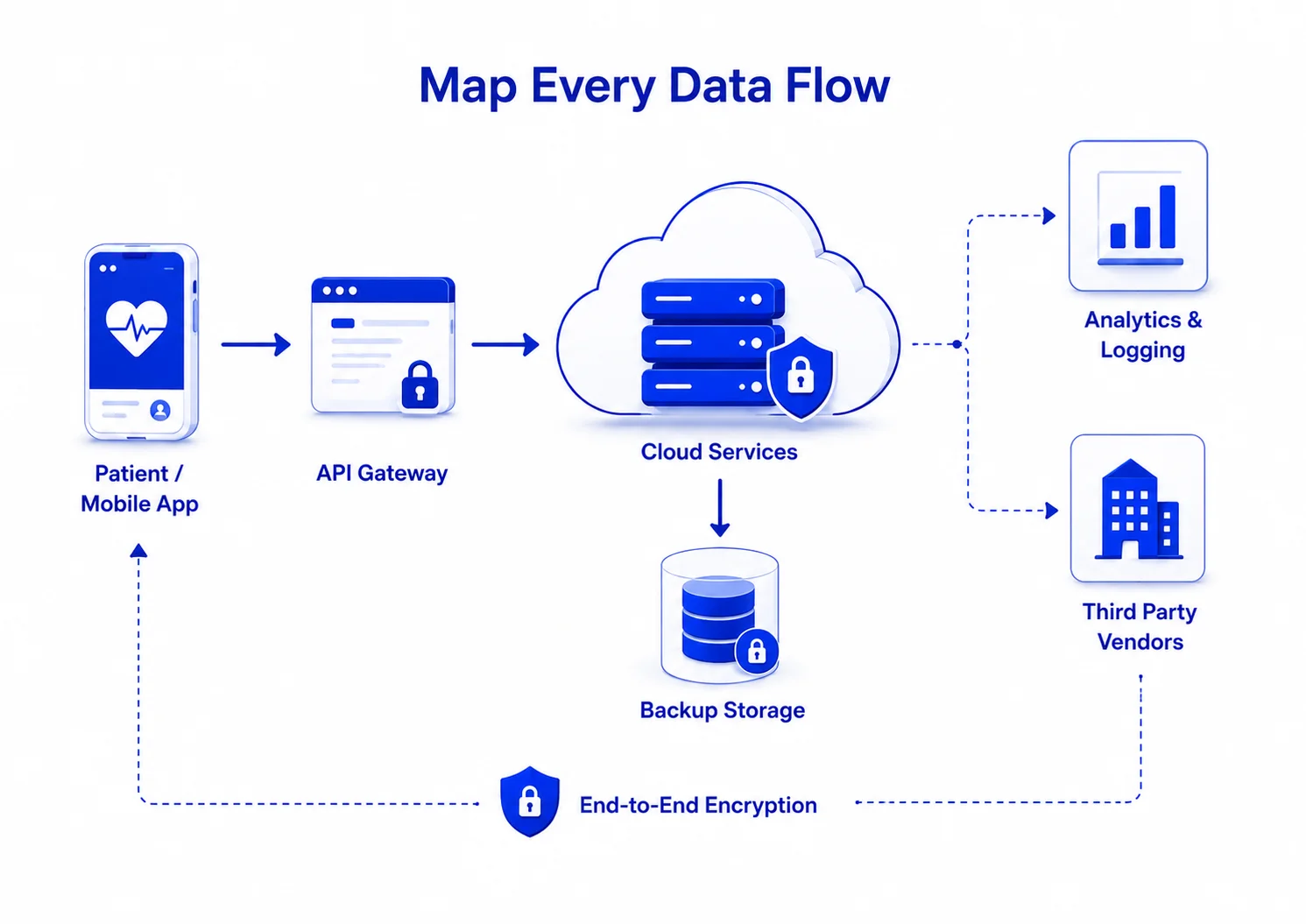
Before adding security tools, map how patient data moves through your systems. Track where it enters, is processed, stored, shared, logged, backed up, and deleted.
Include secondary locations such as support tools, analytics platforms, development environments, AI systems, and backups. This map supports access control, vendor reviews, retention policies, incident response, and audit preparation.

Preparing for SOC 2, hospital procurement, or investor due diligence?

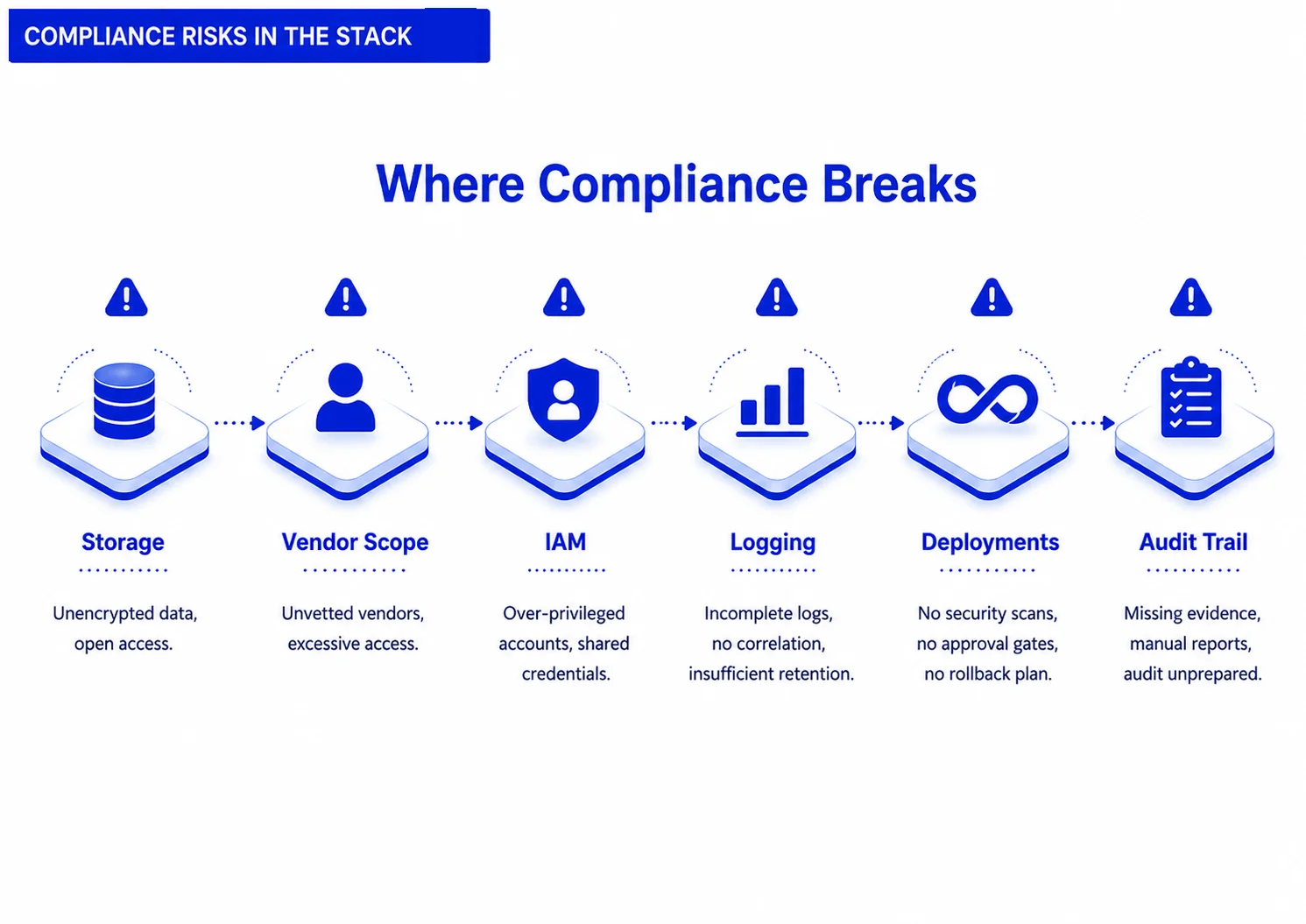
Where compliance breaks in a typical HealthTech stack
The same infrastructure weaknesses appear repeatedly as HealthTech companies grow.
| Risk area | What usually goes wrong | What good control looks like |
|---|---|---|
| Storage | Buckets, snapshots, file shares, or backups have broader access than intended | Private-by-default storage, encryption, continuous policy checks, and access reviews |
| Vendor scope | A service is introduced without confirming BAA coverage, retention, subprocessors, or data location | Formal vendor review before procurement and integration |
| IAM | Temporary broad permissions remain active long after the original sprint | Role-based access, least privilege, MFA, documented approval, and periodic review |
| Logging | Patient IDs, email addresses, tokens, or medical information appear in logs | Redaction, encryption, limited access, controlled retention, and export monitoring |
| Deployments | Production changes are pushed manually without a traceable approval path | Controlled CI/CD pipelines with reviews, scans, approvals, and evidence |
| Audit trail | Access grants, configuration changes, or security decisions cannot be reconstructed later | Automatic evidence collection linked to identities, tickets, and timestamps |
What a compliant deployment pipeline looks like
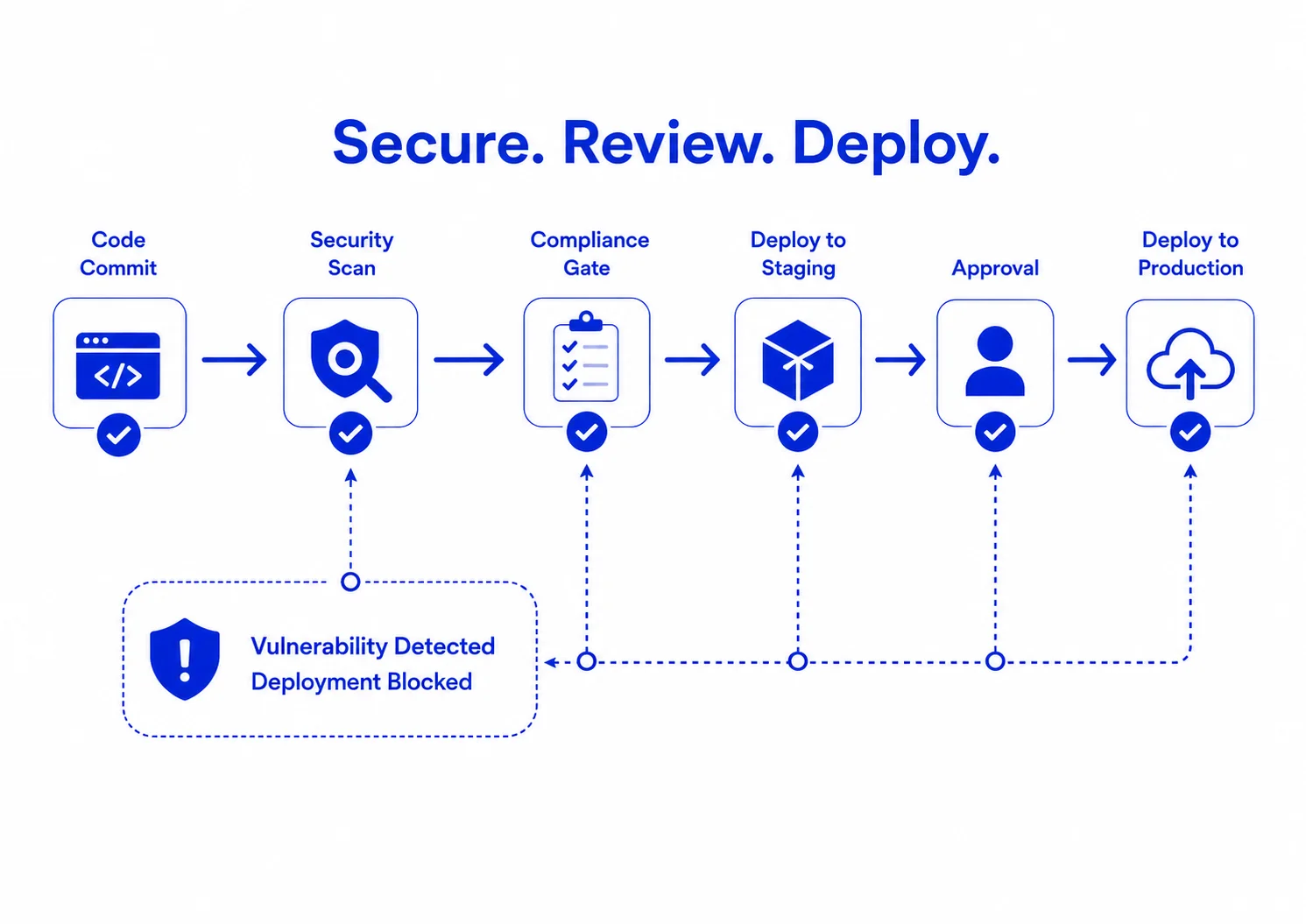
A compliant pipeline should be controlled, repeatable, and traceable. Code reviews, security scans, policy checks, and approval gates should happen automatically before deployment. Staging should follow production-level access controls, and every release should record the code version, test results, approver, environment, and rollback status.
| Pipeline stage | Evidence that should be captured |
|---|---|
| Code review | Developer identity, ticket, reviewer, approval |
| Security testing | Scan results, vulnerabilities, policy violations |
| Staging deployment | Environment, configuration, test outcome |
| Production approval | Approver, timestamp, risk classification |
| Deployment | Commit ID, target environment, deployment result |
| Rollback | Reason, time, owner, restored version |
The main difference between this and a typical startup pipeline is not the technology. Compliance is built into the route to production rather than added as a manual review after release.
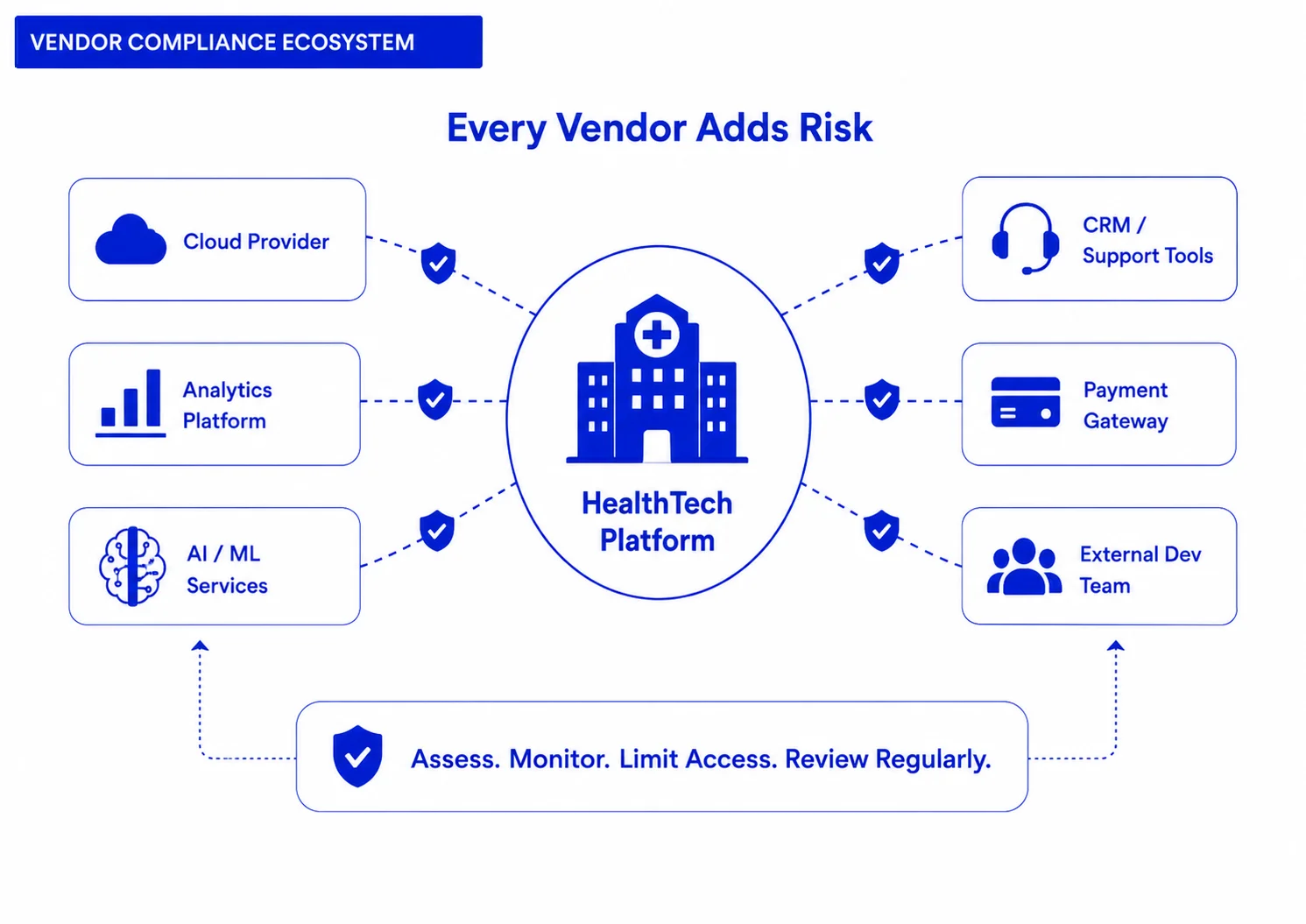
Your vendors are part of your compliance scope

Scope
Any monitoring, CRM, AI, analytics, database, CI/CD, or support platform that can access health data may fall within your compliance boundary.

Review
Check BAA coverage, subprocessors, data location, retention, deletion, access controls, incident terms, and whether data is used for model training.

Decision
A recognised brand or SOC 2 report is not enough. Suitability depends on how the service handles your data and how your team configures it.
Compliance also means recovering when production goes down
HealthTech security is not only about confidentiality. The infrastructure must also protect the integrity and availability of sensitive information.
That means preparing for ransomware, accidental deletion, failed deployments, cloud-region outages, database corruption, compromised credentials, and third-party service failures.
Two recovery targets should be defined clearly.
| Recovery metric | Question it answers |
|---|---|
| Recovery Time Objective | How long can the system remain unavailable? |
| Recovery Point Objective | How much recent data can the organisation afford to lose? |
Backups should be encrypted, access-controlled, monitored, and protected against accidental or malicious deletion. Most importantly, they should be tested. A backup that has never been restored is only an assumption. Recovery exercises should document what was tested, how long restoration took, what failed, and what needs to improve.
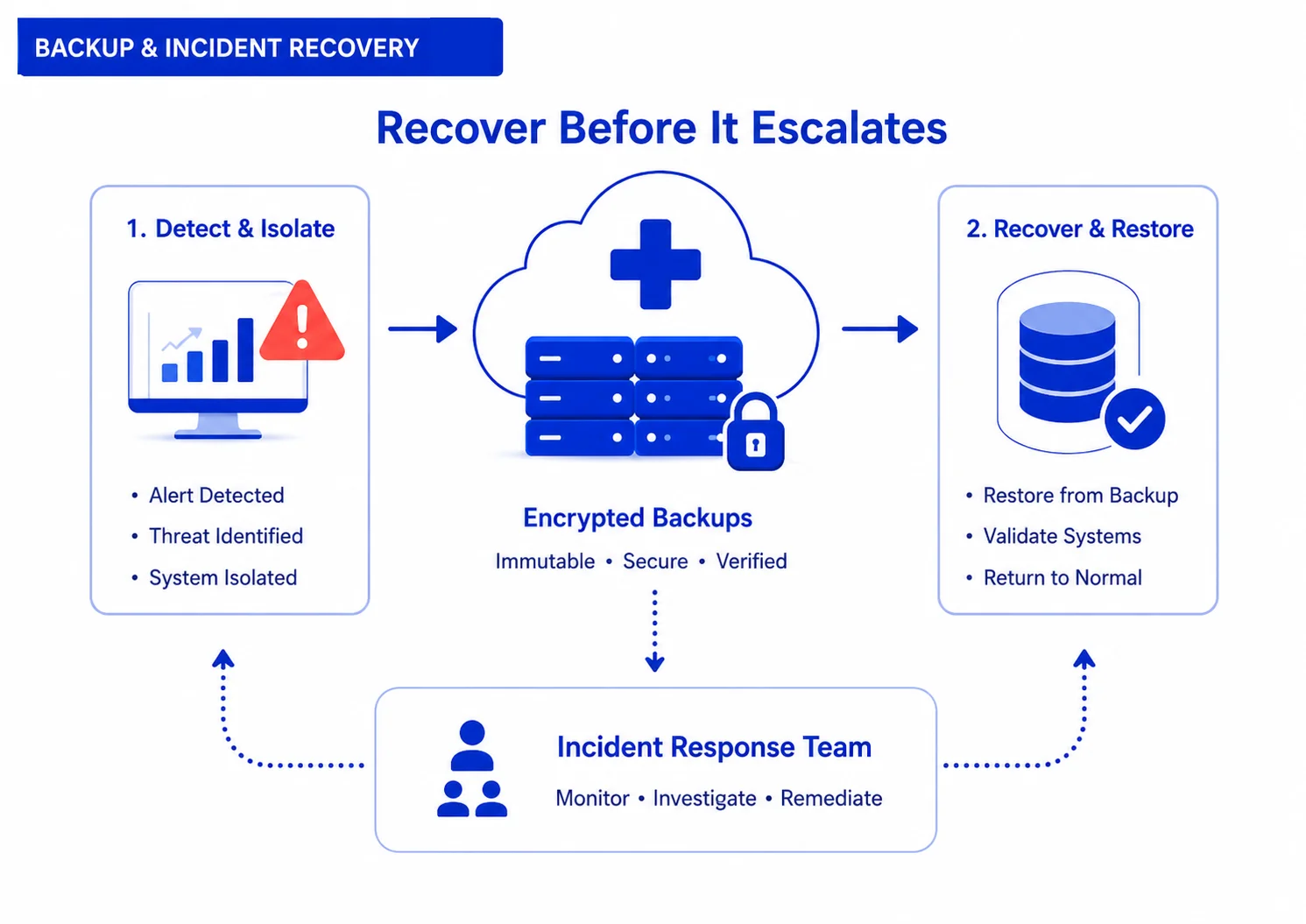
What happens during the first 24 hours of a suspected breach?
Infrastructure controls must support a real incident, not only an audit.
When suspicious access or data exposure is detected, the organisation should already know who owns the response, who can isolate systems, how evidence will be preserved, which vendors must be contacted, and when legal or compliance teams need to become involved.
A working incident-response plan should define roles, severity levels, escalation paths, evidence-preservation procedures, communication responsibilities, and recovery steps. It should also be tested through tabletop exercises.
A written plan that nobody has practised will often fail under pressure.
AWS, Azure, or Google Cloud: which is better for HealthTech?
AWS, Microsoft Azure, and Google Cloud can all support regulated healthcare workloads. None of them makes an application automatically compliant.
| Platform | Common strengths | Typical consideration |
|---|---|---|
| AWS | Broad managed-service catalogue, fine-grained IAM, strong infrastructure-as-code and audit tooling | Large service surface can make governance complex |
| Microsoft Azure | Strong integration with Entra ID, Microsoft 365, SAP, Databricks, and enterprise systems | Works best when governance tools are configured and actively maintained |
| Google Cloud | Strong data engineering, analytics, Kubernetes, machine learning, and healthcare data capabilities | Teams must still verify service scope and configure controls correctly |
The right provider is usually the one the team can govern consistently. The decision should consider existing architecture, internal skills, identity management, data residency, customer requirements, enterprise integrations, evidence collection, and BAA coverage.
Poorly configured infrastructure is risky on every cloud.
The HIPAA Security Rule may become more prescriptive
US regulators have proposed stronger cybersecurity requirements under the HIPAA Security Rule, with greater emphasis on documentation, asset inventories, access reviews, recovery testing, and continuous evidence of compliance. Although these changes are not yet final, HealthTech teams should build infrastructure that can support stricter requirements in the future.
What compliant HealthTech infrastructure can cost
| Company stage | Initial setup or buildout | Ongoing management |
|---|---|---|
| Early stage or pre-Series A | $15,000 to $40,000 | $3,000 to $8,000 per month |
| Series A or Series B | $50,000 to $150,000 | $10,000 to $25,000 per month |
| Enterprise or multi-region | $200,000 or more | $30,000 or more per month |
Actual costs
depend on the existing architecture, number of environments, data sensitivity, integrations, security maturity, audit deadlines, and remediation complexity.
Early-stage work
often includes IAM controls, account restructuring, network segmentation, encryption, logging, backup configuration, and CI/CD controls.
Growth-stage work
may also include centralised monitoring, vendor management, penetration-test remediation, disaster-recovery testing, and audit-evidence automation.
At enterprise scale, the scope may expand into multi-region infrastructure, HITRUST preparation, dedicated security operations, compliance platforms, business-continuity exercises, and ongoing assurance.
The cost teams most often overlook is engineering time.
When compliance is added after launch, senior engineers may spend weeks remediating permissions, restructuring environments, locating sensitive data, and producing evidence instead of building product features.
Build, hire, or augment?
HealthTech companies generally have three options.
| Approach | Advantage | Limitation |
|---|---|---|
| Build an internal team | Long-term control and internal knowledge | Hiring senior DevOps, security, and compliance-aware engineers can take months |
| Use an agency for a one-time build | Faster initial setup | Ongoing ownership may disappear after the engagement ends |
| Use embedded specialists | Flexible capacity, specialist experience, and continuous support | Requires close integration with the internal team |
- An internal team provides control, but one person is often expected to cover cloud architecture, DevOps, security, audit evidence, incident response, and cost optimization. That creates key-person risk.
- A one-time agency can establish the initial architecture quickly, but cloud environments continue to change after the project ends.
- Embedded specialists provide continuous support without the delay of building every capability in-house. They can work inside the existing engineering process, transfer knowledge, support audits, and maintain controls as the product grows.
The key question is not whether compliance needs to be solved once. It is who will maintain it after the initial controls are implemented.
How Nyx Wolves helps
What we support
Secure cloud infrastructure, Azure and Databricks environments, DevSecOps pipelines, IAM, infrastructure-as-code, monitoring, backups, SAP and ERP data engineering, and cloud migration.
Where we work
AWS, Microsoft Azure, IBM, NVIDIA, SAP, and Databricks ecosystems.
How we approach it
Instead of rebuilding everything, we identify the highest-risk gaps first, strengthen access and deployment controls, improve recovery and monitoring, and automate audit evidence without slowing the product roadmap.
What you receive from a Nyx Wolves infrastructure audit
A HealthTech cloud infrastructure audit is designed to identify technical risk and translate it into a practical remediation plan.
| Audit area | Typical output |
|---|---|
| Data and architecture | Sensitive-data flow review and architecture assessment |
| Identity | IAM, privileged access, and service-account review |
| Cloud configuration | Storage, network exposure, encryption, and service-scope review |
| DevOps | CI/CD, deployment control, and evidence assessment |
| Monitoring | Logging, alerting, and visibility gap analysis |
| Recovery | Backup, disaster recovery, and resilience review |
| Vendors | Integration, BAA, and third-party risk review |
| Remediation | Prioritised roadmap, estimated effort, and executive summary |
The objective is not to produce a long report that sits unused. It is to show what creates immediate risk, what could block an enterprise deal, what should be fixed first, and what evidence must be produced.
Get your infrastructure reviewed before your next compliance check
The worst time to discover an infrastructure gap is during hospital procurement, investor due diligence, a SOC 2 examination, a HITRUST assessment, a customer security review, or an active security incident.
Nyx Wolves helps HealthTech teams identify cloud and DevOps risks, prioritise remediation, implement controls, and build the evidence needed for enterprise and compliance reviews.
Questions HealthTech CTOs ask
AWS provides services that can support HIPAA-regulated workloads and offers a Business Associate Agreement for qualifying use cases.
The application does not become compliant simply because it runs on AWS. The organisation remains responsible for selecting appropriate services, configuring them correctly, controlling access, protecting data, and monitoring activity.
For an early-stage HealthTech company, a typical initial setup may range from approximately $15,000 to $40,000, with ongoing management starting at a few thousand dollars per month.
Costs increase with larger datasets, more environments, enterprise integrations, audit requirements, and complex legacy systems.
HIPAA is a US federal law and regulatory framework that applies to covered entities and business associates.
HITRUST is a certifiable assurance framework that maps controls to HIPAA and other standards. It can provide structured assurance, but it does not replace the organisation’s HIPAA responsibilities.
Possibly. HIPAA and SOC 2 overlap in areas such as access control, risk management, incident response, and monitoring, but they are not interchangeable.
Enterprise procurement teams often request a SOC 2 report because it provides independent assurance about how controls are designed and operated.
Yes. Compliance slows delivery when it depends on manual reviews, last-minute documentation, and separate approval processes.
When controls are automated inside the pipeline, security scanning, policy checks, approval records, and evidence collection become part of the normal deployment process.
No. Encryption is one control.
A compliant environment must also address access, authentication, logging, backups, vendors, incident response, availability, data retention, employee processes, and risk management.
Potentially, but only after confirming whether the provider will sign an appropriate BAA, whether the product is covered, whether data is retained or used for training, which subprocessors are involved, and where information is processed.
Patient information should not be entered into a general AI tool without completing this review.