How to Hire an LLM Engineer: Skills, Red Flags and Interview Guide
A company can build an AI demo in a week, but turning it into a reliable business system is where most teams get stuck. Many candidates can talk about ChatGPT, prompts, RAG and fine tuning, but few can handle evaluation, hallucination control, data security, cost, latency and production deployment. Hiring an LLM engineer is not about tool familiarity. It is about finding someone who can turn real business problems into working AI systems. At Nyx Wolves, we help companies hire pre-vetted LLM engineers who can build practical, production ready AI solutions, not just impressive demos.
Hire LLM engineers
An LLM engineer builds applications and systems powered by Large Language Models. Their work usually sits between AI research, backend engineering, data engineering and product development.
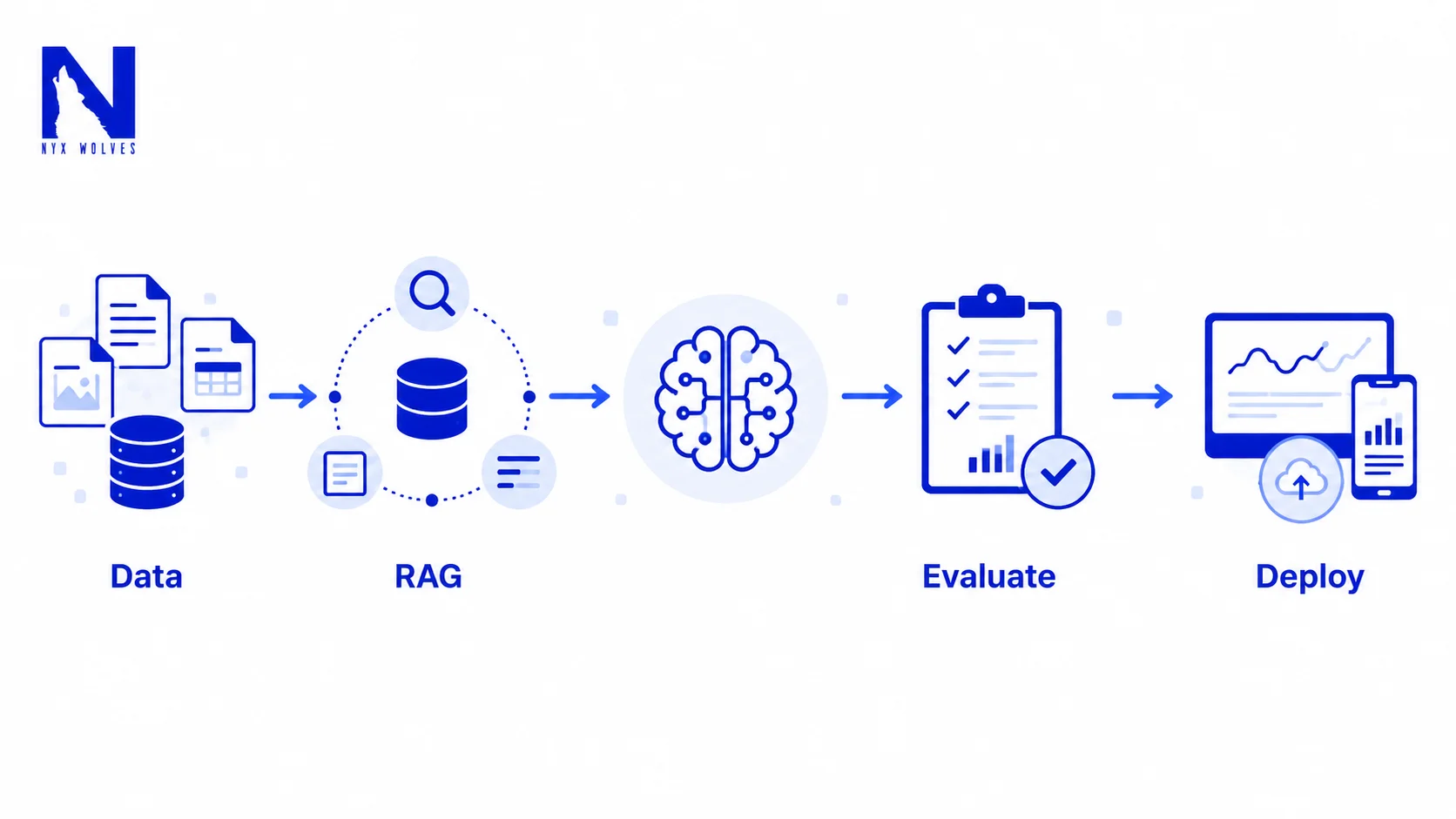
Choose the right model for the business use case
Design prompts, workflows and retrieval systems
Build RAG pipelines for company specific knowledge
Connect LLMs with APIs, databases and internal tools
Evaluate output quality with clear test cases
Reduce hallucination, latency and cost
Add safety controls, logging and monitoring
Deploy the system into production
This is why hiring an LLM engineer is different from hiring a traditional backend developer or a pure machine learning researcher. A backend developer may understand APIs and infrastructure but not model behaviour. A machine learning researcher may understand transformers but not product constraints. A strong LLM engineer bridges both worlds.
Why companies are hiring LLM engineers now
Companies are hiring LLM engineers because AI adoption has moved from “let us try a chatbot” to “how do we automate real workflows?”
The most common business use cases include:
- Internal knowledge assistants
- AI customer support agents
- Proposal and document automation
- Sales and lead qualification agents
- Compliance and policy search
- Healthcare documentation assistants
- Finance report generation
- AI coding and QA support
- Enterprise search and RAG systems
- Workflow automation using AI agents
The challenge is that these systems are easy to demo but difficult to make reliable. A basic prototype can be created in a few days. A production grade LLM system needs evaluation, guardrails, role based access, audit logs, error handling, cost controls and continuous improvement.
That is why companies need LLM engineers who are not just prompt users. They need builders.
Must have skills when hiring an LLM engineer
1. Strong programming fundamentals
The candidate should be a solid software engineer first.
They should be comfortable with:
- Python
- APIs
- Backend development
- Databases
- Git
- Docker
- Cloud deployment
- Testing and debugging
LLM projects often fail when the engineer only understands AI tools but cannot build stable software around them. Ask them to explain how they would design a simple LLM powered customer support system with authentication, document ingestion, retrieval, logging and fallback handling. A strong candidate will talk about architecture, not just prompts.
2. Understanding of LLM fundamentals
They do not need to train frontier models from scratch, but they must understand how LLMs behave.
Look for knowledge of:
- Tokens and context windows
- Temperature and sampling
- Embeddings
- Vector databases
- Prompt structure
- RAG
- Fine tuning
- Function calling
- Model limitations
- Hallucination patterns
A good LLM engineer knows when to use prompting, when to use RAG, when to fine tune and when not to use an LLM at all. Also the best AI engineers do not force AI into every problem. They know when a simple rule engine, search index or workflow automation is a better solution.
3. RAG and retrieval system experience
Retrieval Augmented Generation is one of the most practical patterns in enterprise AI. Most companies do not need a model that knows everything. They need a model that can answer accurately using their internal documents, policies, product data, tickets, contracts or knowledge base.
A strong LLM engineer should understand:
- Document chunking
- Embedding models
- Vector search
- Metadata filtering
- Hybrid search
- Reranking
- Source citations
- Retrieval evaluation
- Permission aware retrieval
- Handling stale or conflicting documents
This is one of the biggest hiring filters. Many candidates can build a basic RAG demo. Fewer can build a RAG system that respects user permissions, cites the right source, handles bad documents and improves over time.
4. Evaluation mindset
This is one of the most important skills. LLM output can sound confident even when it is wrong. So a serious LLM engineer must know how to test and measure quality.
They should be able to create:
- Golden test sets
- Prompt evaluation cases
- RAG accuracy checks
- Hallucination tests
- Safety tests
- Latency benchmarks
- Cost benchmarks
- Human review workflows
- Regression tests after prompt or model changes
A weak candidate says, “It looks good.” A strong candidate says, “Here is how we measure whether it is good.” Production LLM systems also need observability across quality, latency, token usage, errors and user feedback, which Microsoft explains well in its guide to generative AI observability.
At Nyx Wolves, this is one of the areas we check carefully when vetting AI and LLM engineering talent. We look for engineers who can ship measurable systems, not just impressive demos.
5. Security and compliance awareness
LLM systems can expose sensitive data if they are poorly designed.
A good LLM engineer should understand risks such as:
- Prompt injection
- Data leakage
- Insecure tool access
- Sensitive information in logs
- Unsafe output handling
- Model misuse
- Weak access control
- Poor auditability
This becomes even more important for healthcare, finance, government, legal, insurance and enterprise clients. The engineer should know how to design safe AI workflows with human review, role based access, audit logs, input validation and output controls. If a candidate treats security as “someone else’s job,” that is a red flag.
6. Product and business thinking
LLM engineers should not build in isolation. They need to understand the workflow, the user, the business outcome and the operational constraint.
A good candidate will ask questions like:
- Who will use this system?
- What decision does it support?
- What happens if the model is wrong?
- What level of accuracy is acceptable?
- What data can the model access?
- How will users give feedback?
- What is the cost per task?
- How will success be measured?
This is especially important for companies hiring their first LLM engineer. The first hire should not be someone who only waits for tickets. They should be able to shape the AI use case, push back on weak ideas and help the company avoid expensive mistakes.

Not sure what AI should actually do inside your business?

Green flags to look for:
Here are signs that an LLM engineer is worth serious consideration.
They talk about systems, not just models
Strong candidates do not obsess over one model name. They explain tradeoffs between models, data pipelines, retrieval, latency, cost, safety and maintainability.
They have built something beyond a demo
Look for candidates who have shipped internal tools, production APIs, RAG systems, AI agents, evaluation dashboards or automation workflows.
They can explain failures clearly
Ask them about a project that did not work. Good engineers can explain what failed, what they measured and what they changed.
They understand business constraints
The right engineer knows that the best solution is not always the most complex one. They can balance accuracy, speed, cost and delivery timeline.
They can work with non technical teams
LLM projects often involve operations, sales, support, compliance, legal and leadership teams. Communication matters.
Red flags when hiring an LLM engineer

1. They only talk in buzzwords
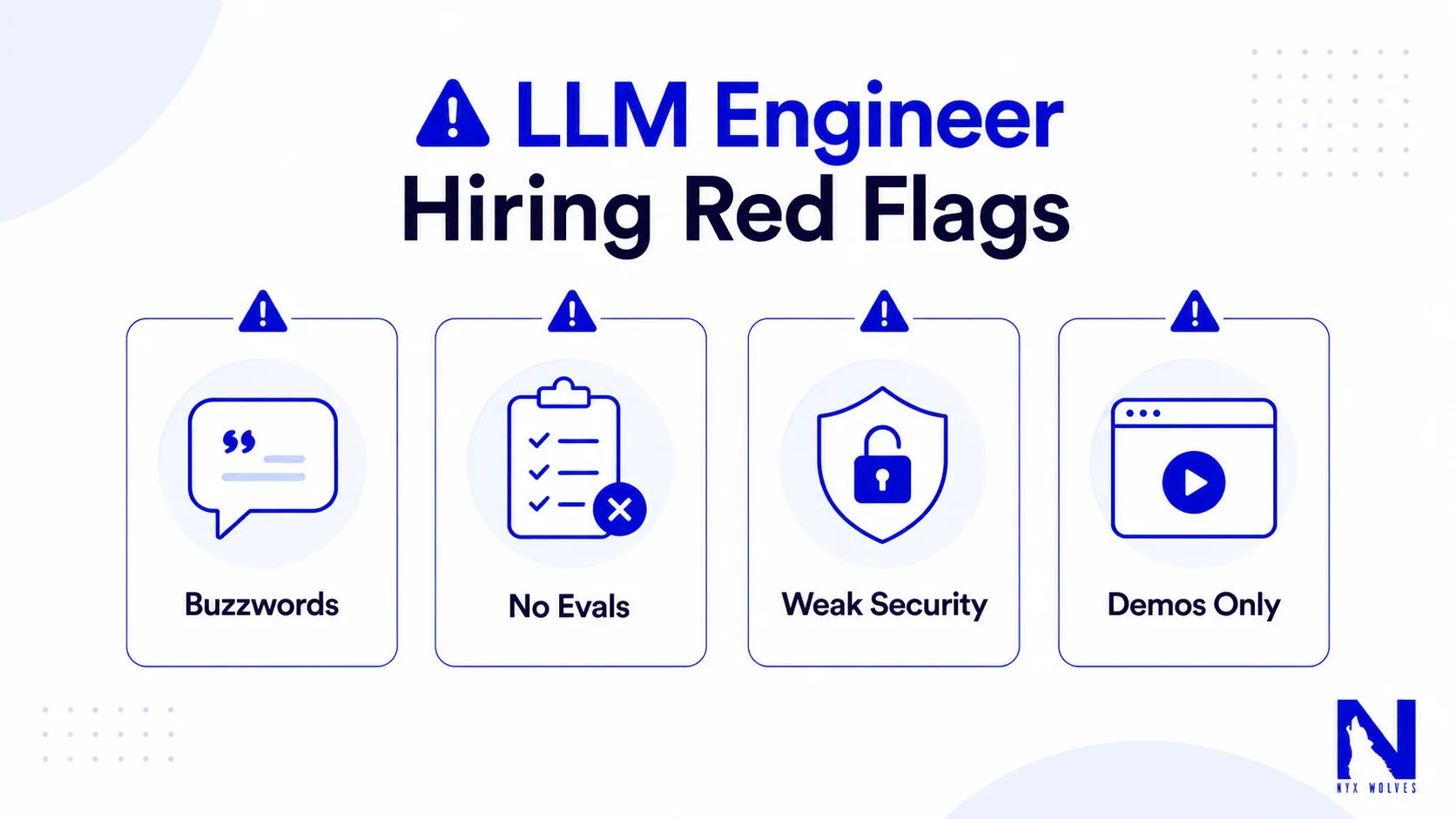
If every answer includes “agentic AI,” “autonomous workflows,” “fine tuning” and “multi agent orchestration” but no real architecture, be careful. Ask them to explain a previous system step by step. If they cannot describe data flow, failure cases and evaluation, they may not have built much.

2. They cannot explain when not to use an LLM
This is a major red flag. Some problems are better solved with rules, search, automation scripts or traditional software. A serious LLM engineer knows the difference.

3. They ignore evaluation
If the candidate says quality can be checked manually after launch, they are not ready for production work. LLM systems need structured evaluation from the beginning.

4. They have no security awareness
If they do not understand prompt injection, data exposure, access control or audit logs, they should not be building enterprise AI systems without senior supervision.
5. They overpromise accuracy
No serious LLM engineer promises perfect output. Instead, they should talk about reducing risk, creating fallback paths, adding human review and measuring performance.

6. They cannot write clean code
LLM knowledge cannot compensate for poor engineering hygiene. Look for readable code, tests, clear APIs, version control and deployment awareness.

7. They confuse fine tuning with every AI solution
Fine tuning is useful in specific cases, but many business problems are better solved with retrieval, better prompts, structured workflows or tool calling. If their answer to every problem is fine tuning, they may not understand the broader solution space.
Interview questions to ask an LLM engineer
Use these questions to separate practical builders from surface level AI users.
How would you design a RAG system for a company knowledge base?
How would you evaluate whether the answers are accurate?
When would you use fine tuning instead of RAG?
How would you reduce hallucinations in an LLM application?
How would you handle documents that contain conflicting information?
How would you control token cost in a high usage application?
How would you protect sensitive data in prompts and logs?
How would you design fallback behaviour when the model fails?
How would you monitor an LLM system after launch?
How would you test a prompt change before pushing it to production?
Give the candidate a small system design task.
Example:
“Design an internal HR policy assistant for a company with 5,000 employees. The assistant must answer questions using HR documents, cite sources, respect user permissions and escalate uncertain answers to HR.”
Ask them to reply about Architecture, Data ingestion, Retrieval strategy, Evaluation method, Security controls, Cost controls, Monitoring approach and Deployment plan. This will reveal more than a resume. What salary or engagement model should you expect? The right model depends on your hiring urgency, location and internal AI maturity.
Companies usually choose one of these options:
Full time local hire
Contract LLM engineer
Offshore LLM engineer
Dedicated AI engineering team
AI consulting plus implementation team
For many companies, the fastest route is not hiring one permanent engineer immediately. It is starting with a vetted LLM engineer or small AI delivery team that can validate the use case, build the first version and create a roadmap before scaling the internal team.
This is where Nyx Wolves help.
We support companies that need LLM engineers, AI engineers, RAG specialists, AI product builders and implementation teams across global markets. Our model is designed for companies that want practical AI delivery without spending months filtering unqualified candidates.
How Nyx Wolves helps you hire LLM engineers
Nyx Wolves helps companies build AI teams through staff augmentation, dedicated engineering teams and AI consulting support. Our approach is simple. We help you define the role properly, match the right engineer to the actual business problem and support execution beyond hiring.
Companies work with Nyx Wolves when they need:
- Pre vetted LLM engineers
- AI engineers with production experience
- RAG and GenAI application builders
- Offshore AI engineering teams
- Contract AI developers
- AI consultants who can shape the roadmap
- End to end AI implementation support
The advantage is that you do not have to guess from resumes alone. We help you identify engineers who understand real delivery: data, architecture, evaluation, security, deployment and business outcomes.
Final checklist before hiring an LLM engineer
Before making the hire, ask yourself:
- Can this person build production software?
- Do they understand LLM behaviour beyond prompts?
- Can they design and evaluate RAG systems?
- Do they understand AI safety and security?
- Can they explain tradeoffs clearly?
- Have they shipped something real?
- Can they work with product and business teams?
- Do they know how to control cost and latency?
- Can they monitor and improve the system after launch?
- Are they solving the business problem, or just using AI because it is trending?
Talk to Nyx Wolves about hiring pre-vetted LLM engineers
AI engineers and dedicated AI teams for your next AI project.
Conclusion
Hiring an LLM engineer is not about finding someone who knows the latest AI tool. It is about finding someone who can turn business problems into reliable AI systems. The best LLM engineers combine software engineering, model understanding, data quality, evaluation, security and product thinking. The wrong hire will give you demos, but the right hire will help you ship systems.
If your company is planning to build LLM powered products, internal AI assistants, RAG systems or AI automation workflows, Nyx Wolves can help you hire the right LLM engineers and build the team around them. Need LLM engineers who can actually ship?