NEW EBOOKThe enterprise playbook to getting AI pilots right — grab your complimentary copy.Check it out ›
Why enterprise AI projects and pilots fail, and
what I&O leaders can do about it
To help I&O leaders identify why AI projects are failing, and how their approach is the problem, not the technology
By Raghav S. · 7 min read
Introduction
“We are the middle children of history.” This adage rings true for the state of enterprise AI today. We’re at a time between having to build AI from the ground up, and trusting AI to get things done, end-to-end. Our generation has pioneered Generative AI powered by LLMs, yet we are also the ones plagued with unreliable or fabricated outputs, AI-led vulnerabilities and failed AI projects.
Enterprises are downsizing to reprioritize AI budgets, yet most AI rollouts are failing at scale. 52% of Fortune 500 companies reported organizational restructures that cost a staggering $49.4 billion in severance, but only 10% of these restructures are being attributed to AI costs. The truth of the matter is that there is a huge bet on the success of AI, and restructuring to support the vision. Despite this, there is a reticence to discuss this bet publicly, because the technology is unproven, unpredictable and might not succeed.
Approximately 80% of enterprise AI projects fail to deliver their promised business value due to poor data quality and organizational misalignment, according to research compiled by Gartner. Gartner predicts that over 40% of agentic AI projects will be canceled by the end of 2027. They further predict that only 28% of infrastructure and operations AI projects fully meet return-on-investment expectations, with 20% failing outright. At least 50% of GenAI projects fail to progress from the proof-of-concept stage to production.
It doesn’t have to be so, with the right approach to piloting AI.
80%
of enterprise AI projects fail to deliver their promised business value
What is leadership getting wrong?
Most leadership teams get the diagnosis backwards. They treat AI failure as a technology problem and go looking for a smarter model or a flashier vendor, when RAND’s interviews with sixty-five industry practitioners point the other way. Their research indicates that 84% of industry practitioners called leadership itself the biggest reason AI projects fail, ahead of bad data, immature tools, and anything the build team got wrong.
Which means that leadership is identifying the wrong problems, chasing the wrong metrics, and minimizing the timeline for an at-scale business wide cultural shift to that of a software patch. AI initiatives should not be treated like IT changes, which can be plugged in, tested for failure, and left idle. AI initiatives should be handled as projects with preset milestones that lie along the lifecycle of your enterprise’s collective AI maturity.
85% of knowledge workers use AI in some form, but only 29% have actually folded it into daily practice. More tellingly, 37% admit to hiding their own AI use from their managers, afraid it’ll cost them credit for the work. That’s not an adoption problem. That’s a trust problem, dressed up as one.
The state of enterprise AI initiatives is difficult to gauge right now. The pressure to adopt remains sky high, though the vision for where AI will deliver tangible value remains scarce. Treating AI as a one-stop solution for legacy processes, low IT maturity and as a replacement for your workforce is sure to backfire. Any AI initiative or technology you deploy will only be as good as the people, processes and data it is layered on top of. A weak foundation will leave your AI initiatives crumbling before they are built.
Leadership Failure
0
%
AI Usage
0
%
Daily Adoption
0
%
Layoff Regret
0
%
55% of employers who made AI-linked layoffs already regret it, and two out of three are already rehiring. That’s more than half the sample size, reconsidering within six months. This isn’t a technology bet gone wrong, but rather a leadership bet that hasn’t panned out. The stakes are too high, and outcomes are getting hit, left, right and center. The uncomfortable question isn’t whether your leadership believes in AI. It’s whether they’ve proven anything yet that justifies taking such bold calls, when results are yet to be seen.
Not layering your AI on top of your business model and context is a definite path to falling short of expectations. The costliest version of this mistake is already in the headlines: mass layoffs before the AI has proven it can do their job is a disaster. Announcing the layoff gets treated as a strategic move, while proving the AI can actually own the work gets treated as somebody else’s homework, due later.
What are IT teams getting wrong?
But this is not to say that the fault lies entirely with leadership. If leadership’s mistakes happen in the boardroom, IT’s mistakes happen at the grassroot levels. And the two don’t cancel out, they only compound.
Your engineers are shipping more AI-generated or assisted work than ever, yet trusting less of what they ship. RAND found a staggering pattern: technical teams often opt for the newest, most technically interesting tool on the market, not because the business problem demands it, but because knowing the latest tool is what gets rewarded in a hot job market. Your workforce is reaching for frontier AI models and bleeding edge technologies, because that’s what the industry rewards, and this could prove detrimental to your AI outcomes.
Then there are the foundations that nobody wants to pay for. Data pipelines, monitoring, logging, deployment infrastructure, none of these demo well in a stakeholder update, so it’s the first thing cut when a team needs to show something working, fast. It’s also the first thing that causes failure when the system meets real, messy, production-scale data instead of the clean pilot set it was built on. 87% of AI projects never make it to production for exactly this reason: poor data quality nobody budgeted the unglamorous work to fix.
Generic solutions aren’t feasible, either. Specialized systems that actually understand your fiscal definitions, vocabulary, and business logic outperform generic ones by roughly 20% on accuracy and 40% on speed, answering the same real questions. Generic ships faster. It doesn’t work better. Every enterprise that’s conflated the two has found out the hard way during production, and in front of the business unit that trusted it. But specialized AI systems need long term prompting, honing and a feedback loop that helps improve their results. This is not factored in, since leadership is breathing down on your IT teams’ necks to deliver. Simply put, they neither have the time, or the budget.
And once it’s live, most IT teams stop watching. Go-live gets treated as the finish line instead of the starting line. The definitions that a model was built on keep changing after launch, meanwhile, the compliance checks that existed for the pilot rarely survive the handoff to whoever inherits it. No AI model tells us it’s gone stale. It just keeps answering confidently, wrong, until someone downstream notices the damage.
So where do we go from here?
None of this is a case against AI. It’s a case against the way AI is being built into the modern AI-ready enterprise. We’re rapidly implementing AI without the right approach and then acting surprised when the foundation gives out. Get the order right, and the technical parts of the implementation goes from being the riskiest, to the easiest part of your AI projects.
Get started on these five concrete steps to ensure success in your AI initiatives:
01
Unify your workflows by interconnecting your IT toolset:
Scale AI maturity with varying degrees of capability, spanning APIs, MCP and iPaaS
02
Centralize & distribute data to your AI systems:
Build a data foundation layer beneath your AI stack to ensure your assistance is grounded in business context
03
Align your AI and your workforce architecturally:
Make AI adoption natural for your workforce and reduce friction for an easier path to realizing value
04
Governance as a proactive best practice:
The race to adopt AI leaves caution in the wind. Prioritize accountability from the get-go to avoid remediation costs
05
Evaluate outcomes as KPIs, not numbers:
Conflating data and KPIs has become the norm. But when it comes to AI, your tangible outcomes matter more than statistics.
We’ll break these pointers down into in-depth actionable approaches in our latest ebook. We’ve compiled everything you’ll need to set up your AI pilots for success, from our decade of experience in the field. Grab your complimentary copy to learn more about how you can:
Build a data driven approach to enterprise AI projects by leaning on data from leading analysts and industry researchers
Take away learnings from their findings and avoid the blackhole of AI investments that yield no results, or unimpressive value
Avoid the mistakes that most enterprises have made, and learn what they got right
Learn how you can tailor your AI projects and solutions to your businesses unique requirements
FREE EBOOK
The enterprise playbook to getting AI pilots right
Here's your free copy
If your download doesn't start automatically, please click here.
A copy of the ebook has also been dispatched to your inbox.
FROM THE BLOG: AI PILOT FAIL
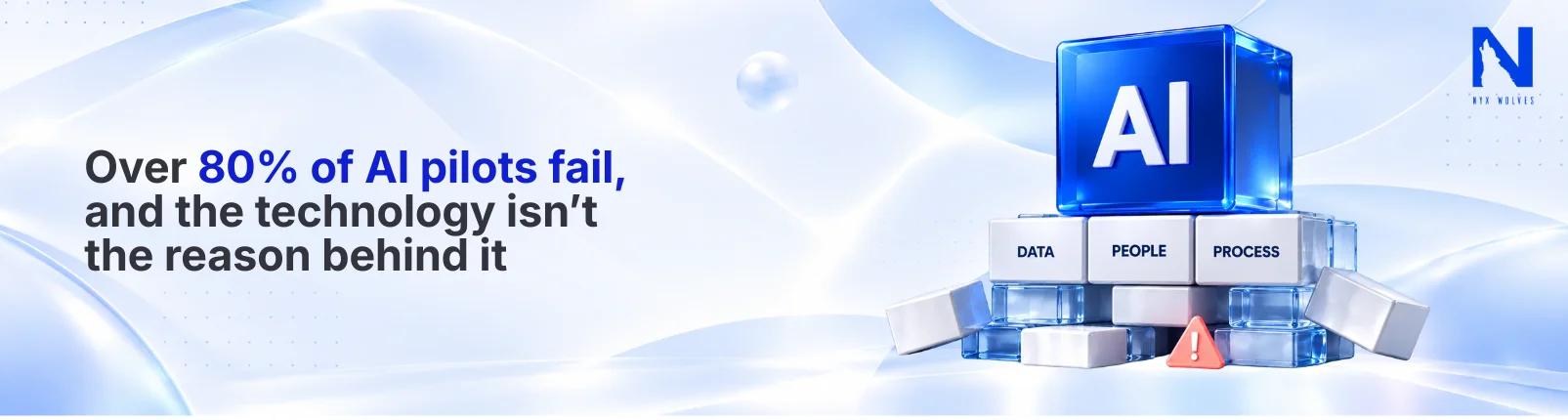
Over 80% of AI pilots fail, and the technology isn’t the reason behind it
Be it AI projects, bespoke solutions, or staffing, we’ve got you covered.
6%
McKinsey’s most recent survey on the state of AI found that 6% of organizations qualify as true AI high performers.
These businesses are
- Thrice as likely to have fundamentally redesigned their workflows around AI
- Thrice as likely to have senior leadership directly committed to the effort, past the pilot
- Thrice as likely to be scaling AI agents across the business, rather than in silos across functions and business teams
FREE EBOOK
The enterprise playbook to getting AI pilots right
Here's your free copy
If your download doesn't start automatically, please click here.
A copy of the ebook has also been dispatched to your inbox.
Are you looking for AI solutions for your organization?
Be it AI projects, bespoke solutions, or staffing, we’ve got you covered.