How to Build a Successful Offshore Development Team in Portugal: Structure, Management & Common Pitfalls
Introduction
You’ve decided to build an offshore development team. You’re not hiring a single contractor, you’re committing to a 12–24 month partnership with a distributed group of engineers who’ll own critical product features, integrate with your existing team, and scale as you grow.
Building an offshore development team in Portugal is fundamentally different from hiring a freelancer. It requires intentionality around structure, communication norms, skill composition, and cultural integration. Done right, an offshore team in Portugal becomes a force multiplier. Done wrong, it becomes a bottleneck that is expensive, difficult to manage, and rarely delivers at the speed you need.
This guide walks through exactly how to structure, hire, and scale an offshore development team in Portugal without the common failures that plague distributed engineering organizations.

Why Portugal for Offshore Development Teams?
Before diving into structure, let’s be clear about why Portugal has become a preferred hub for building managed offshore teams.
1. Cost Efficiency at Scale
A 5-person offshore team in Portugal costs approximately $18,000 to $28,000/month all-in (including management overhead, benefits, workspace). The same team in the US or Western Europe costs $55,000–$85,000/month. That's not just 30% savings, it's strategic capital you redeploy into product, marketing, or additional headcount.
2. Team Stability Over Freelance Flux
Unlike marketplace hiring, teams in Portugal have lower churn. You're not managing a rotating door of contractors. The developers stay, learn your codebase, and build institutional knowledge. Retention rates consistently hit 85–90% over 18+ months.
3. Timezone Overlap (Or Planned Asynchronous Work)
Depending on your headquarters, Portugal offers real-time collaboration windows with either Europe or Asia, and asynchronous handoff windows with North America. This beats the 12+ hour gaps that plague pure offshore models.
4. Emerging Enterprise Maturity
Portugal is no longer "budget offshore." Major enterprises in energy, finance, and government now have dedicated teams here. This professionalization means practices around code standards, documentation, and process are legitimately world-class.
The Right Team Structure: From Startup to Scale
There’s no one-size-fits-all offshore team. Structure depends on your product stage, engineering maturity, and what problems you’re solving.
Best for: Early-stage startups (Series A–B), specific product initiatives, landing new geographies
Composition:
- 1 Senior engineer (architect/tech lead)
- 2–3 Mid-level engineers
- 1 QA engineer (part-time, shared)
Setup time: 6–8 weeks
Monthly cost: $18,000–$24,000
Output: 1 major feature per quarter + bug fixes + technical debt
Why this works: Small enough to onboard quickly, large enough to own meaningful work. The senior engineer becomes your bridge to your HQ team; the mids do the bulk of shipping.
Common failure: Underestimating the senior engineer’s load. They end up spending 40% of time in sync calls and code reviews, 60% coding. Real output slips.
Best for: Companies scaling to $10M+ ARR, multiple concurrent features, autonomous execution
Composition:
- 1 Tech Lead / Architect (6+ years)
- 2–3 Backend engineers (mid-level)
- 2 Frontend engineers (mid-level)
- 1 DevOps / Infrastructure engineer
- 1 QA engineer (full-time)
Setup time: 10–12 weeks
Monthly cost: $28,000–$40,000
Output: 2–3 major features per quarter + infrastructure improvements + test automation
Why this works: Near-complete autonomy. They own features soup-to-nuts: design, backend, frontend, testing, deployment. Your HQ team focuses on strategy; offshore team focuses on execution.
Common failure: Lack of clear product direction. Without a sharp PRD and roadmap, offshore teams default to asking questions constantly. Async communication fails. Ensure weekly async updates and monthly strategy syncs.
Best for: Mature products with stable roadmaps, high support burden, reactive hiring needs
Composition:
- 1 Senior engineer (incident response + mentorship)
- 1–2 Mid-level engineers (feature work + support)
- 1 Part-time QA or DevOps engineer
Setup time: 4–6 weeks
Monthly cost: $12,000–$18,000
Output: Bug fixes + small features + technical debt reduction + production incident handling
Why this works: Lower investment, immediate value. Excellent entry point if you’ve never hired offshore before.
Common failure: Treating support work as “leftovers.” Offshore teams sense low priority and disengage. Be explicit: support work is critical, valued, and career-advancing.
Hiring the Right Mix: Avoiding Top-Heavy or Junior-Heavy Teams
The single biggest failure mode is team composition: too many juniors, not enough senior guidance; or too many seniors fighting for leadership, not enough doers.
The 30-50-20 Rule:
30% Senior/Lead engineers (5+ years)
Architecture, mentorship, HQ communication
50% Mid-level engineers (2–5 years)
Core shipping, feature ownership, some mentorship
20% Juniors or Specialists (0–2 years or deep expertise)
Execution, support, skill-building
This ratio ensures
- You have architectural thinking + mentorship capacity
- You're not overpaying for execution roles
- Juniors have role models and growth paths
Hiring timeline for a 5-person team
- Week 1–2: Define roles, write JDs, source candidates
- Week 3–4: Screen 40+ résumés, phone interviews with top 10–12
- Week 5–6: Technical assessments and code reviews (paid, 3–4 hours each)
- Week 7: Reference checks + offer decisions
- Week 8: Onboarding begins

Build Your Offshore Team the Right Way

Onboarding Timeline: How we Build Productivity in the First 12 Weeks
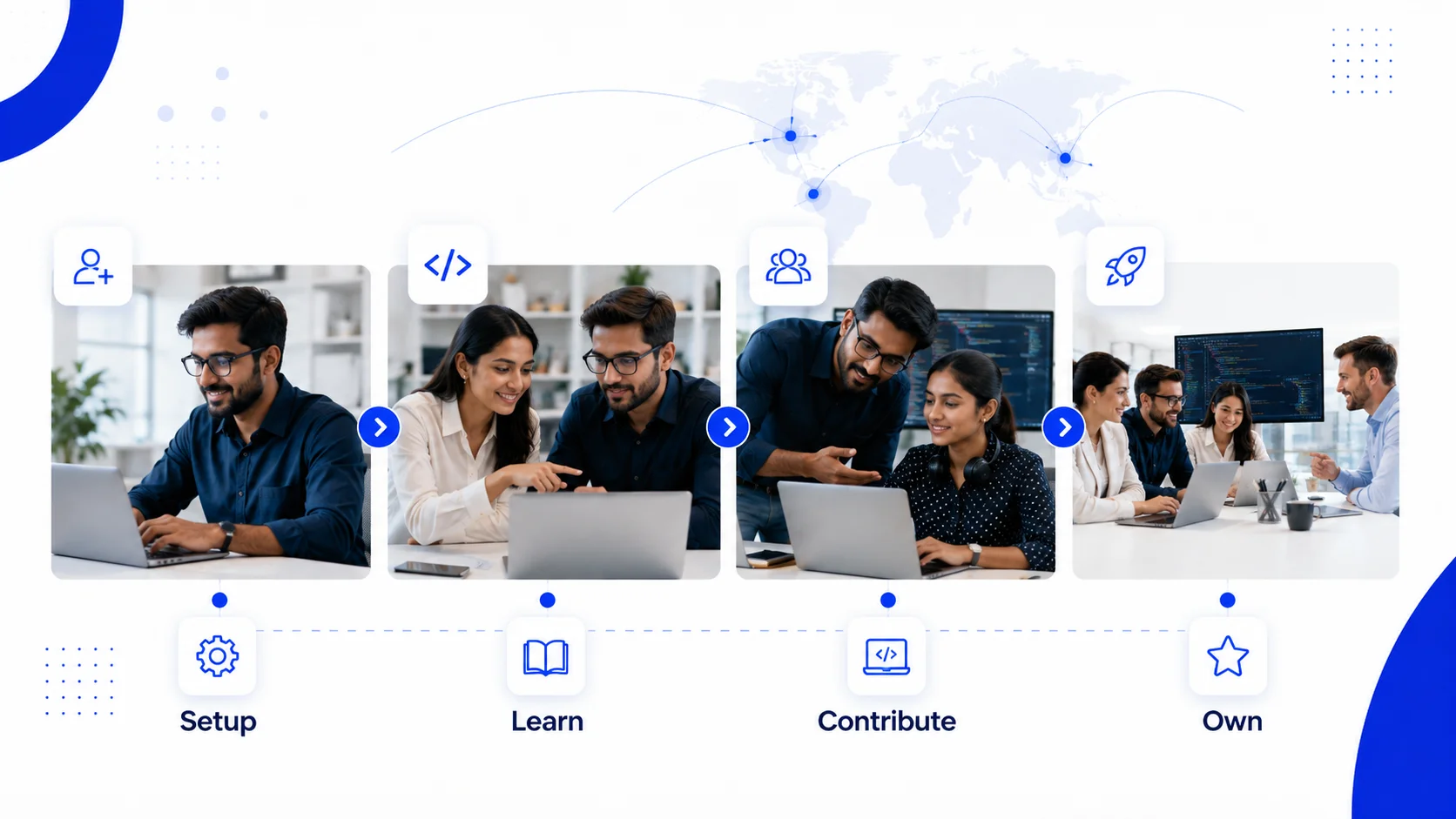
A strong offshore team does not become productive on day one. The first 12 weeks decide whether the team becomes a reliable delivery unit or a disconnected group waiting for instructions. Good onboarding gives engineers context, confidence, and ownership early.
| Timeline | Focus Area | Key Actions | Expected Outcome |
|---|---|---|---|
| Week 1 | Foundations | Set up credentials, tools, workspace, hardware, and access. Introduce the company, product, engineering culture, and delivery expectations. Run codebase walkthroughs and pair programming sessions with the HQ senior engineer. | Engineers understand the product, tools, workflows, and technical environment. |
| Days 1–3 | Setup & Orientation | Complete access setup, workspace readiness, company overview, product walkthroughs, and engineering process introduction. | The team is ready to start contributing without access or context blockers. |
| Days 4–5 | Codebase Deep Dive | Walk through architecture, repositories, deployment flow, coding standards, and current sprint priorities. Include 4–6 hours of pair programming with the HQ team. | Engineers understand how the codebase works and how decisions are made. |
| Weeks 2–4 | Ramp to Contribution | Assign a well-scoped medium-difficulty task such as a feature enhancement or refactor. Run daily 15-minute standups, conduct 2 weekly 1:1s with the tech lead, and review every PR in detail. | Engineers begin shipping real work while learning standards through feedback. |
| Weeks 5–8 | Building Autonomy | Increase task complexity, reduce standups to 3 times per week, introduce weekly async updates, and let mid-level engineers mentor juniors. | The team starts solving problems independently and communicating blockers clearly. |
| Weeks 9–12 | Full Contribution | Give ownership of full features from design to development, testing, and deployment. Include the offshore team in architecture discussions and decision-making. | The team becomes capable of owning meaningful product work with reduced handholding. |
| End of Week 12 | Performance Review | Assess shipping speed, communication quality, technical independence, cultural fit, and ability to work with the HQ team. | Leadership gets a clear view of whether the offshore team is ready for long-term scale. |
| Investment | Why It Matters |
|---|---|
| Pair Programming | At least 40 hours across the first 8 weeks helps offshore engineers understand coding patterns, architecture decisions, and team expectations faster. |
| Documentation | Every engineer should write one internal wiki article about what they learned. This improves knowledge sharing and reduces dependency on one person. |
| Code Review | Every PR should be reviewed by the HQ team in the early phase. The goal is not just approval, but education and alignment. |
| Product Context Sync | A weekly 30-minute session on roadmap, customer feedback, and business goals helps engineers understand why they are building, not just what they are building. |
The goal of onboarding is not just to make offshore engineers familiar with the codebase. It is to turn them into product-aware contributors who can own outcomes, communicate clearly, and deliver with confidence.
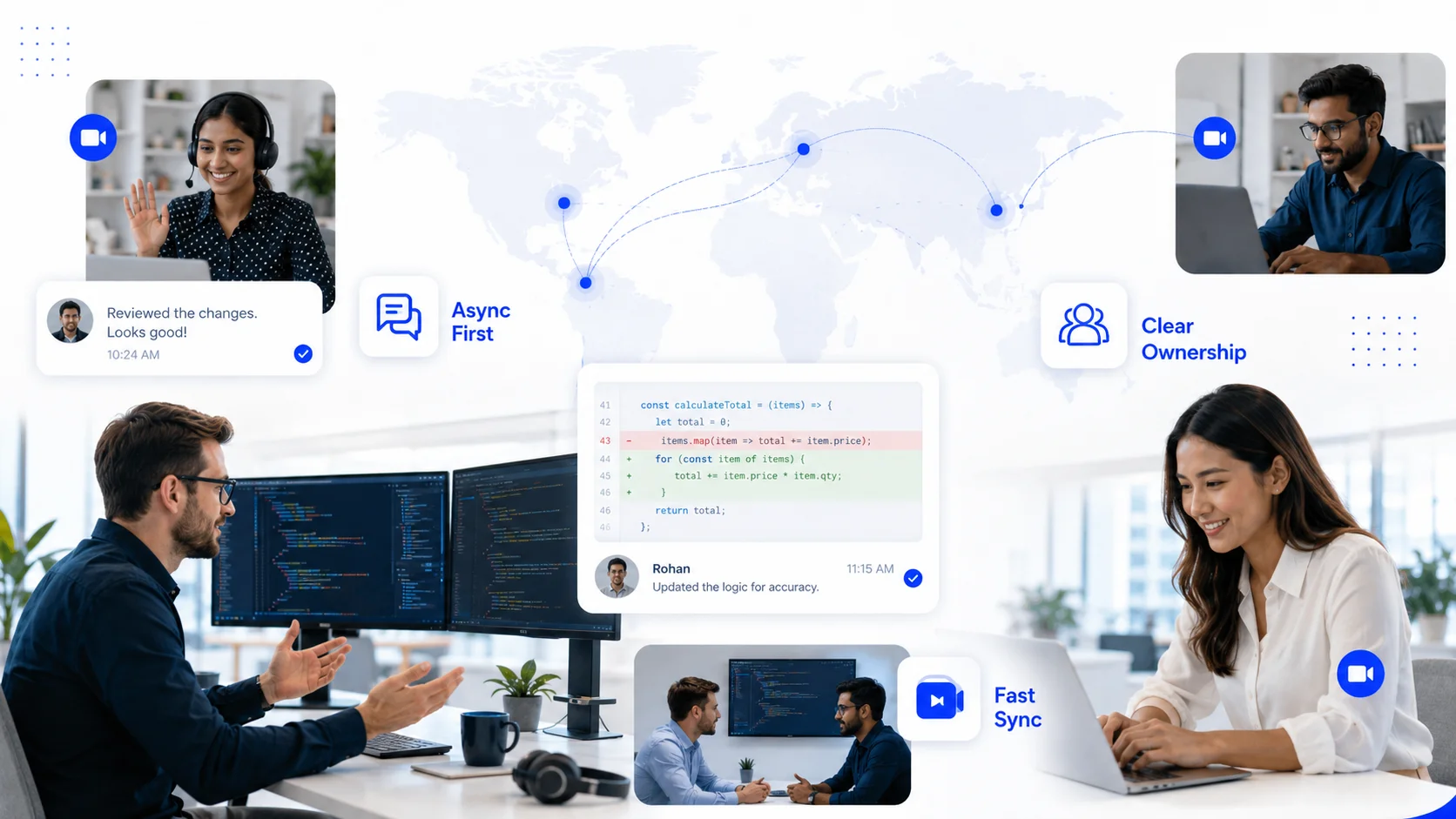
Communication & Coordination: Async First, Sync When Necessary
This is where offshore teams either thrive or die.
An async-first communication model helps offshore teams move faster without depending on constant meetings. Every key decision should be documented in Slack threads, Confluence pages, or shared project notes so the full team can refer back to the context later. Pull requests should be reviewed within a clear response window, ideally within four hours, instead of waiting for the same day or the next morning.
Architecture discussions should begin as written RFCs, allowing engineers to think through trade-offs before jumping into real-time debate. When a developer is blocked, the escalation should be quick and practical: move to a focused 15-minute call, resolve the issue, and return to async execution instead of waiting for the next scheduled meeting.
- Daily stand-up (15 min): 3x/week only after ramp; format: what shipped, what’s next, blockers
- Weekly tech sync (30 min): Deep-dive on one architecture decision or technical challenge
- Monthly strategy sync (60 min): Product roadmap, quarterly priorities, team feedback
- Slack: Daily communication, quick questions, pair programming coordination
- Confluence: Architectural decisions, onboarding docs, post-mortems
- GitHub: PR reviews, code comments, clear commit messages (they’re documentation for async readers)
- Figma / Miro: Whiteboarding architectural decisions (better than Zoom sketching)
- Loom: Record 5-min video walkthroughs instead of 30-min calls
Every call is a chance for managers to feel in control. But every hour in meetings is an hour not shipping. Offshore teams especially suffer if you over-sync. Aim for 3–5 hours of meetings per week per engineer (including standups, pair programming, code review calls).
Common Pitfalls That Destroy Offshore Teams
Pitfall #1: Lack of Clear Ownership
Lack of clear ownership is one of the biggest reasons offshore teams slow down. If every decision needs HQ approval, engineers lose confidence and start waiting instead of moving. The better approach is to give them full responsibility to design, build, test, and deploy features.
Pitfall #2: Treating Offshore as Cost Center, Not Product Team
Treating offshore teams as a cost center creates weak ownership and poor motivation. If they only receive low-value or leftover work, they will never feel like part of the core product team. Give them important features to own so accountability, delivery quality, and engagement improve.
Pitfall #3: Weak Tech Lead
A weak tech lead can damage the entire offshore team. The lead must be strong in architecture, mentoring, and communication with HQ. A strong tech lead prevents confusion, reduces delays, and helps the team make better technical decisions.
Pitfall #4: No Transition Plan for Departures
Not having a transition plan creates serious delivery risk. Team members may leave, so important knowledge should never stay with one person. Document architecture decisions, code patterns, and project learnings from the start to keep delivery stable.
Pitfall #5: Unlimited Growth Without Scaling Management
Scaling without management support quickly creates leadership gaps. One tech lead may be enough for 3 engineers, but a team of 7 needs more structure. Add a second lead once the team crosses 5 engineers so reviews, mentoring, and delivery stay smooth.

Measuring Success: KPIs for Offshore Development Teams
With Nyx Wolves, companies in Portugal get support across three critical decisions:

Shipping and Quality
Track whether the team is delivering features on time, within scope, and with a low bug rate. Also measure code review speed, test coverage, and incident response time.

Team Health
Track retention, engagement, promotion rate, and onboarding time. A healthy offshore team should stay stable, motivated, and productive over time.

Business Impact
Track revenue from shipped features, customer satisfaction, cost per feature, and speed from idea to production. This shows whether the offshore team is creating real business value.

Final Goal
Do not measure only activity. Measure outcomes, quality, stability, and business impact.
Building vs. Outsourcing: When to Use a Managed Team
Build your own offshore team when
- You have 5+ engineering roles to fill
- You have dedicated HQ leadership bandwidth to manage the team
- You're building for 12+ months (break-even point)
- Your product roadmap is clear for 6+ months
Outsource to an agency when
- You need <3 engineers
- You have undefined scope or frequently changing priorities
- You can't commit HQ leadership bandwidth
- You're building a one-off feature or MVP
Nyx Wolves specializes in both: we can help you hire and structure your own team (lower cost long-term, requires HQ involvement) or we can manage a dedicated team on your behalf (higher cost, zero HQ overhead).
Timeline: From Decision to Shipping (12 Weeks)
Weeks 1–2
Hiring process (sourcing, screening, technical assessments)
Weeks 3–4
Offer, negotiation, visa/onboarding logistics
Weeks 5–8
Intensive onboarding (pair programming, codebase deep-dives, first features)
Weeks 9–12
Ramp to autonomy, team gels, first shipped feature
Expected output by week 12
A functional offshore team, 1–2 features shipped, foundational knowledge established.
Building an offshore development team in Portugal
One of the highest-ROI hires a scaling company can make. But it requires thoughtfulness, that is, clear structure, strong leadership, and intentional integration.
To discuss your team structure, timeline, and hiring needs. We’ll give you a realistic roadmap and recommended team composition for your stage.
Key Takeaways
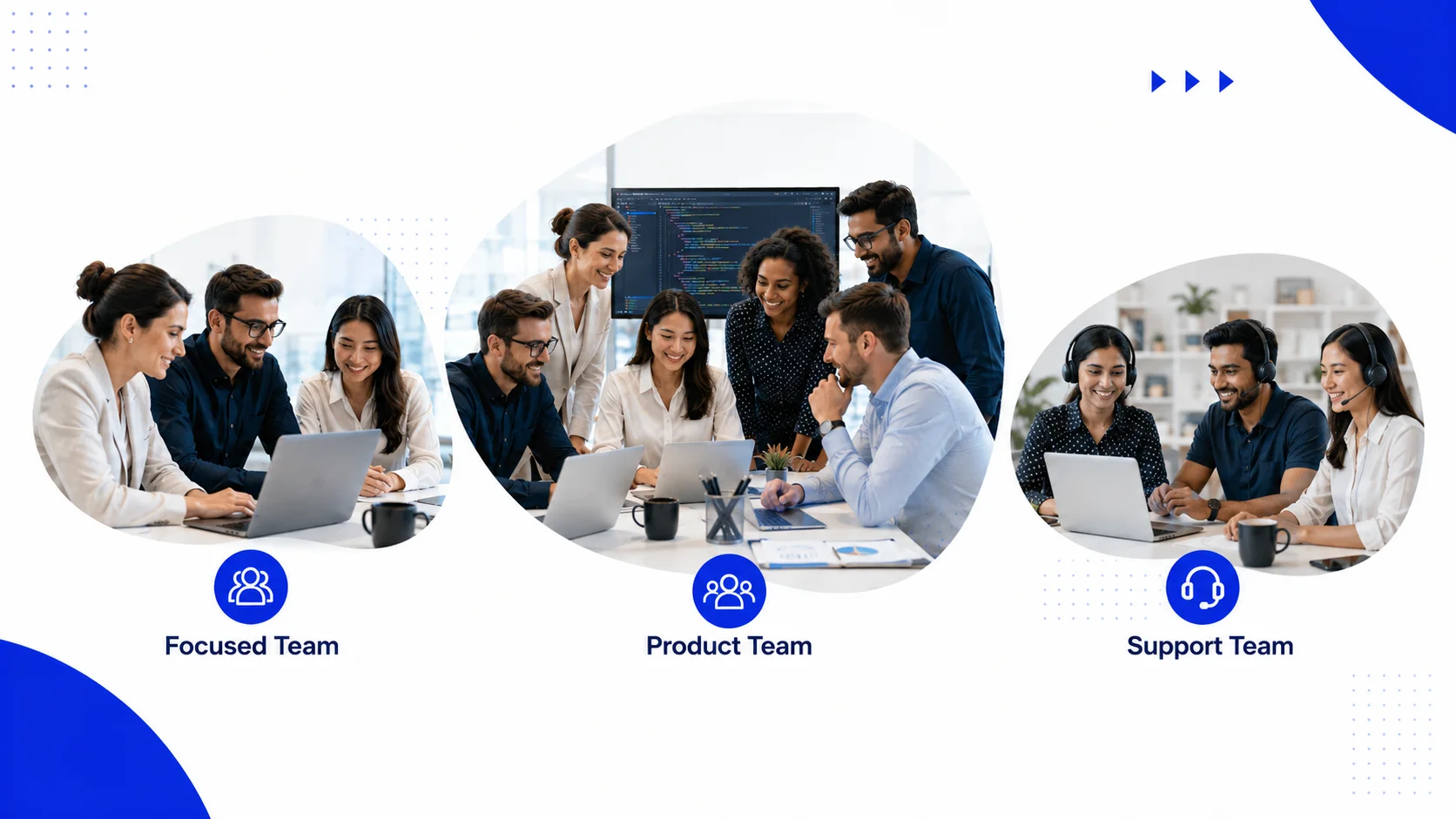
- Three models: Focused feature team (3–5), full-stack product team (5–8), dedicated support team (2–4)
- Hire with the 30-50-20 rule: seniors, mids, juniors in balance
- Onboarding takes 12 weeks (don't skip it)
- Async-first communication > sync-heavy management
- Clear ownership and treating offshore as a product team (not cost center) changes everything
- Measure shipping + quality + team health, not just velocity
- Break-even point: 12–18 months; full value realization: 24+ months
The best offshore teams don’t feel “offshore”, they feel like an extension of your HQ engineering organization. That’s the goal.
FAQs
The ideal size depends on the stage of your product. A 3 to 5 member team works well for focused feature delivery, while a 5 to 8 member team is better when you need full-stack product ownership.
A small offshore team can cost around $18,000 to $28,000 per month, depending on seniority, location, management support, and team structure. The final cost also depends on whether you need frontend, backend, QA, DevOps, or tech leadership.
An offshore team is ready when it can understand product goals, ship features with fewer blockers, communicate clearly, and participate in technical decisions. This usually happens after a structured 8 to 12 week onboarding period.
The biggest mistake is treating the offshore team like a low-cost task force instead of a real product team. Offshore engineers perform better when they own meaningful features, understand the roadmap, and are trusted with delivery responsibility.
Choose a managed offshore team when you need faster setup, vetted engineers, structured onboarding, and less internal management burden. Build your own team only if you have long-term hiring needs and enough leadership bandwidth to manage the team directly.
Partner with Nyx Wolves
As an experienced provider of AI and IoT software solutions, Nyx Wolves is committed to driving your digital transformation journey.
Your benefits:
- Client-oriented
- Independent
- Competent
- Results-driven
- Problem-solving
- Transparent
What happens next?
We Schedule a call at your convenience
We do a discovery and consulting meeting
We prepare a proposal
Schedule a Free Consultation
See Our Case Studies
AI-powered job matching platform
PerpectV AI-Powered Job Matching Platform for Leading South African
No-code web based AR Platform
Revolutionizing Online Product Showcase with No-Code WebAR Xarwin is

Case Study – Ecostay
Srivalli Ecostays offers a unique hospitality experience, allowing guests