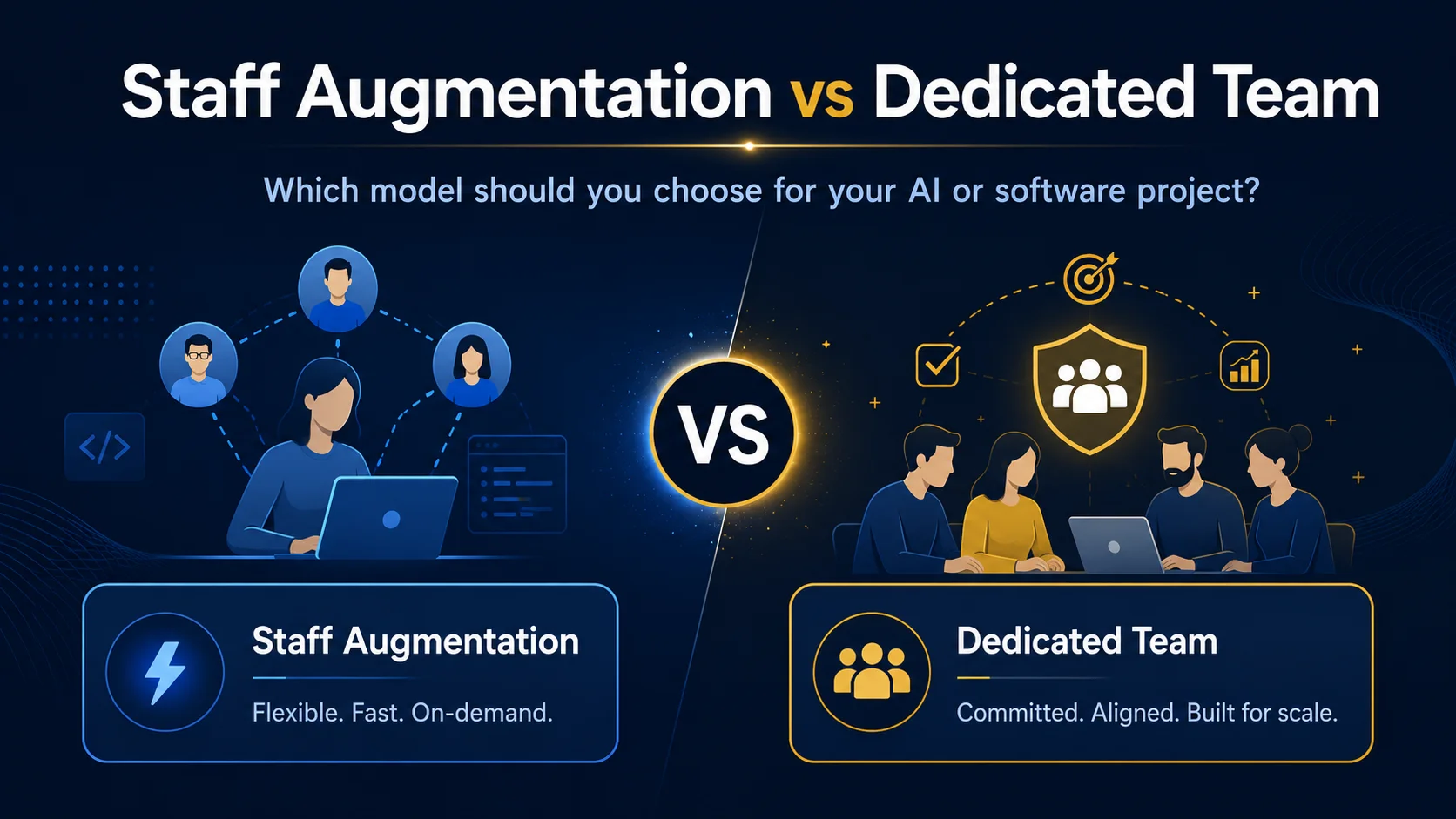
Staff Augmentation vs Dedicated Team
You’re three months into a critical software project. Your in-house team is stretched thin. Your CTO can see the deadline slipping. You have two options on the table: bring in contractors to fill the gaps quickly, or commit to building a dedicated offshore team. One keeps you flexible. The other gives you committed capacity. One costs less upfront. The other scales more predictably. Which do you choose?
The truth is: there’s no one-size-fits-all answer. But there’s a right answer for your situation. This guide breaks down staff augmentation and dedicated teams side-by-side with the real trade-offs, hidden costs, and decision framework used by engineering leaders at scale-ups and enterprises across MENA, Europe, and North America.
What's the Difference? (And Why It Matters More Than You Think)
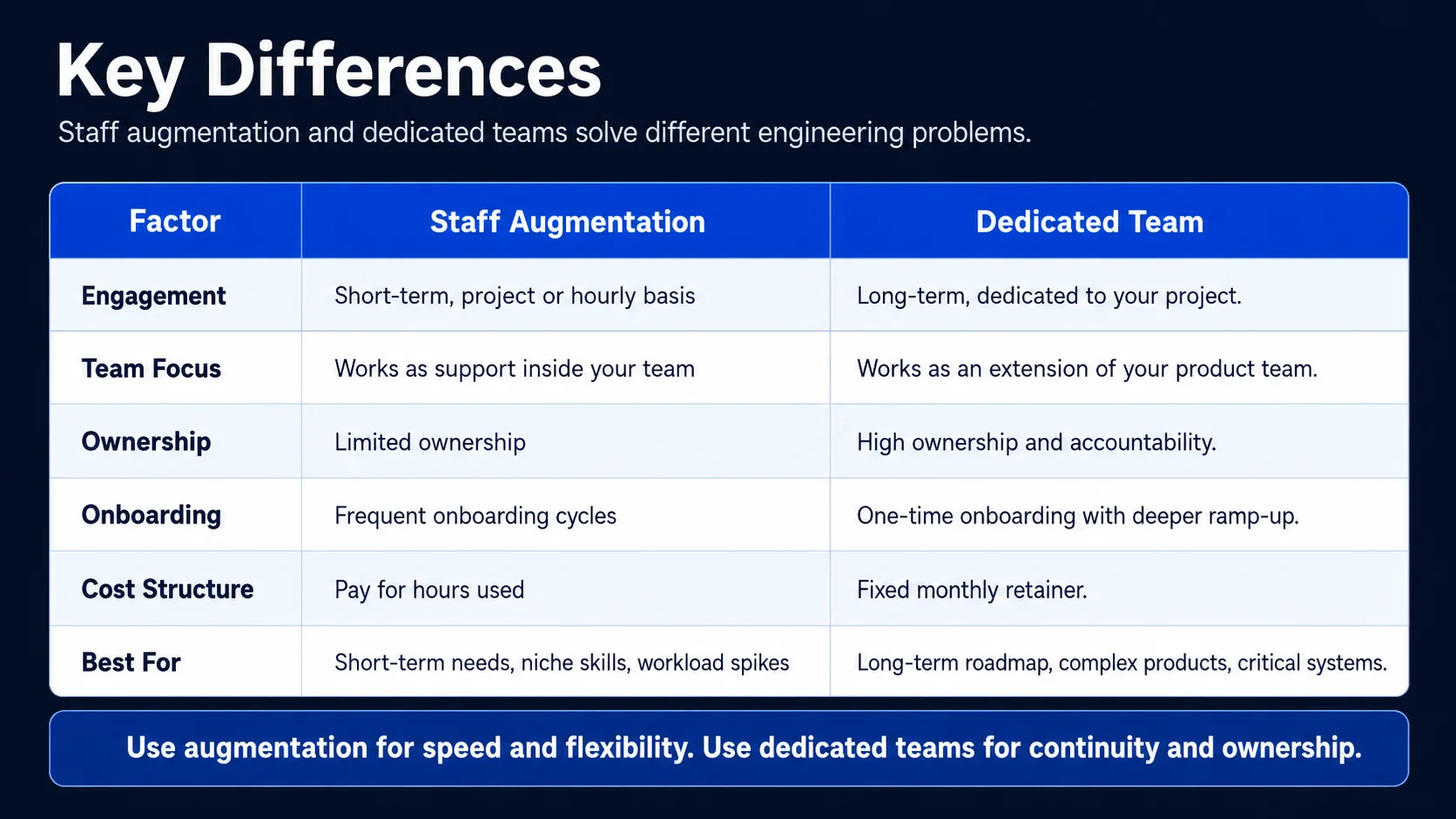
Staff augmentation is simple: you hire contractors, freelancers, or augmented staff on a project or hourly basis. They plug into your team. You pay for hours worked. They leave when the work is done. Think of them as force multipliers (fast, flexible, and temporary).
A dedicated team is the opposite: you commit to a team that works exclusively for you (or primarily for you) over months or years. They’re not shared with other clients. They sit in your standup. They own code modules. They stay through release cycles. Think of them as an extension of your payroll minus the employment overhead.
The distinction matters because it shapes everything downstream: how you architect work, build culture, manage risk, and ultimately how much you’ll spend.
When Staff Augmentation Wins: The Flexibility Play
Staff augmentation is your move when you need to solve right now and don’t know if you need it forever.
Best use cases:

Emergency scaling
A feature takes longer than expected. You need five more backend engineers for eight weeks. Augmentation is faster to mobilize than hiring or building a team.

Niche expertise you'll use once
You need someone who's shipped AI data pipelines in Kubernetes or has deep Azure FinOps experience but only for a three-month engagement. Hiring them permanently wastes money.

Validating an idea before committing
You're not sure if an offshore centre of excellence makes sense yet. Augment with a few people, learn the workflow, then scale up if it works.

Filling a specific gap in the team
Your QA lead is on parental leave. You need three QA engineers fast. Augment. Don't hire.
Seasonal or project-based load
Your product has spiky demand—say, year-end financial software. You augment hard in Q4, dial down in Q1.
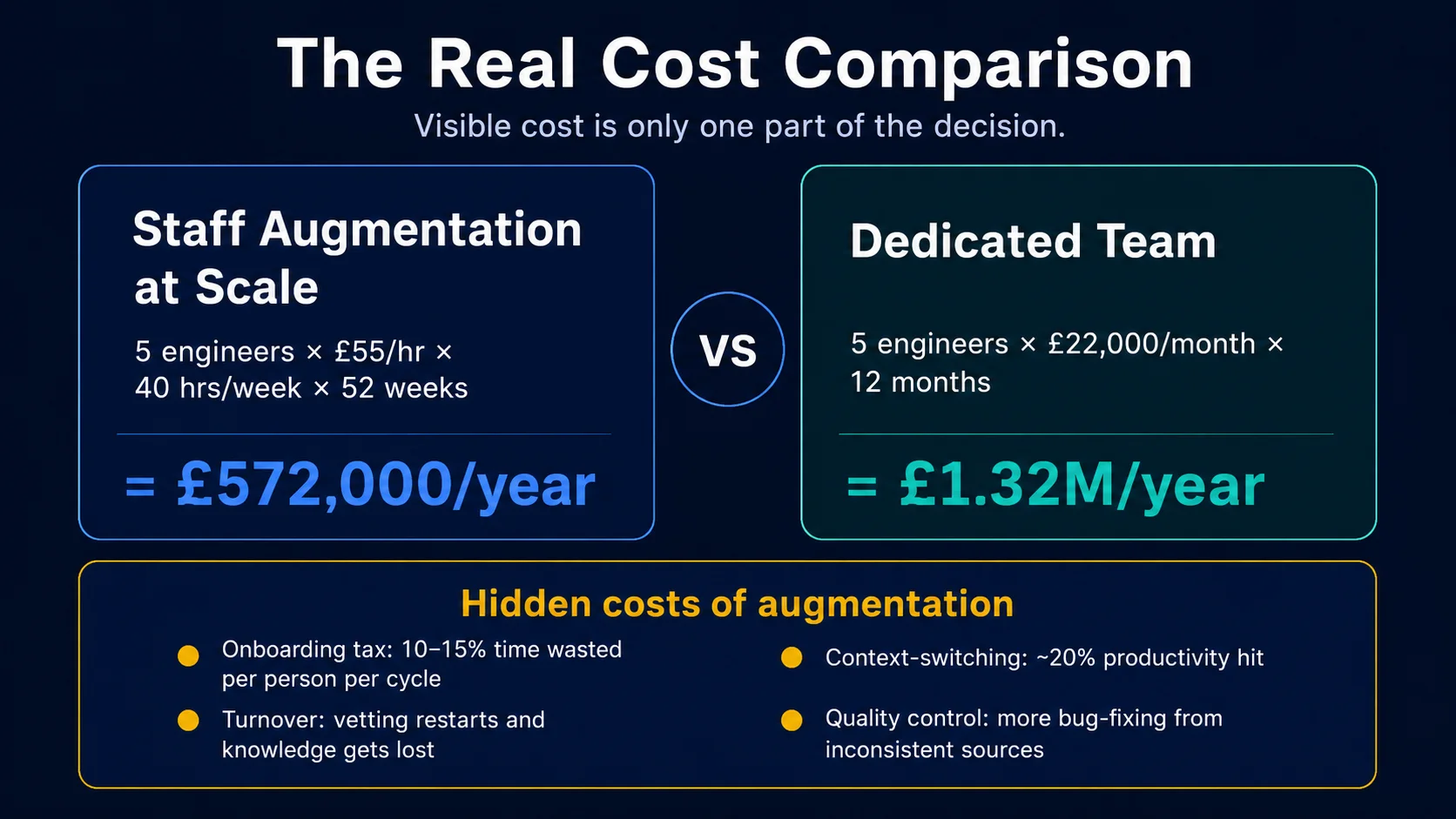
The real cost of augmentation
| Cost Factor | Staff Augmentation |
|---|---|
| Billing Model | Hourly or monthly billing |
| Typical Developer Cost | £40–80/hr for skilled developers in MENA/EU |
| US Developer Cost | £60–120/hr |
| Ramp-up Cost | Lower upfront ramp-up cost |
| Mobilization Time | Faster to mobilize, usually 1–2 weeks |
| Compared to Hiring | Avoids 6–8 weeks of traditional hiring |
| Commitment | Zero long-term commitment |
| Payment Flexibility | Pay only for the hours used |
The catch
- Onboarding overhead every cycle. Each person needs 2–4 weeks to be productive.
- Context switching kills velocity. If you swap people in and out, nobody owns the big picture.
- Morale impact. Your core team may feel like they're managing contractors rather than building.
- Quality variance. You get what you vet for; if your vetting is weak, you'll know it fast.
When Dedicated Teams Shine: The Ownership Model
A dedicated team is your play when you have sustained work and want continuity, accountability, and deep product understanding.
Best use cases:
12+ month roadmap
You have committed work for the next year. A dedicated team justifies the investment because ramp-up pays off in velocity month 4 onwards.
Building a geographic expansion hub
Nyx Wolves works with companies building engineering centres in Riyadh, Dubai, or Berlin. A dedicated team makes sense because you're investing in infrastructure, process, and talent density.
Scaling an established product
Your SaaS product needs more engineers, but you want them to understand your codebase, architecture, and user base deeply. Dedicated team = better code, fewer architectural misunderstandings.
Mission-critical systems
You're building a backend that handles £10M+ in transactions daily. You want the same people debugging it at 3 AM. A dedicated team owns it.
AI/ML projects requiring deep iteration
Building an LLM-powered feature? You need continuity. Model training , fine-tuning, and evals are iterative. Swapping people breaks momentum.
The real cost of a dedicated team
| Cost Factor | Dedicated Team |
|---|---|
| Billing Model | Monthly retainer |
| Typical Team Cost | £15,000–35,000/month for a 3–5 person team in MENA/EU |
| Team Structure | Fully managed team, not just headcount |
| Upfront Setup Time | 4–6 weeks for team composition, hiring, and onboarding |
| Break-even Period | Longer break-even period due to ramp-up time |
| Initial Cost Impact | You may overpay for the first 8 weeks while the team ramps up |
| Commitment Level | Higher long-term commitment |
| Responsibility | You are responsible for the team’s stability and growth |
The upside
- By month 4, velocity per pound/dollar spent exceeds augmentation (because you're not perpetually onboarding).
- Ownership culture: The team cares about the product because they're not juggling five clients.
- Institutional knowledge: They know your codebase, your customers, your bugs.
- Mentorship flows: Your senior engineers coach the team. Relationships deepen.
- Scalability. You add one more person at marginal cost, not ramp-up cost.

Ready to Choose the Right Team Model?

Why Choose Nyx Wolves?
Nyx Wolves helps companies choose the right engineering model based on their roadmap, product complexity, budget, and delivery goals. Whether you need short-term specialists, a dedicated offshore team, or a hybrid model, we help structure the right setup for your AI or software project.
With experience across AI/ML, SaaS platforms, enterprise software, automation, computer vision, cloud applications, and scalable product engineering, we do not just provide developers. We help reduce onboarding friction, improve delivery continuity, and build a team model that fits your stage of growth before the wrong structure becomes expensive.
The Economics: When Does Dedicated Actually Cost Less?
This is where most companies get it wrong. They assume augmentation is cheaper. Sometimes it is. Often, it’s not.
- 5 engineers × £55/hr × 40 hrs/week × 52 weeks = £572,000/year
- Assumes zero onboarding waste, zero context-switching tax. (Unrealistic.)
- 5 engineers × £22,000/month × 12 months = £1.32M/year
- Includes management, recruitment, infrastructure, benefits.
- Onboarding tax: 10–15% of time wasted per person per cycle.
- Context-switching: 20% productivity hit when you’re juggling projects.
- Turnover: restarting relationships, vetting cycles, knowledge loss.
- Quality control: bug-fixing code from inconsistent sources.
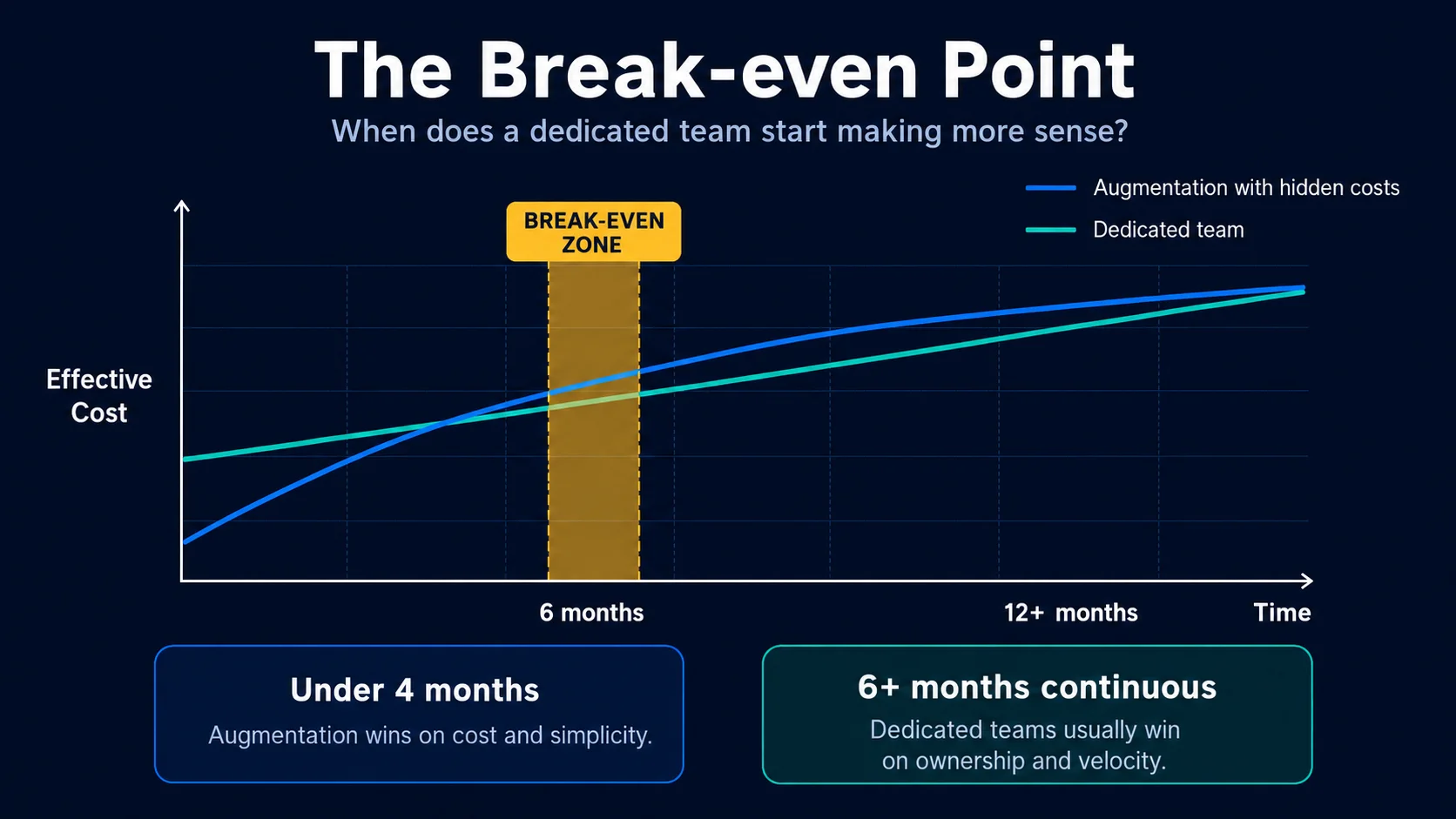
By year two, the effective cost of augmentation often approaches or exceeds a dedicated team, especially if you’re cycling people every 2–3 months.
The break-even point: If you need engineering capacity for 6+ months continuously, a dedicated team is usually cheaper and faster. Under 4 months, augmentation wins on cost and simplicity.
Decision Scorecard: Augment or Dedicated Team?
| Question | Choose Staff Augmentation If… | Choose Dedicated Team If… |
|---|---|---|
| How long is the workstream? | Under 3 months | 6–12 months, and definitely 18+ months |
| Do you need product ownership? | It is a one-off task like migration, infrastructure refresh, or temporary support | It is a critical system, scalable product, or AI project |
| Are you actively hiring? | Yes, and you need temporary support while hiring | No, and you need a stable team without building one internally |
| Can your team handle context-switching? | Yes, systems are loosely coupled and internal ownership is clear | No, release cycles are fast and continuity matters |
| Do you have strong onboarding? | Yes, documentation and engineering processes are mature | No, the team needs to learn through continuity and ownership |
Common Mistakes (And How to Avoid Them)
You tell yourself “let’s try with contractors first.” Six months later, you’re still augmenting, your product is half-built, your core team is burnt out, and you finally hire a dedicated team. You lost four months.
Lesson: if your plan is 6+ months, commit upfront.
You dedicate a 4-person team to a client project with a 16-week scope. Week 20 rolls around project ends, team sits idle. You can’t scale them to another client (they’re dedicated to you). Costly mistake.
Lesson: make sure the work is sustainable before dedicating people.
You hire a dedicated team and expect them at 70% velocity week 1. Reality: week 1–3, they’re at 30%. By week 8, they’re at 100%. Account for this in roadmap planning.
You cycle through eight contractors over 12 months. Each brings a different style, makes different architectural choices, and leaves after eight weeks. The codebase becomes a mess.
Lesson: if you augment, keep augmentees longer (8–12 weeks minimum) and use them to build consistency, not just add headcount.
The Bottom Line
- The timeline is under 4 months.
- You know exactly what you need.
- You need flexibility to dial up/down.
- Your systems are loosely coupled.
- The timeline is 6+ months.
- You’re building something that compounds (product, platform, strategic initiative).
- You want ownership and accountability.
- You plan to scale over time.
- You need speed and depth.
- You’re entering a new market or building a new product line.
- You have capital to invest and a timeline to justify it.
The engineering leaders we work with at scale-ups and enterprises across MENA, Europe, and North America don’t usually ask “should we augment or dedicate?” They ask “what’s the right mix for this roadmap and this stage of growth?” And that’s the question worth answering.