NEW EBOOKThe enterprise playbook to getting AI pilots right — grab your complimentary copy.Check it out ›
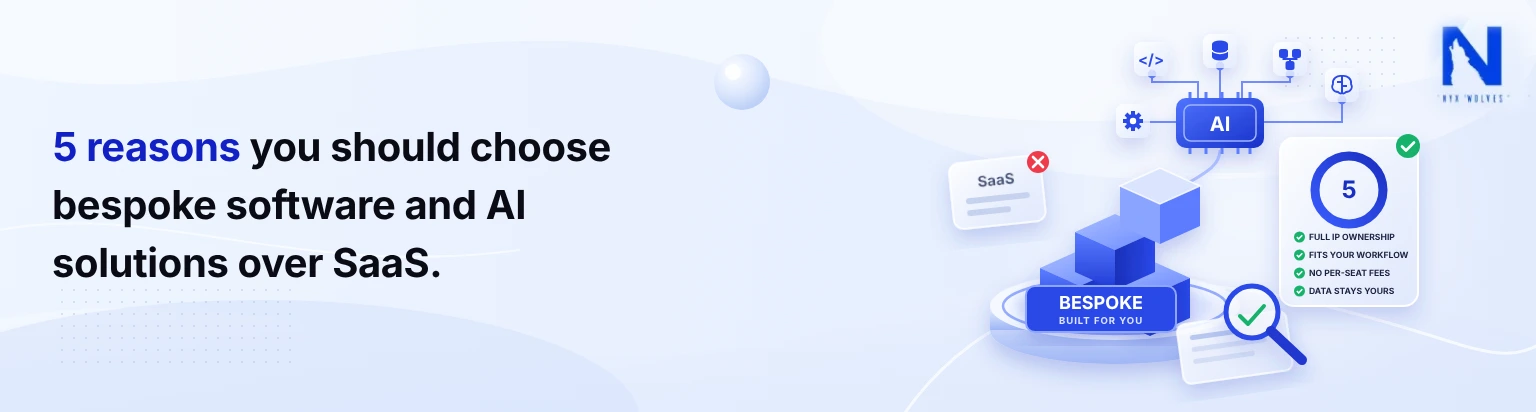
5 reasons you should choose bespoke software and AI solutions over SaaS
To help I&O leaders understand why bespoke software is a better fit right now
RS
Raghav S.·October 30, 2026·7 min read
RS
Raghav S.·October 30, 2026·7 min read
Introduction
Most enterprise software stacks look the same today. The same CRM, the same service desk, and the same AI copilot bolted onto all of it. My disclaimer for SaaS would be the age old adage: the grass always appears greener on the other side. My problem with SaaS is that it is an off-the-shelf stack of technology that is built to be industry agnostic and as flexible to meet anyone’s requirements satisfactorily. It can never excel at meeting your requirements.
And that is why the state of enterprise software is starting to change. Retool’s 2026 Build vs. Buy Report surveyed 817 builders, and found that 35% of teams have already replaced at least one SaaS tool with a custom build. 78% expect to build more this year. Which means that bespoke has stopped being a luxury line, and enterprises are now deciding which of their processes deserve it.
In one of our recent blogs, we argued that enterprise AI fails on leadership and execution, and rarely on the technology. What your enterprise wears to work is one of those leadership decisions. Here are five reasons to evaluate the other path.
35%
of teams have already replaced at least one SaaS tool with a custom build.
Why should you opt for the generic, industry-agnostic solution?
Off-the-shelf SaaS and commercial AI tools are sold to you and to every competitor you have, at the same price, with the same features. They standardize how work gets done, and that is the whole point of them. If your pricing logic or your claims process runs on the same product as the firm across the street, then neither of you has an edge. It’s almost like you’re wearing a uniform.
Bespoke software and proprietary AI models change what you walk away with. Your internal logic, your algorithms and your automated agent workflows get cut into a flow that exists nowhere else. That makes the process of building such a tool, your intellectual property. The amount of unique business logic, process flows and operational constraints that bespoke software can account for, could blow your mind.
Do you really own your data? Is it really secure?
In a multi-tenant SaaS model, you store your data in your vendors’ data centers: customer records, contracts, financials, and now, every prompt your workforce types into an AI feature. That data sits on third-party servers, next to the data of thousands of other customers. And all of this data may be in use to train your vendor’s AI solutions. But that’s not even the scariest aspect. Verizon’s 2025 Data Breach Investigations Report studied 12,195 confirmed breaches, and found that the share involving a third party had doubled to a staggering 30%.
And it isn’t like we were unaware of these failures. We’re choosing to overlook them. In Cisco’s 2025 Data Privacy Benchmark Study, 64% of respondents worried about inadvertently sharing sensitive information through generative AI tools, and 90% saw local storage as inherently safer. Data privacy should not be treated as a vendor’s promise in a contract. Data privacy should be handled as part of the cut. Custom solutions let you host fine-tuned models and software on an isolated virtual private cloud, or on local infrastructure. You control the encryption, the access logs, and manage your own compliance posture.
Why should you change your processes to suit your toolset?
Once your data is in a SaaS product, your processes follow it there. SaaS tools come with a rigid interface and a standard data model, and your organization is expected to compromise and adapt to its nuances. Processes that will take years to settle, get altered to suit the nitty-gritties of your SaaS toolset. Then there are the add-ons you never asked for, the bundled features that add complexity, that aren’t in use, but you’re still being billed for.
Your workforce is already unhappy with the state of SaaS. The same Retool survey found that 60% of respondents had built software outside IT oversight in the past year. Which means that people are taking up the fight themselves, because your SaaS tools don’t fit the job. Bespoke applications are measured against your existing internal systems, your databases, and your specialist edge cases. There is no bloat, and no fragile third-party integration tool pinning two systems together. Time to deploy is low, maintenance and customization overhead is easily overcome.
What is your TCO?
Evaluate your software partners not only by the quality of the product itself, but by the total cost of ownership. The SaaS model makes it so that you never own your software. You are simply renting it through contract. Not only is SaaS a poor fit for a business’ unique requirements, it is also an expensive undertaking. Every workaround needs another seat, add-on or escalation. SaaS is cheap in the short term, but over time, you don’t realize how much you have spent on the software. Per-seat licensing grows with every new employee, token surcharges grow with every AI query, and the features are always packaged in a way that forces you to upgrade tiers.
And SaaS pricing skyrockets year on year. Vertice tracks SaaS inflation across the contracts it manages, and recorded 16.4% in June 2026, the highest rate it has measured and almost four times general inflation. Bespoke software asks for more capital up front, and there is no getting around that. But what it removes is the recurring per-seat billing, and the markup on third-party API calls. Over a three to five year duration, bespoke software will often cost less than SaaS, provided you budget for its upkeep.
What happens when you aren’t supported anymore?
Price is only one of the things a vendor can change without asking you. When core business functions depend on an external SaaS or a proprietary AI provider, a pricing shift, a deprecated API, a removed feature or an outage lands on your desk, and on their timeline.
As frequently as once a month, a SaaS company can be acquired, merged or dissolved. And product roadmaps and support for older versions, server specifications and on-premise support are as volatile as can be. One fine day, if you are in the minority of customers that fit into a particular bracket, then you may be forced to decide between changing your tool, which you’ve worked so hard to compromise and adapt to, or to make a decision that isn’t in your best interest.
For example, Atlassian forced their customers into Atlassian Ascend: a program with the sole intent of pushing on-premise customers towards cloud software. This forced all their on-premise users to decide between choosing a different vendor with on-prem support, or to convert to cloud users, pay higher SaaS costs, and change their mode of deployment, without having any say in the matter.
They’re not the only ones. Ask VMware’s customers. After Broadcom’s acquisition, a Civo survey of 1,000 VMware users found that 48% were paying more for the same features they already had, and 45% said their organization could no longer operate with the same agility.
Owning your source code and a self-hosted AI architecture means the alterations are yours to order. You decide when a model is fine-tuned, when a system is upgraded, and how long your tech stack stays stable. Nobody discontinues your line. And the best part is, if your product isn’t to your liking or specifications in a few years, and you want to build on top of it, you can simply commission the same team who build your product to make the changes required, and you will still be paying less than SaaS.
Should everything in your toolset be bespoke?
None of this is to say that SaaS has no place. Sometimes its better not to reinvent the wheel. Email, payroll and video calls are the same in every enterprise, and buying them off-the-shelf is the sensible call. Bespoke software belongs amongst the two or three processes where your business is different from everyone else’s.
But here’s something to be mindful of. Software built outside IT oversight is a vulnerability waiting to be exploited. Shadow IT and software should not be condoned. Bespoke only pays off when it is planned properly, built to be maintained, and owned by an IT leader/manager after launch.
Closing notes
None of this goes to say that SaaS is the wrong choice. You need to weigh the merits and demerits of SaaS and bespoke software, and make the choice that truly suits your needs. Every SaaS firm will push you to sign the contract. So will every bespoke software development firm.
Your requirements will never get fulfilled if you get excited about names or discounts. You need to evaluate vendors on the basis of the functionality they can support, their track record, their expertise, and the promises they make. Picking the right partner for your IT and AI journeys can often help you build the foundations of your business and IT operations.
You've chosen bespoke. How do you get the first fitting right?
Choosing bespoke over SaaS is the easier half of the decision. When you choose not to implement SaaS, and to implement a custom AI solution in its place, you take ownership of the product maintenance and upkeep, unlike with SaaS. You also oversee the process of the software development. Which process goes first, who signs off on the fit, and how you know it works before the whole organization is wearing it. That first fitting is your pilot.
We’ve laid out the pointers and functional differentiations you’ll have to make to set that rollout up for success in our latest ebook. It brings together everything you’ll need to get your AI pilots right, from our decade of experience in the field. Grab your complimentary copy to learn more about how you can:
Pick the processes where a custom AI solution earns back its upfront cost, by leaning on data from leading analysts and industry researchers
Scope and measure a pilot for bespoke software, so that it reaches production and does not stall at the demo
Avoid the mistakes that most enterprises have made in their AI pilots, and learn what they got right
Tailor your AI projects and solutions to your business’s unique requirements
FREE EBOOK
The enterprise playbook to getting AI pilots right
Here's your free copy
If your download doesn't start automatically, please click here.
A copy of the ebook has also been dispatched to your inbox.
FROM THE BLOG: BESPOKE SOFTWARE AND AI SOLUTIONS OVER SAAS
The enterprise playbook to getting AI pilots right
Be it AI projects, bespoke solutions, or staffing, we’ve got you covered.
6%
McKinsey’s most recent survey on the state of AI found that 6% of organizations qualify as true AI high performers.
These businesses are
- Thrice as likely to have fundamentally redesigned their workflows around AI
- Thrice as likely to have senior leadership directly committed to the effort, past the pilot
- Thrice as likely to be scaling AI agents across the business, rather than in silos across functions and business teams
FREE EBOOK
The enterprise playbook to getting AI pilots right
Here's your free copy
If your download doesn't start automatically, please click here.
A copy of the ebook has also been dispatched to your inbox.
Are you looking for AI solutions for your organization?
Be it AI projects, bespoke solutions, or staffing, we’ve got you covered.