NEW EBOOKThe enterprise playbook to getting AI pilots right — grab your complimentary copy.Check it out ›
Why IT burnout keeps getting worse, and how AI can actually help
To help I&O leaders understand why IT burnout hasn’t improved despite widespread AI adoption, and where AI actually has to be pointed to fix it
PJ
Paul J.·October 27, 2026·5 min read
PJ
Paul J.·October 27, 2026·5 min read
Introduction
“Work expands so as to fill the time available for its completion.” C. Northcote Parkinson wrote that in 1955 about government clerks, and it describes a typical IT team of 2026 uncomfortably well. AI was supposed to hand time back to the people who keep a company’s systems running. The time was saved, and then it was filled again.
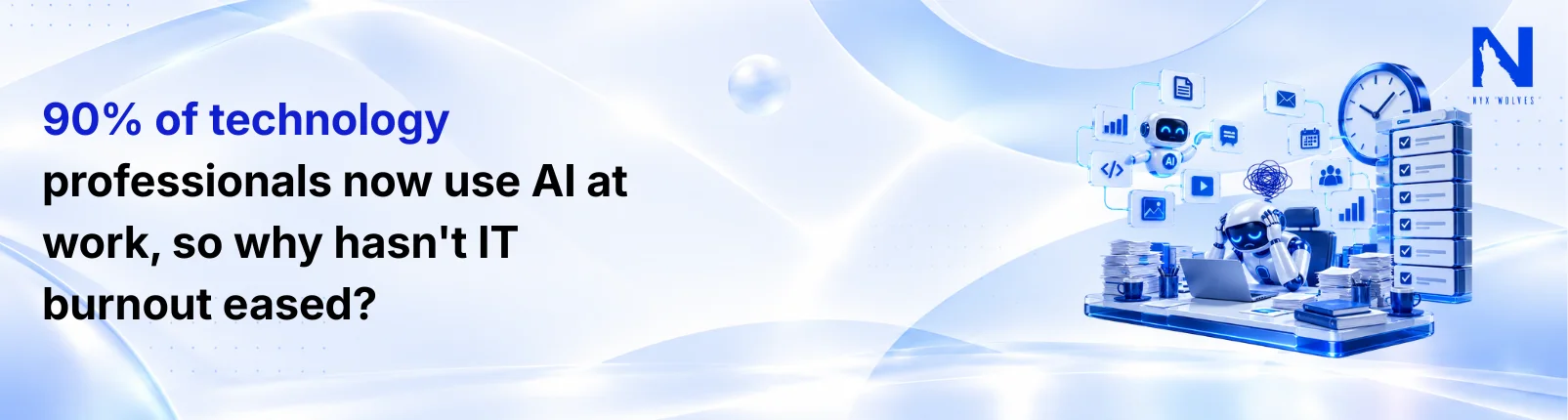
The numbers tell the story. Google’s DORA research program surveyed nearly 5,000 technology professionals for its 2025 report and found that 90% of them now use AI at work. The same report found that AI had no measurable effect on burnout. McKinsey’s 2025 global survey shows the same reach from the boardroom side, with 88% of organizations regularly using AI in at least one business function.
So the AI tools have arrived, evolved, and are in use daily. But the exhaustion that comes with repetitive work is still here. That outcome is avoidable, and it comes down to where AI is being deployed.
88%
of organizations regularly using AI in at least one business function.
What is leadership getting wrong?
Picture a kitchen in a gourmet restaurant. Let’s say the owner invests heavily in an oven that can cook dishes twice as fast. And in the following week, the owner doubles the number of reservations they accept. The kitchen will still struggle, because the chef still has to wash every dish by hand. The chef also has to taste twice as many dishes, since the new oven can burn some of the food.
That kitchen is how most IT departments operate today. The oven we’ve purchased is our set of AI tools. The reservations are the targets set by leadership, and the tasting is the QC we do to verify AI’s outputs. The dishes in the sink are the small, repetitive requests that never stop coming.
Leadership’s mistake lies in a misconception about AI-driven productivity. A UC Berkeley Haas study published in Harvard Business Review spent eight months inside a 200-person tech company and found that generative AI did not free up time. Gartner’s 2026 Global Labor Market Survey, covering 12,004 employees and managers across 40 countries, found that many executives track AI success by hours saved, yet 19% of employees reported no time saved at all. Yet businesses are expecting extra outputs, since productivity has been boosted on paper.
There’s a second miss. The same Gartner survey found that 73% of highly productive AI users are managers or executives, so the gains are pooling at the top of the kitchen. In IT terms, the people who set the targets see the benefit, while the people who work the queue see far less of it. Harvard Business Review research with Boston Consulting Group found that workers whose managers took time to answer their AI questions reported 15% lower mental fatigue. Most teams were handed the oven with no instructions and a fuller dining room. They got new AI tools, little guidance on how to use them, and higher targets in the same month.
What are IT teams getting wrong?
But the fault isn’t entirely with leadership. If leadership filled the dining room, IT teams chose what to do with the new equipment, and most of them left the sink exactly as it was.
AI got pointed at the interesting work: drafting, summarizing, hunting for the cause of a fault. The dull work stayed human. Think of password resets and access requests, the “tickets” that employees log whenever something stops working. McKinsey found that only 23% of organizations are scaling AI agents anywhere in the business, and that in any single business function the figure is no more than 10%. An agent is an AI that completes a task from start to finish on its own, where an assistant only suggests an answer for a person to carry out. Most teams have the assistant, so every dish still passes through a pair of human hands. In IT, that means a person still closes every ticket, even when AI wrote the reply.
Then, there’s the tasting. In IT, this is the QC work employees do while eliciting outputs from AI models. The Harvard Business Review and Boston Consulting Group study of 1,488 workers found that when AI needed a high degree of human oversight, people spent 14% more mental effort, felt 12% more mental fatigue, and reported 19% more information overload. Hands got lighter and heads got heavier. The researchers gave the feeling a name, “AI brain fry.” It’s the mental fatigue that comes from using or supervising AI tools beyond what a person can comfortably keep track of, and 14% of the workers studied reported it. They experienced 33% more decision fatigue, and 34% of them were actively planning to leave their company, against 25% of everyone else.
Tool count makes it worse. The same research found that while working with over three AI tools, productivity scores dipped. Every extra tool is another oven’s dishes that need to be tasted and tested before serving. The age-old adage goes, too many cooks spoil the broth. But a single chef spread thin across ovens can lead to disaster just as easily. For an IT engineer, that is one person checking the outputs of several AI tools, on top of the work they already had.
So where do we go from here?
The research that describes the problem also paves the path to find your way out. The Harvard Business Review study found that using AI to replace routine or repetitive tasks was associated with reduced burnout. Burnout in IT comes from three places: a queue of repetitive requests that never empties, the mental load of checking AI’s work, and targets that rise every time a tool saves an hour. AI brings burnout down when it takes the repetitive requests off the queue entirely, and when the hours it saves are given back to the team.
Get started on these five concrete steps to bring burnout down in your IT team:
01
Start with the repetitive requests:
Find the password resets, access requests, and routine tickets eating your team’s week, and automate those before anything else
02
Let AI finish the job:
Move from assistants that suggest to agents that complete routine tasks, so a person only steps in for exceptions
03
Hand the saved time back:
Decide in advance how much of each efficiency gain goes to recovery and deeper work, and how much goes to new output
04
Cap the tools:
Fewer, better-connected AI tools mean less supervising and less switching for the people using them
05
Make managers the first line of support:
Give managers the time and training to answer AI questions, since that alone lowers fatigue
There’s one more cause of burnout, and it sits upstream of all five steps: the AI rollout itself. Gartner predicts that over 40% of agentic AI projects will be canceled by the end of 2027, and McKinsey found that nearly two-thirds of organizations have not yet begun scaling AI across the enterprise. A pilot that stalls doesn’t leave the team where it started. The old process is still running, the new tool still needs feeding and checking, and the team carries both. Which means that every AI project that fails to reach meaningful use adds to the workload it was bought to reduce. Getting the rollout right is where lower burnout begins.
We’ve compiled everything you’ll need to set up your AI pilots for success, from our decade of experience in the field. Grab your complimentary copy to learn more about how you can:
Build a data driven approach to enterprise AI projects by leaning on data from leading analysts and industry researchers
Take away learnings from their findings and avoid the blackhole of AI investments that yield no results, or unimpressive value
Avoid the mistakes that most enterprises have made, and learn what they got right
Learn how you can tailor your AI projects and solutions to your businesses unique requirements
Sources
- Google Cloud DORA, 2025 State of AI-assisted Software Development (nearly 5,000 technology professionals): 90% use AI at work, no measurable effect on burnout or friction
- McKinsey, The state of AI in 2025 (1,993 respondents, 105 countries): 88% use AI in at least one function, 23% scaling AI agents, no more than 10% in any single function, nearly two-thirds have not begun scaling AI across the enterprise
- Gartner, Global Labor Market Survey 1Q26 (12,004 employees and managers, 40 countries): 19% report no time saved, 73% of highly productive AI users are managers or executives
- Gartner press release, 25 June 2025: over 40% of agentic AI projects will be canceled by end of 2027
- Harvard Business Review, “When Using AI Leads to ‘Brain Fry'” (Boston Consulting Group and UC Riverside, 1,488 US workers): 14% brain fry, 14% more mental effort, 12% more fatigue, 19% more information overload, 33% more decision fatigue, 34% vs 25% intent to leave, 15% lower fatigue with manager support, dip after three tools, routine-task replacement linked to reduced burnout
- Harvard Business Review, “AI Doesn’t Reduce Work, It Intensifies It” (UC Berkeley Haas, February 2026): eight months, 200-person tech company, generative AI did not free up time
FREE EBOOK
The enterprise playbook to getting AI pilots right
Here's your free copy
If your download doesn't start automatically, please click here.
A copy of the ebook has also been dispatched to your inbox.
FROM THE BLOG: WHY IT BURNOUT KEEPS GETTING WORSE
The enterprise playbook to getting AI pilots right
Be it AI projects, bespoke solutions, or staffing, we’ve got you covered.
6%
McKinsey’s most recent survey on the state of AI found that 6% of organizations qualify as true AI high performers.
These businesses are
- Thrice as likely to have fundamentally redesigned their workflows around AI
- Thrice as likely to have senior leadership directly committed to the effort, past the pilot
- Thrice as likely to be scaling AI agents across the business, rather than in silos across functions and business teams
FREE EBOOK
The enterprise playbook to getting AI pilots right
Here's your free copy
If your download doesn't start automatically, please click here.
A copy of the ebook has also been dispatched to your inbox.
Are you looking for AI solutions for your organization?
Be it AI projects, bespoke solutions, or staffing, we’ve got you covered.